




About this worksheet
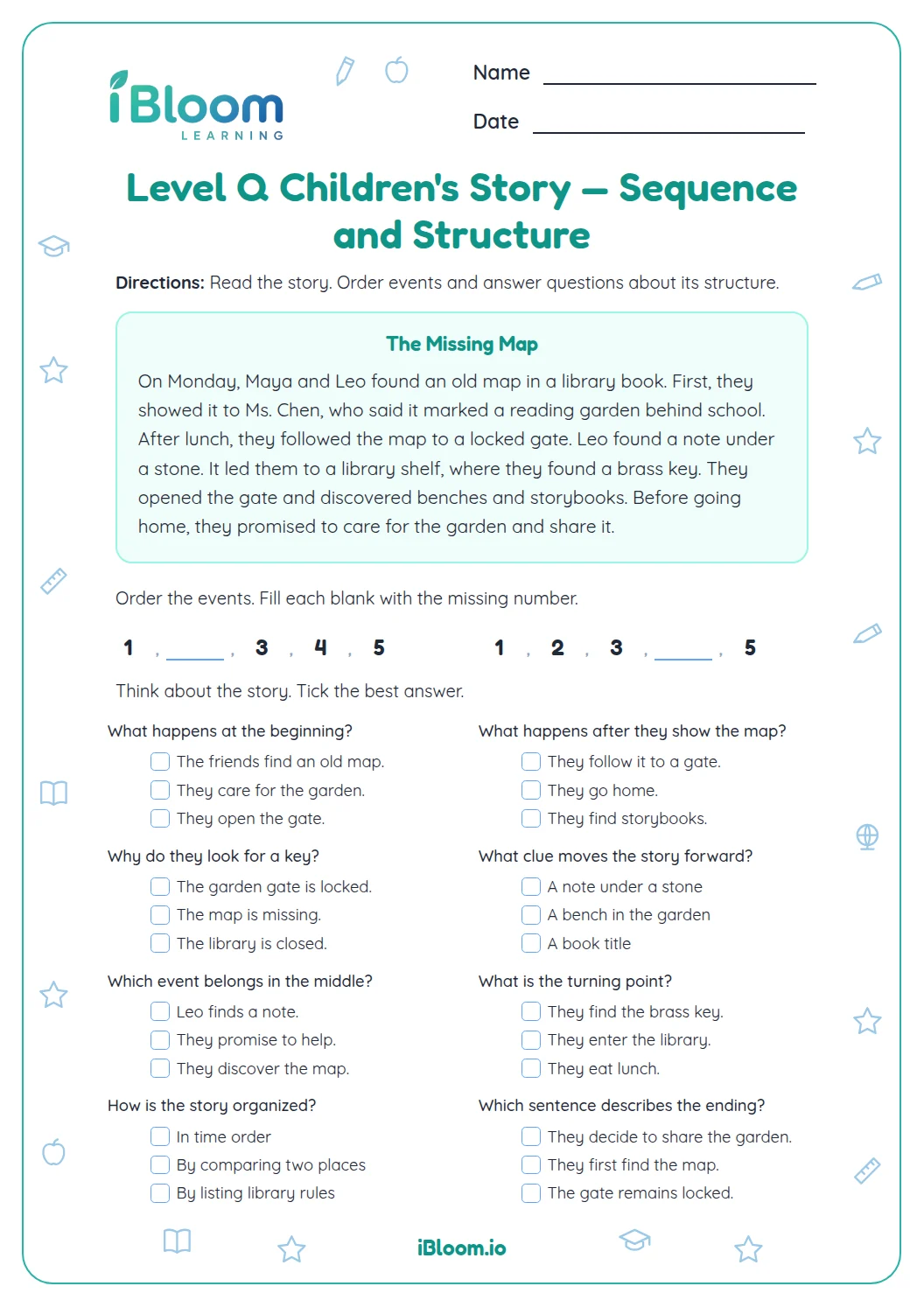
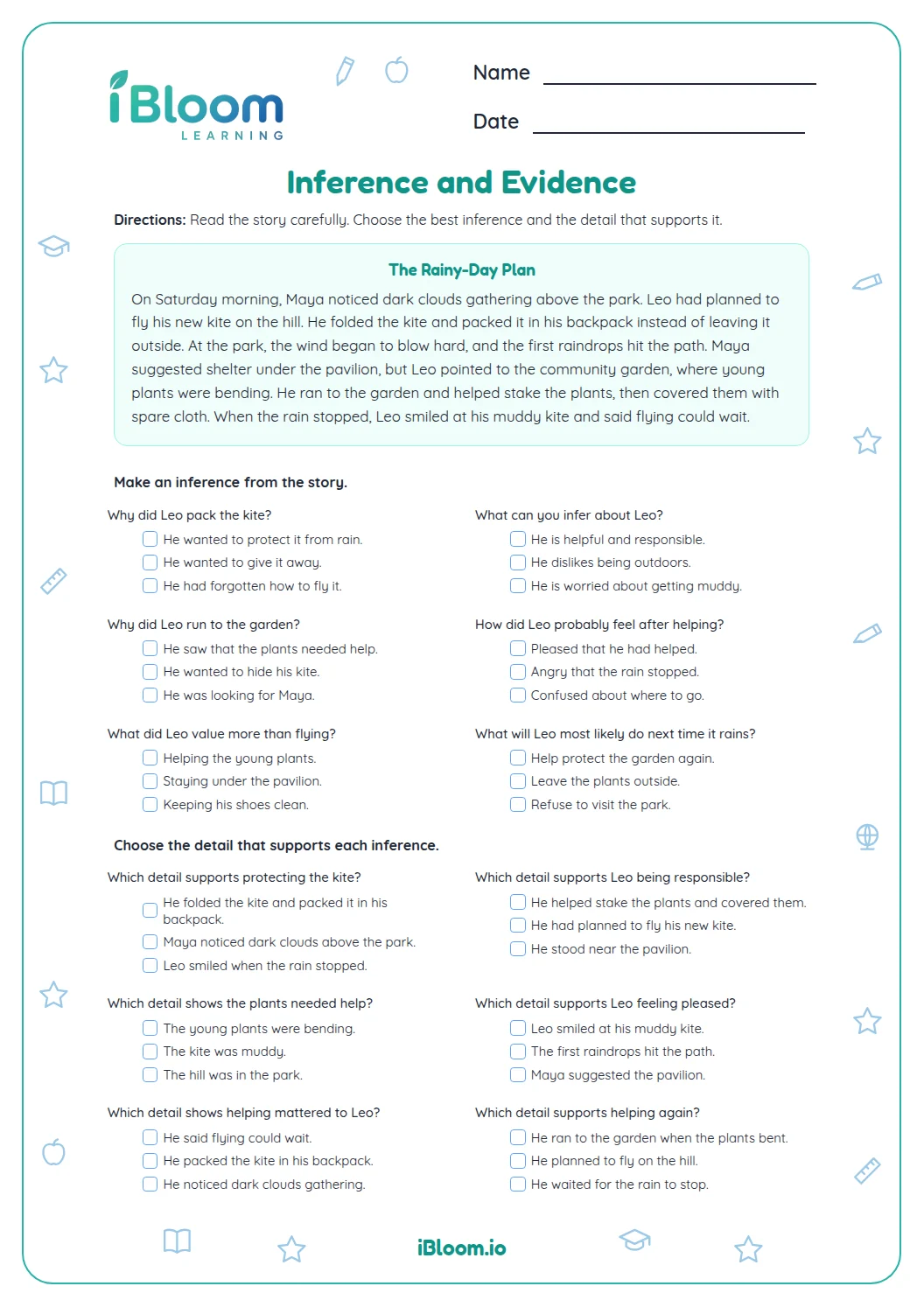
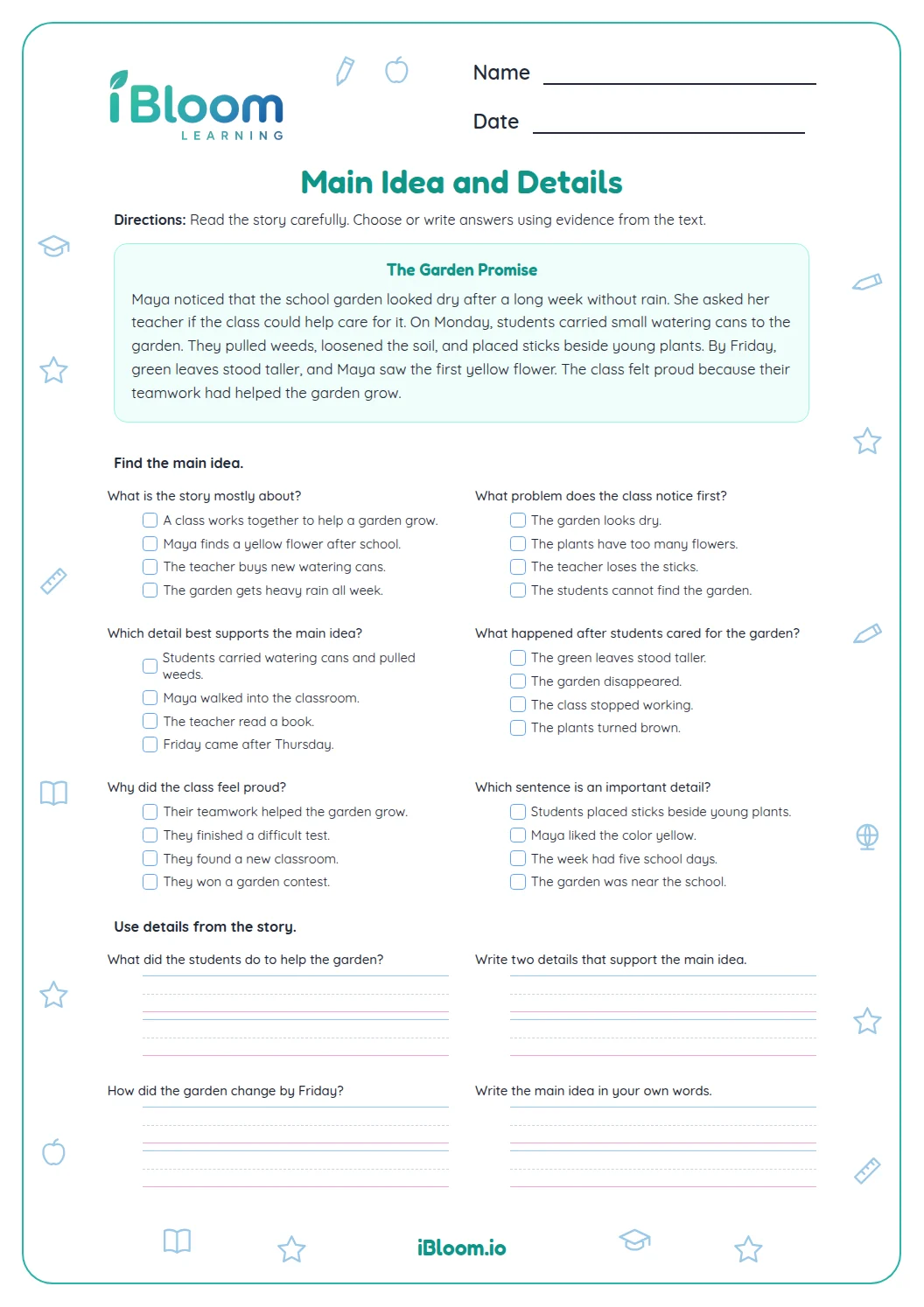
This free worksheet in the Grade 4 Level R collection uses an original story, “The Leaning Bean,” for ten mixed comprehension questions. Mia brings a damaged plant to a school fair and decides what matters about her work. After the passage in Part A, students answer six multiple-choice questions in Part B, complete two details in Part C, and write a summary and explain an inference in Part D. The questions practice using evidence, identifying a theme, and summarizing under Common Core RL.4.1 and RL.4.2. The answer key includes model responses for the explanations.
Aligned to RL.4.1 and RL.4.2
Which events help readers follow Mia’s decision?
Mia first imagines a ribbon for her healthy plant. Her backpack bends the stem on the bus, and Luis offers a replacement at school. Seeing her notebook comes immediately before her decision to keep her own plant.
Ask students to distinguish the accident, the offer, and the reminder. Each event contributes something different: a problem, an easy solution, and a reason to value her original work.
How does the notebook support an inference?
The notebook contains observations from the first shoot to the broad leaves. Those pages connect the plant to Mia’s own work and learning. The passage does not state her whole thought process, so readers use the timing of her decision and the contents of the notebook to explain it.
- 1Question 10 asks why seeing the notebook helps Mia choose.
- 2Detail: The notebook records changes in her own plant.
- 3Next action: Mia decides to bring that plant.
- 4Inference: The record reminds her of what she has learned from growing it.
How can students explain the story’s lesson?
“Value learning” fits the shift from imagining a ribbon to sharing the notebook. Connect that lesson to Mia’s decision to keep her own plant and to her interest in explaining what happened at the fair.
For question 9, a summary should include the damaged stem, Mia’s choice to keep her own plant, and her explanation at the fair. Leave out minor details such as the ribbon’s color. Question 10 then asks students to explain the notebook’s role in her decision.
How to use this worksheet
- 1Read the entire passage once to follow the accident and Mia’s decision.
- 2Reread the opening and ending, marking what Mia pays attention to in each.
- 3Answer Part B and locate a passage detail supporting each choice.
- 4Use passage words to complete the two details in Part C.
- 5Write the summary and explanation in Part D, then check the events and supporting detail against the key.
Mistakes to notice and how to help
The mistake
Saying Mia wins a ribbon.
The fix
The ending says she forgets to look for ribbons; it does not report a prize.
The mistake
Explaining her choice only with “She likes plants.”
The fix
Add the notebook detail and explain how her observations connect her to this plant.
The mistake
Choosing “Value prizes” because Mia imagines a ribbon at the start.
The fix
Read the ending too: Mia explains her plant’s story and forgets to look for ribbons.
Common Core alignment
Use details about Mia’s notebook and actions to explain explicit information and inferences.
On this sheet: Students find explicit details and explain how the notebook influences Mia’s choice.
Show the official wordingHide the official wording
Refer to details and examples in a text when explaining what the text says explicitly and when drawing inferences from the text.
Identify a theme about learning and summarize Mia’s problem, choice, and experience at the fair.
On this sheet: Question 6 asks for a theme; question 9 asks for a summary of the main events.
Show the official wordingHide the official wording
Determine a theme of a story, drama, or poem from details in the text; summarize the text.
What to practice next
Make more practice
Further reading
Questions parents and teachers ask
What is The Leaning Bean about?
It is about Mia taking a bean plant to a school garden fair after its stem is accidentally bent. A friend offers her a replacement, but her growth notebook helps her value her own plant. The ending focuses on explaining what she learned from caring for it.
Which comprehension skills are mixed together?
The questions combine details, inference, context vocabulary, theme, and summary. Students choose six answers, complete two details, then write a summary and an explanation. The final response asks them to explain how the notebook affects Mia’s choice, using a specific story detail.
Does the key require the exact model wording?
No, the summary and explanation can use different wording if they accurately reflect the story. For question 9, look for the damaged plant, Mia’s decision to keep it, and her explanation at the fair. For question 10, look for a link between her growth notes and her choice.
How should students work out the word drooped?
They should read what happens before and after the word. Mia pushes the stem upright, but it droops again; later it needs a support stick and string. These details show that drooped means hung down, which is one of the printed choices.
How can I help a student who gives vague explanations?
Ask the student to name the exact action or object that supports their idea. “She cared” is vague; mentioning the notebook’s record of the plant’s growth makes the explanation checkable. Then ask how that detail helps explain her choice to keep the damaged plant.