



About this worksheet
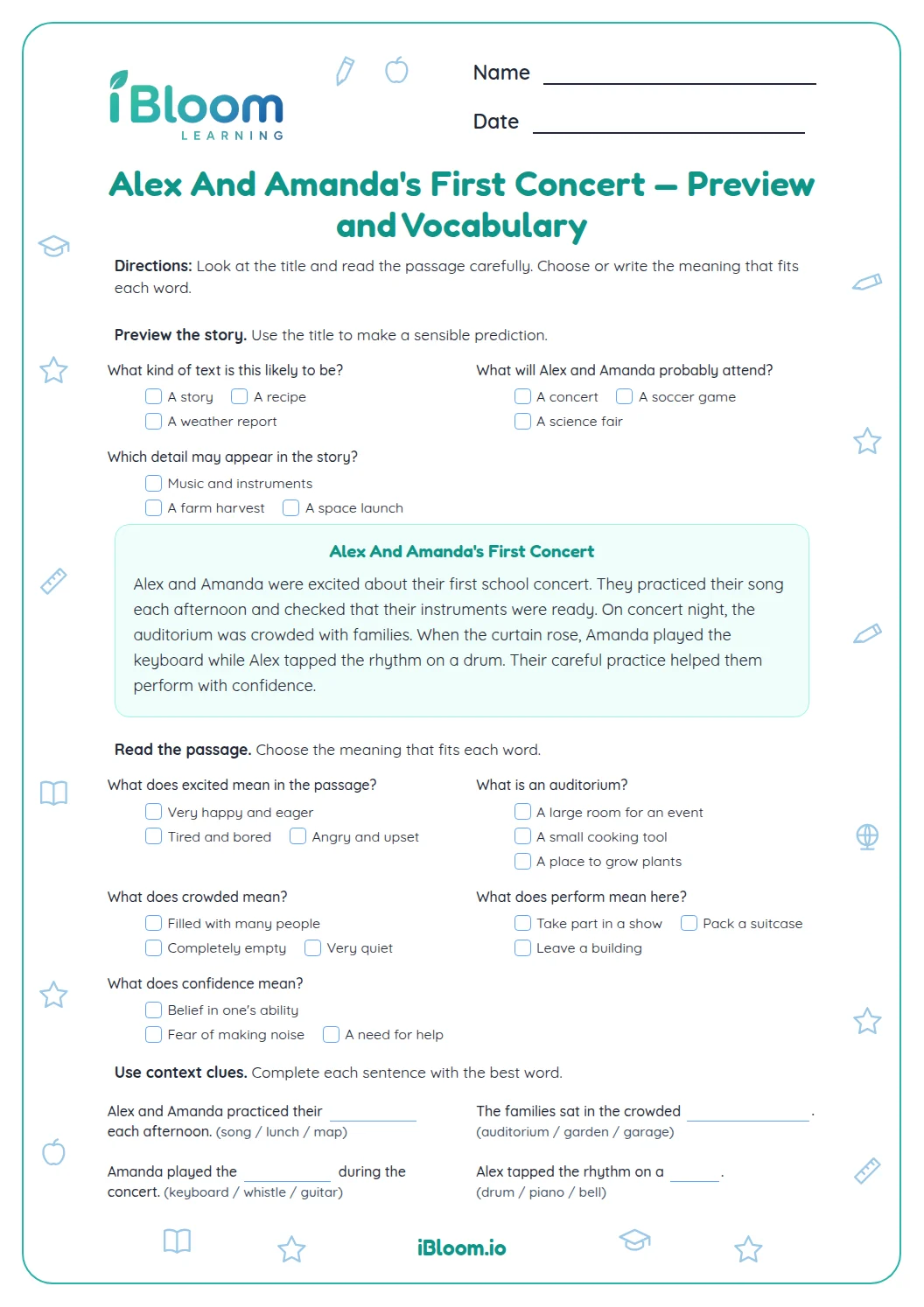
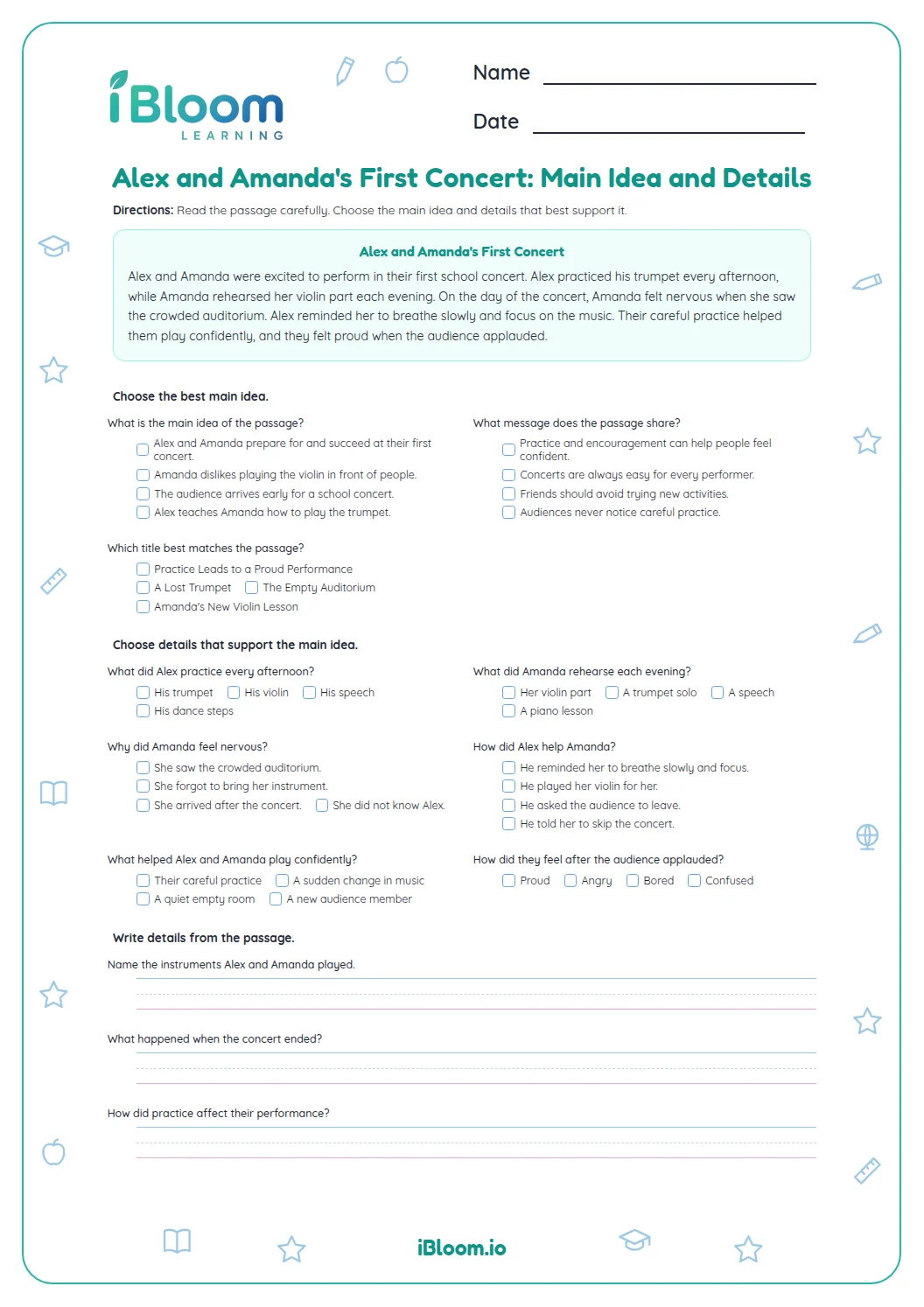
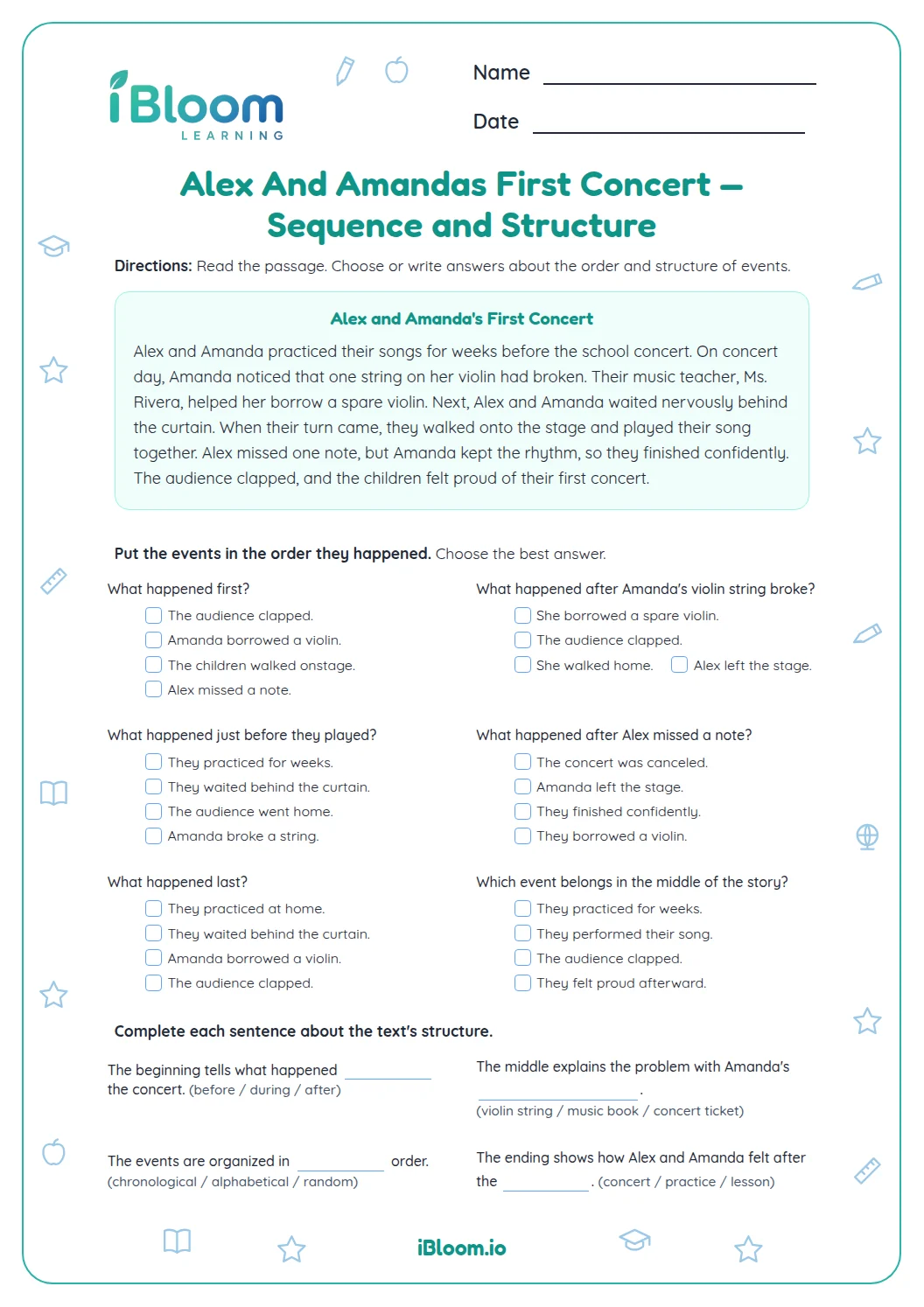
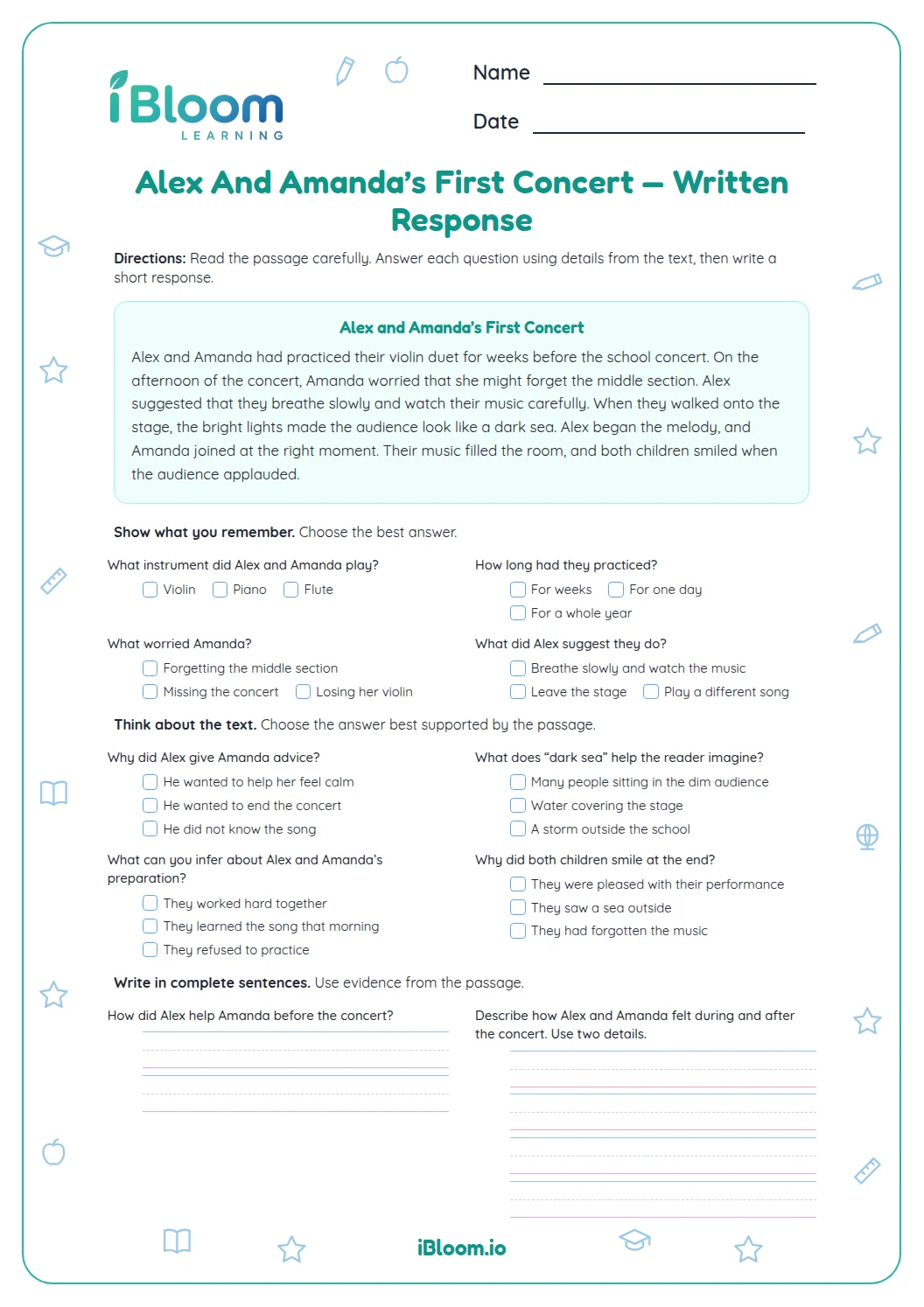
This Grade 5 reading worksheet pairs the settled story “Alex and Amanda’s First Concert” with 14 multiple-choice questions. Students infer how the musicians feel, explain what Amanda’s response suggests, trace how their listening changes the performance, and choose details that support conclusions. Vocabulary and sequence questions also draw on the passage. The answer key follows the question numbers. The work practices Common Core RL.5.1 by drawing inferences and supporting them with accurate text evidence.
Aligned to RL.5.1
What can you infer from the musicians’ actions?
An inference combines a story detail with what the reader knows. Alex wipes his damp palms before the concert, a clue that he feels nervous. Question 2 asks students to select that evidence.
- 1Clue: Alex wipes his damp palms before playing.
- 2Inference: He feels nervous about performing.
How does Amanda help Alex recover?
When Alex loses his place, Amanda does not rush ahead. She plays more softly and slowly until he rejoins. Her actions support the inference that she is helping him recover and keep the duet together.
How does the story show the value of listening?
During practice, both musicians race ahead and the song becomes a jumble. At the concert, they listen and respond to each other. Comparing those events supports an inference about what changed their performance.
How to use this worksheet
- 1Read the passage once to follow the concert from practice to backstage.
- 2Reread the lines named in a question before choosing an answer.
- 3Separate the detail stated in the story from the inference you draw.
- 4For evidence questions, choose the detail that most directly supports the idea.
- 5Use the answer key to check both the choice and its supporting clue.
Common mistakes and quick fixes
The mistake
Choosing an inference that the story never supports.
The fix
Point to an action, dialogue line, or event that makes the inference reasonable.
The mistake
Picking a true detail that does not support the question’s idea.
The fix
Match the evidence to the specific feeling or conclusion being asked about.
The mistake
Treating “faltered” as a synonym for “played louder.”
The fix
Reread the piano-silence clue; in context, faltered means became unsteady.
Curriculum alignment
This worksheet practices RL.5.1 through its question set.
Draw inferences from the story and support them with accurate details from the passage.
On this sheet: The questions directly practice the named skill through identification, application, and explanation.
Show the official wordingHide the official wording
Quote accurately from a text when explaining what the text says explicitly and when drawing inferences from the text.
What to practice next
Make more practice
Questions parents and teachers ask
What story does the worksheet use?
The passage is “Alex and Amanda’s First Concert.” Alex plays piano and Amanda plays violin; their teacher, Ms. Okafor, encourages them to listen to each other during the duet. Have students point to the clue in the question or passage and explain how it supports the choice they made.
What kinds of questions are included?
The 14 questions ask students to infer feelings and intentions, choose evidence, follow the sequence of events, and use the context of a word. Each answer should connect to a detail in the story. Have students point to the clue in the question or passage and explain how it supports the choice they made.
How can students support an inference?
Students can name the detail that led them to the inference. For example, Alex wipes his damp palms before playing, which supports the idea that he feels nervous about performing. Have students point to the clue in the question or passage and explain how it supports the choice they made.
What does Amanda do when Alex loses his place?
Amanda plays the melody more softly and slowly until Alex finds his place and joins her again. Questions ask students to infer how this response helps him and to select the supporting detail. Have students point to the clue in the question or passage and explain how it supports the choice they made.
Which reading standard is practiced?
The questions practice CCSS RL.5.1 by asking students to draw inferences and select accurate details from the passage to support their answers. Have students point to the clue in the question or passage and explain how it supports the choice they made.