






About this worksheet
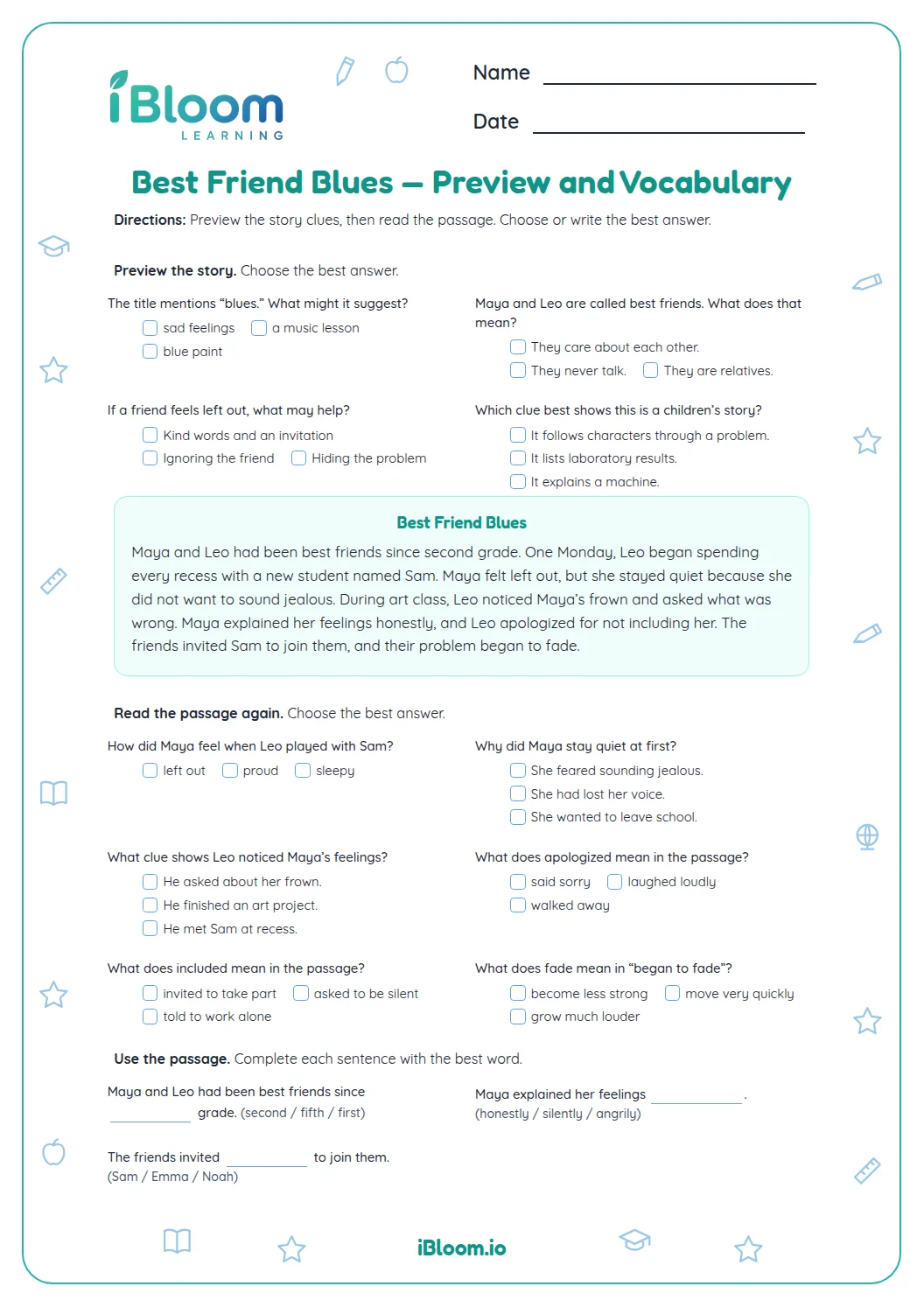
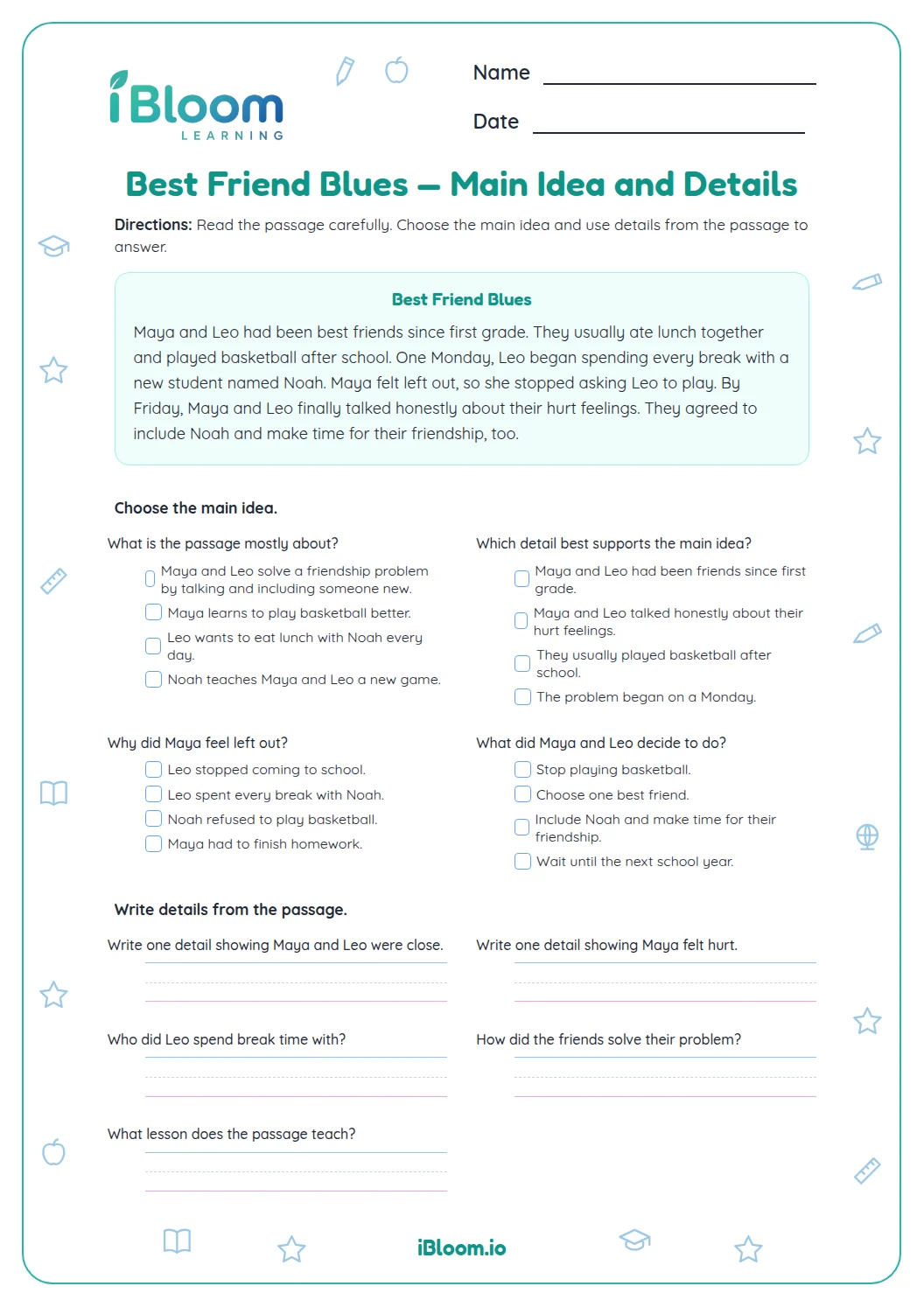
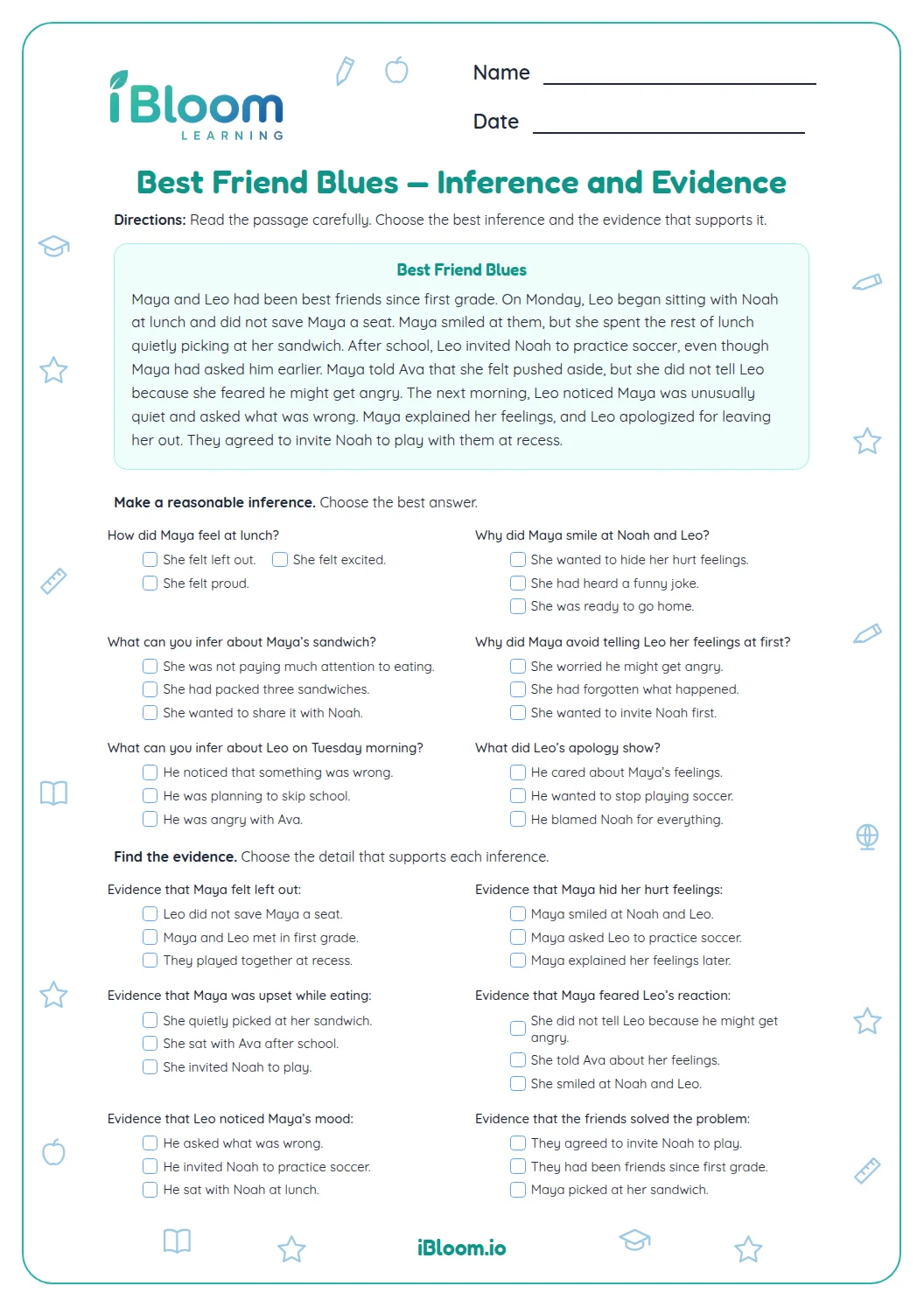
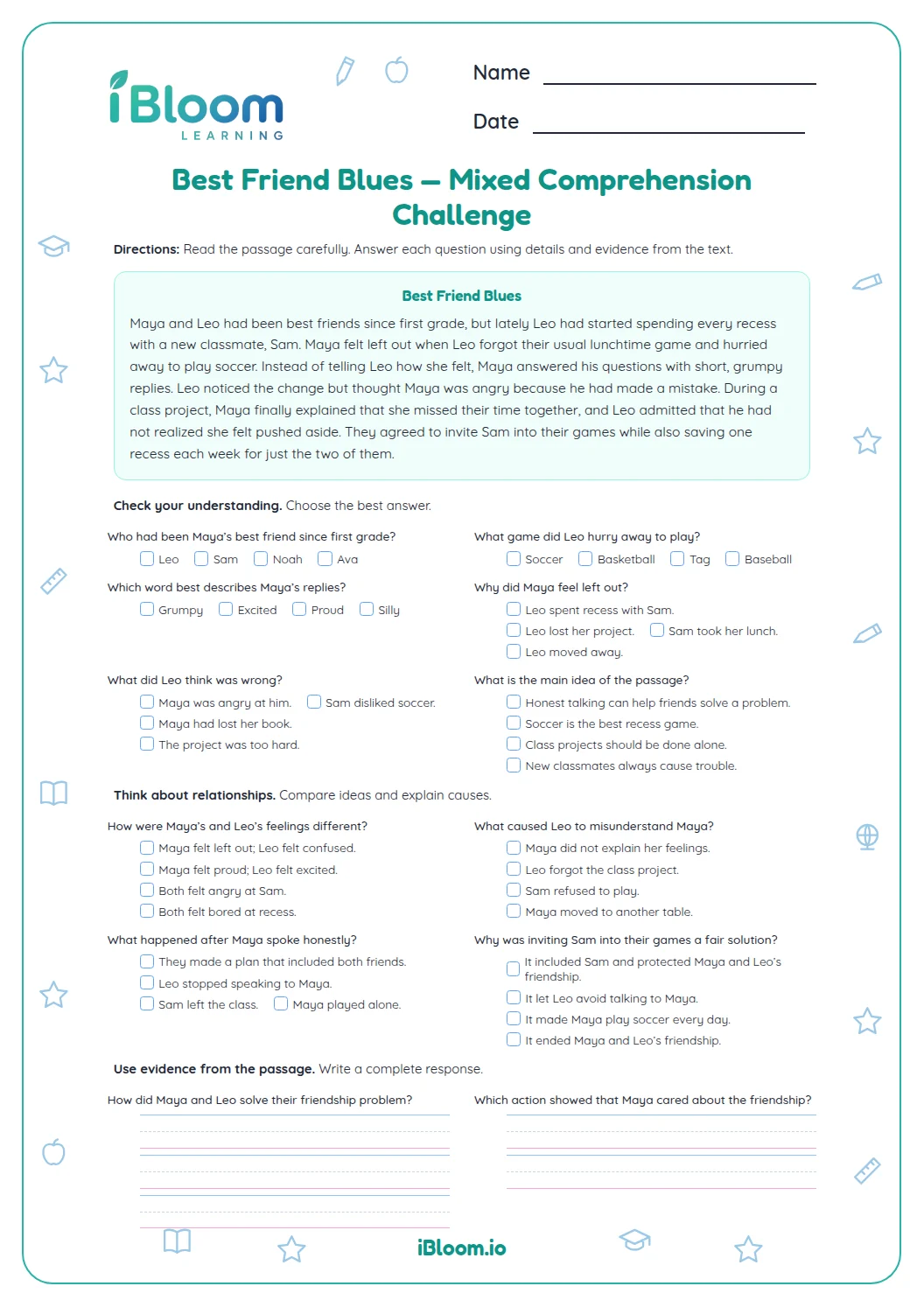
This free Grade 5 printable uses the story “Best Friend Blues” to practice written responses with text evidence. Maya, Leo, and Ava navigate a misunderstanding around a science project; students answer direct questions, infer feelings and motivations, and explain how the friends resolve the conflict. The 12 questions and passage span three worksheet pages, with a separate three-page key. It aligns with Common Core RL.5.1.
Aligned to RL.5.1
What conflict does the story describe?
The story begins when Ava invites Maya into a science project before Maya has spoken with Leo. Leo feels excluded; the next day the friends explain their perspectives and agree to include classmates while still making time for each other.
Which questions ask for explicit details?
The first four questions are multiple choice and check explicit details: who invited Maya, how Leo felt, what he did at recess, and what Maya noticed. The remaining prompts ask students to explain ideas in writing.
How should an inference response use evidence?
State an idea that follows from the passage, then identify the supporting detail. Question 5 asks why Maya waited before asking Leo what was wrong. Her worry that asking might make things worse supports the inference.
- 1Question 5: Why did Maya wait before asking Leo what was wrong?
- 2Inference: She feared that asking could make things worse.
- 3Evidence: The passage says she worried about that possibility.
What makes a complete written response?
A complete response addresses the whole question and includes the most relevant evidence. Questions later in the sheet ask about the friends’ conversation, a possible lesson, and how they balance friendship with including other classmates.
How to use this worksheet
- 1Read the passage and identify the conflict.
- 2For detail questions, return to the sentence that states the answer.
- 3For an inference, combine a clue with what it suggests.
- 4Use only evidence that supports the point you make.
- 5Check that the response answers every part of the prompt.
Common mistakes and quick fixes
The mistake
Giving an opinion without text support.
The fix
Add a detail or short quotation from the story.
The mistake
Retelling the whole plot instead of answering.
The fix
Lead with a direct answer, then use only relevant evidence.
The mistake
Treating a character’s first reaction as the lesson.
The fix
Look at how the character changes or responds by the end.
Common Core alignment
These Common Core standards describe the central skills practiced on this page.
Quote accurately when explaining explicit details and drawing inferences.
On this sheet: Written responses use accurate story evidence to explain inferences.
Show the official wordingHide the official wording
Quote accurately from a text when explaining what the text says explicitly and when drawing inferences from the text.
What to practice next
Make more practice
Further reading
Questions parents and teachers ask
How many questions ask students to write?
The sheet has 12 questions: four multiple-choice questions about story details and eight written responses. Later prompts ask students to infer, interpret a phrase, or explain a lesson using evidence. The answer key includes sample responses. A strong response points to a word or sentence in the passage, not a guess.
What evidence shows that Leo feels left out?
Leo spends recess alone after seeing Maya and Ava plan the project at lunch. That action supports the inference that he feels excluded. Students can use the direct statement that he felt left out as well. A strong response points to a word or sentence in the passage, not a guess.
Why does Maya wait before asking Leo what is wrong?
She worries that asking about his quiet mood might make things worse. The response should connect her hesitation to that worry, which is stated in the first paragraph. Different wording is fine if the idea and evidence match. A strong response points to a word or sentence in the passage, not a guess.
What does “make room for other classmates” mean here?
It means including classmates in their plans while maintaining their friendship. The final sentence balances both ideas: the friends decide to make room for others and still save time for each other. A strong response points to a word or sentence in the passage, not a guess.
How long is the passage worksheet?
The passage and 12 questions fill three worksheet pages. A separate answer key also spans three pages. Students can answer in complete thoughts and use a passage detail to support responses that ask for evidence. A strong response points to a word or sentence in the passage, not a guess.
Can students use a different answer from the key?
Yes, for the written responses. The answer key gives a sample, not a required sentence to copy. A response should answer the prompt and point to accurate evidence from the story; the page’s exact wording is not necessary. A strong response points to a word or sentence in the passage, not a guess.