






About this worksheet
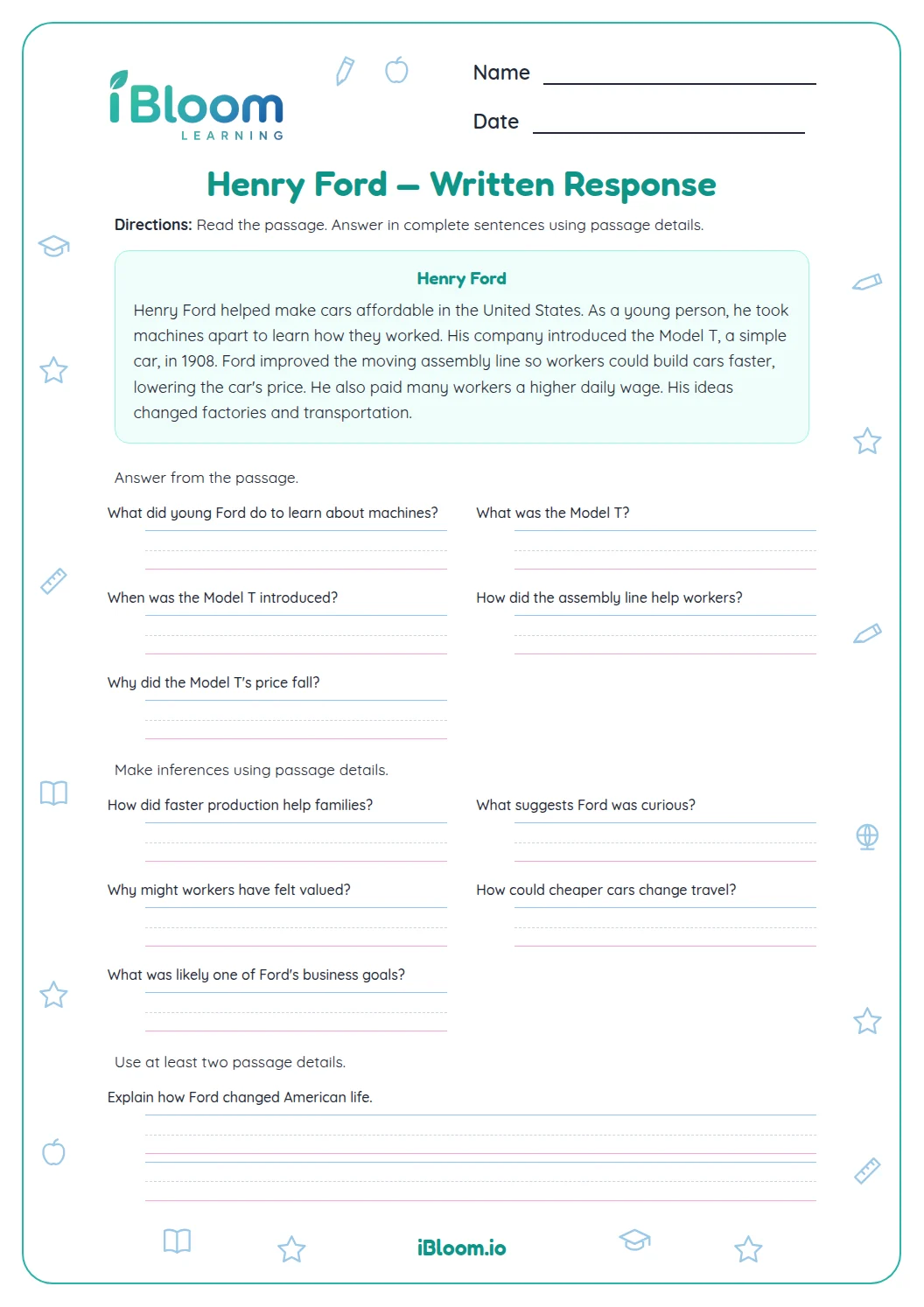
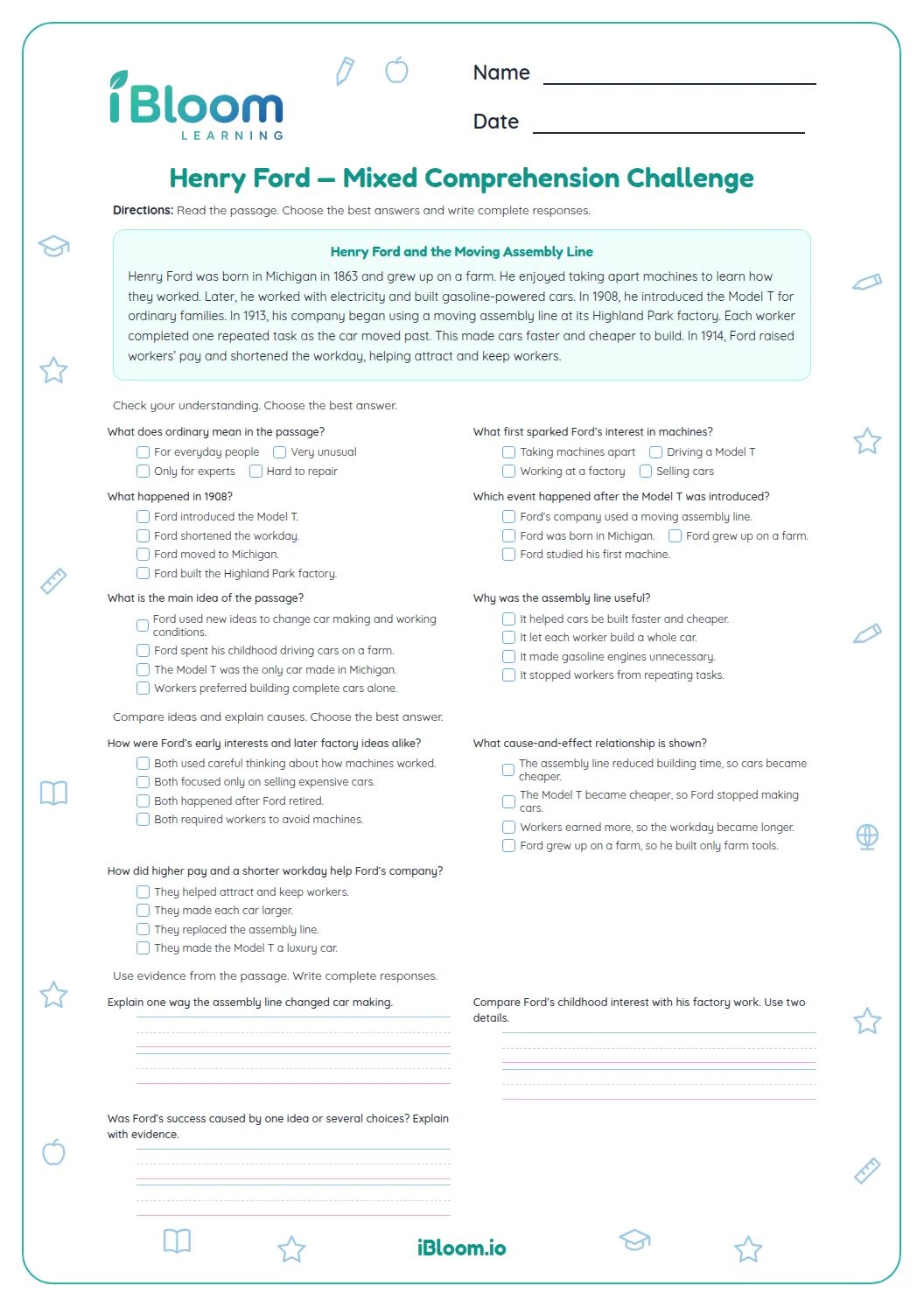
This free Grade 5 reading worksheet pairs an original informational passage about Henry Ford and the moving assembly line with 14 comprehension questions. Students choose, answer, and explain, using details from the passage to support inferences. It aligns with CCSS RI.5.1 and includes a separate answer key with sample responses.
Aligned to RI.5.1
How do readers make an inference?
An inference is a conclusion drawn from details in a text. A reader joins what the passage states with what those details suggest. For example, the passage says the chassis moved from station to station and each worker focused on a task. That supports the idea that workers depended on one another’s timing.
The first four questions ask students to choose an answer supported by the passage. The next questions ask them to explain a clue or a reasonable conclusion.
- 1Question: Why might having parts ready help the line keep moving?
- 2Clue: Workers need parts for their assigned task.
- 3Inference: Ready parts help prevent waiting.
How can a response include text evidence?
Answer the question directly, then point to a specific detail. A useful response does not need to copy a long passage. It can name the moving chassis, the stations, or the workers’ repeated tasks and explain how that detail supports the idea.
The final part includes written responses about the assembly line, affordability, and Ford’s role. The answer key gives sample responses; other clear answers supported by the text can also work.
How to use this worksheet
- 1Read the whole passage once to understand the topic.
- 2Underline details about the workers, the line, and the Model T.
- 3Answer the question directly before adding evidence.
- 4For an inference, explain how the clue supports the conclusion.
- 5Reread the passage to check names and facts.
Common mistakes and quick fixes
The mistake
Giving an opinion without a passage clue.
The fix
Add a specific detail from the text and connect it to the answer.
The mistake
Treating an inference as a directly stated fact.
The fix
Use wording such as “This suggests…” and identify the clue that led to it.
The mistake
Saying Ford invented the automobile.
The fix
Check the passage: it credits Ford’s company with large-scale assembly-line use, not inventing the car.
Common Core alignment
The questions ask readers to draw inferences and cite passage details.
Use accurate passage details when explaining stated ideas and drawing inferences.
On this sheet: Students answer inference questions and support responses with details from an informational passage.
Show the official wordingHide the official wording
Quote accurately from a text when explaining what the text says explicitly and when drawing inferences from the text.
What to practice next
Make more practice
Further reading
Questions parents and teachers ask
What is an inference?
An inference is a conclusion a reader makes by combining text clues with reasoning. For example, the passage describes a moving chassis and workers with separate tasks; a reader can infer that the workers needed to coordinate. Ask the reader to name the passage detail and explain how it supports the answer.
How do students find evidence in this passage?
Look for details about the moving line, the workers’ tasks, and the Model T. A response can name one detail and explain how it supports the answer rather than copying a whole paragraph. For instance, the chassis moved between stations as workers completed focused tasks.
Did Henry Ford invent the automobile?
No. The passage explicitly says he did not invent the automobile. It explains that Ford’s company became known for applying the moving assembly-line system to car production on a large scale. Ask the reader to name the passage detail and explain how it supports the answer.
How many questions are included?
There are 14 questions after the passage: four multiple-choice items, six short answers, and four written responses. They move from selecting supported ideas to explaining inferences with evidence. Ask the reader to name the passage detail and explain how it supports the answer.
What does the answer key include for written questions?
The key provides sample responses for questions with more than one defensible wording. Students can use different wording if their answers make sense and connect to details in the passage. Ask the reader to name the passage detail and explain how it supports the answer.
How long should students spend on this page?
About 30 minutes gives time to read the passage carefully and write evidence-based answers. Students may take longer on the final responses if they are learning to explain how a detail supports an inference. Ask the reader to name the passage detail and explain how it supports the answer.