




About this worksheet
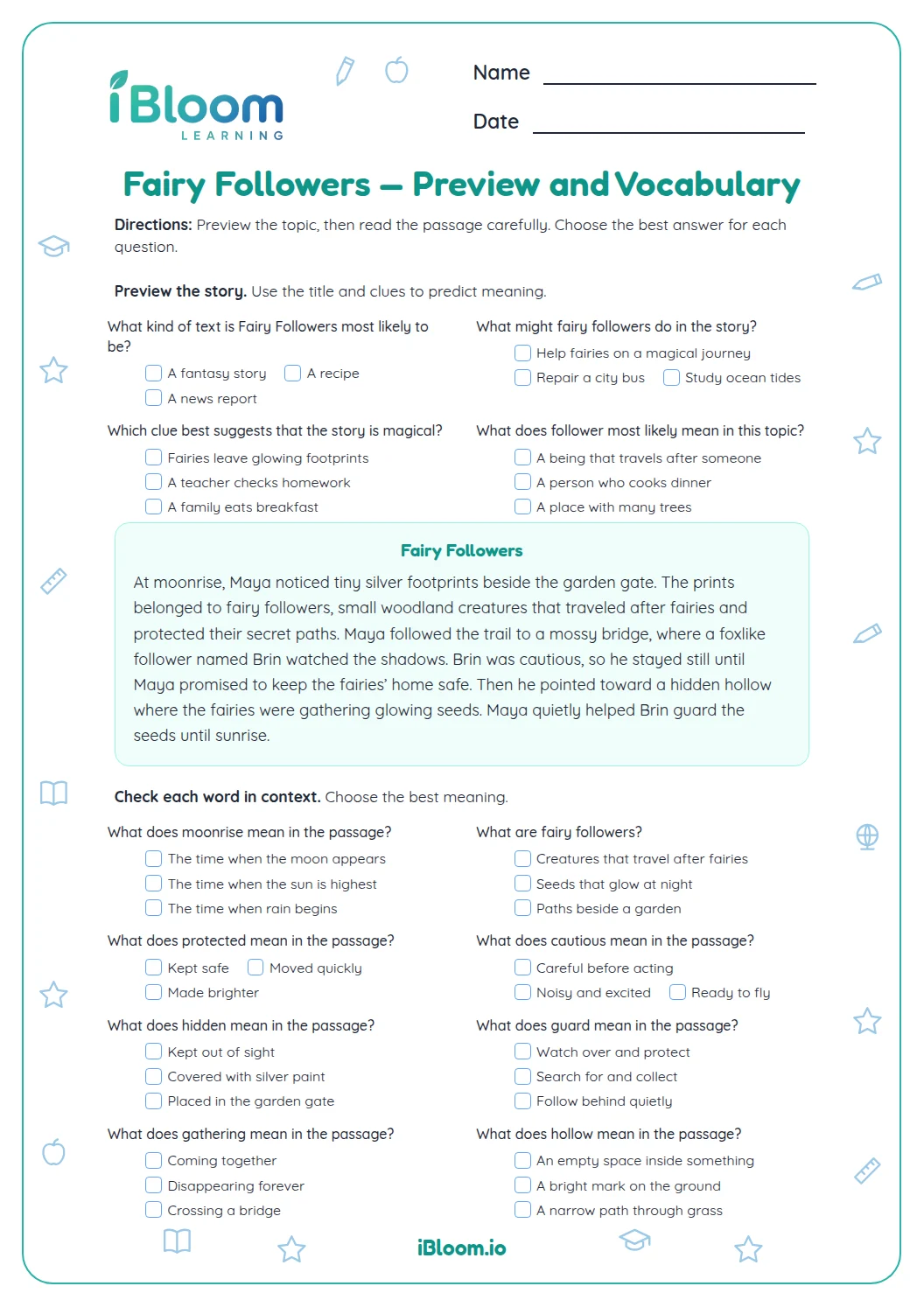
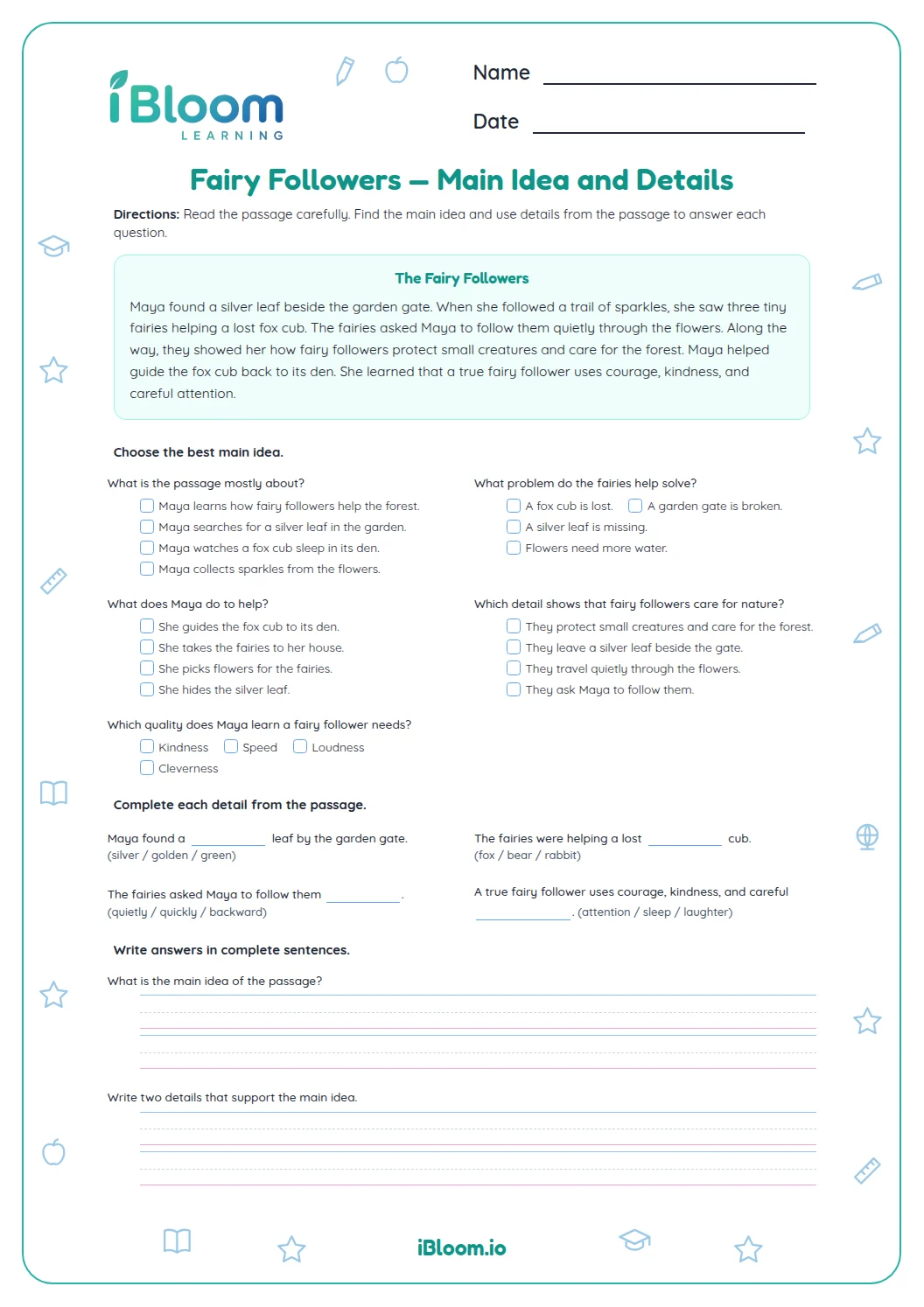
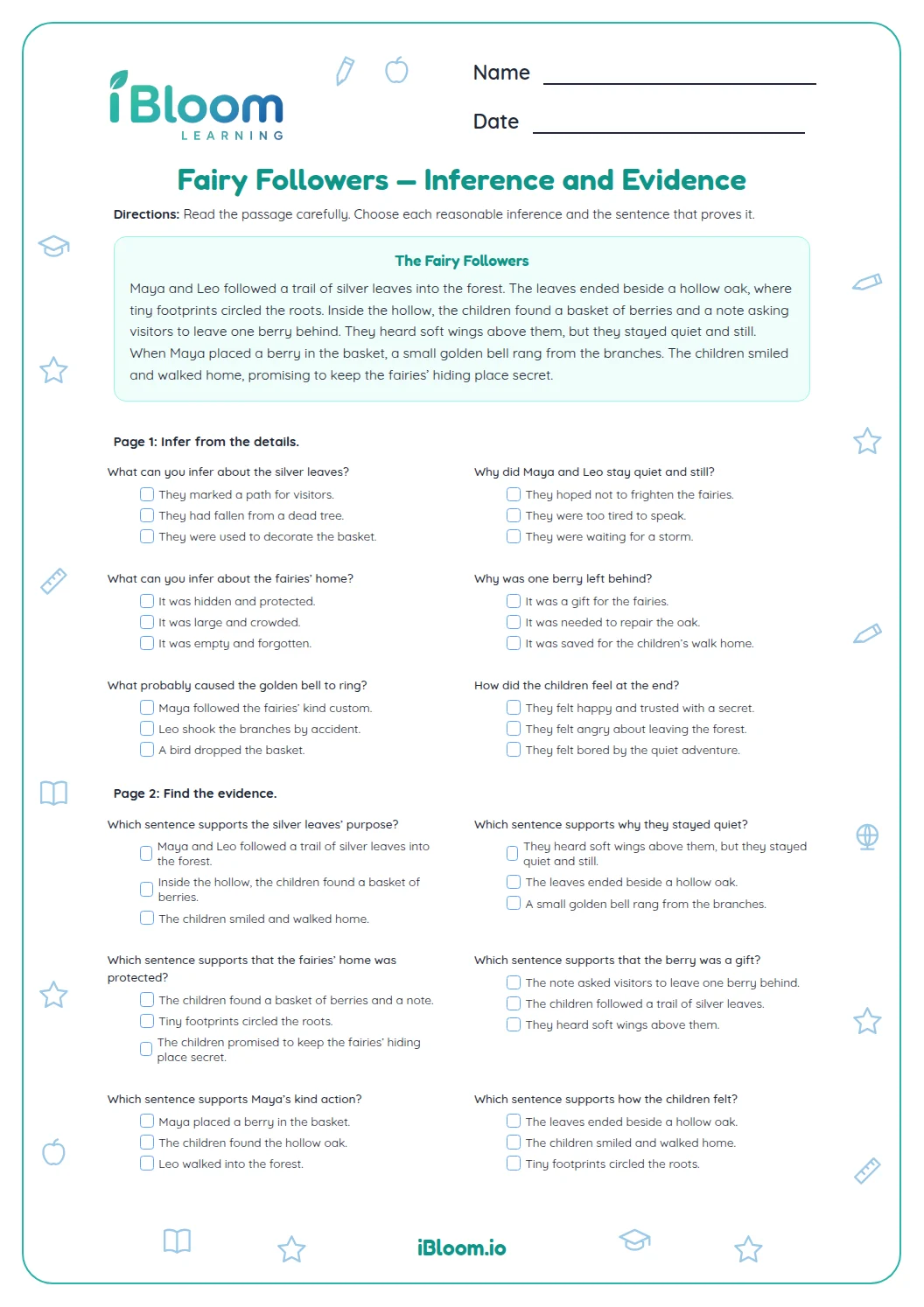
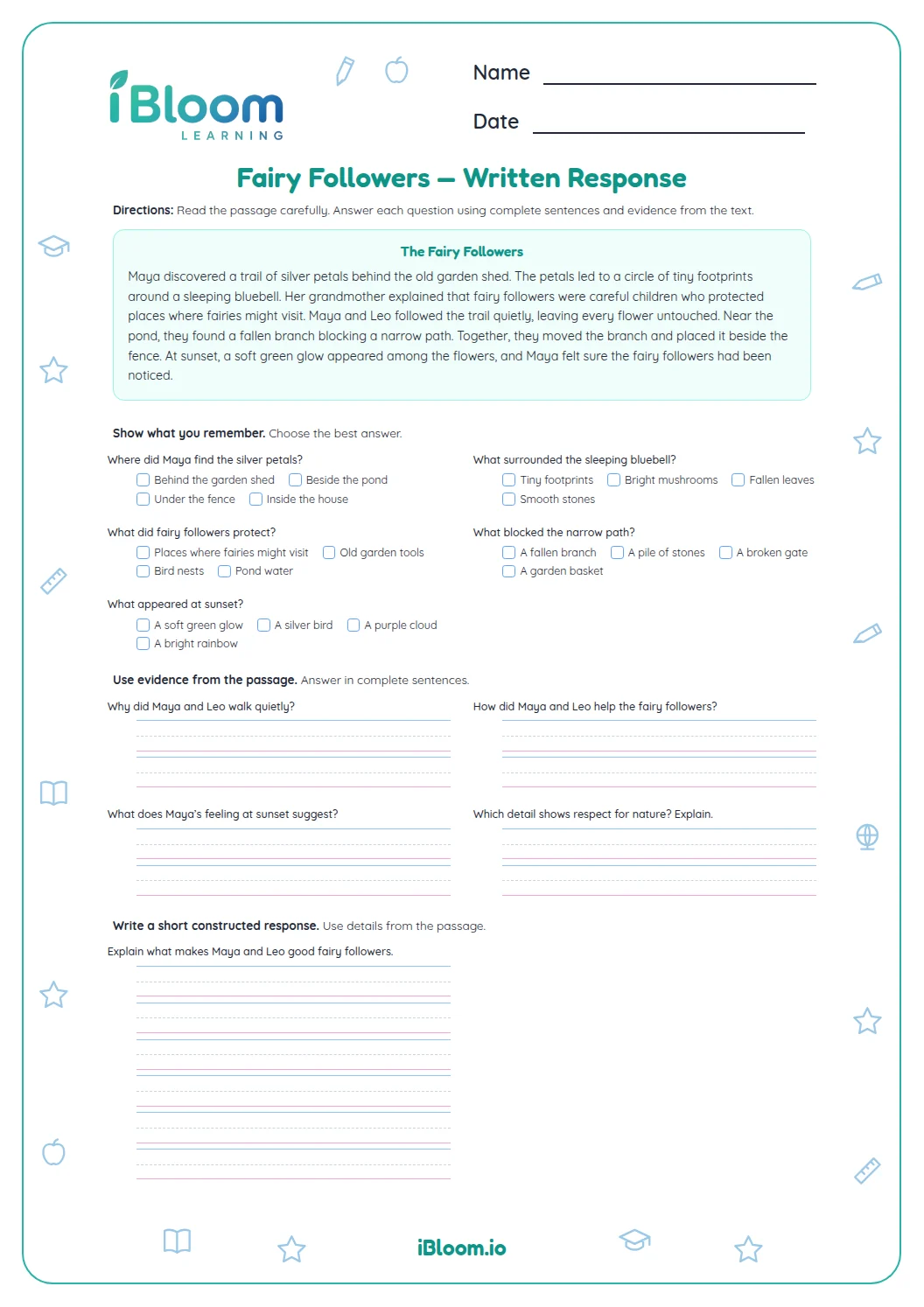
This free Grade 5 printable pairs a two-paragraph Fairy Followers story with 12 questions on vocabulary, sequence, inference, character choices and summary. Ten questions are multiple choice; two ask children to explain or summarize with story details. It practices Common Core RL.5.1 and RL.5.2 and includes a separate key. Maya and Rowan use three blue lanterns to help Fernwood’s tiny garden followers reach the blossoms.
Aligned to RL.5.1 and RL.5.2
How can readers tell what a story states and leaves unresolved?
A careful answer stays close to the passage. Question 5 asks why the followers kept waiting after the branch was moved. The story gives a possible thought from Rowan, but says Maya and Rowan never learn the exact reason.
- 1Clue: “They never learned exactly why the followers waited.”
- 2Answer: The story does not tell exactly why.
- 3Check: Do not turn Rowan’s thought into a fact.
How do details show that both characters helped?
Maya and Rowan move the fallen branch and check the path. Rowan also places the lanterns. Question 7 asks children to connect those actions to the choice that both helped make the path safe.
What does the printable include?
The worksheet has a two-paragraph series story, 12 questions in three parts, and a separate answer key. Readers choose answers about details, sequence and character actions, then explain an inference and summarize the ending.
How to use this worksheet
- 1Read the whole passage once to follow the events.
- 2Reread the sentence or paragraph named by a question.
- 3For an inference, underline the clue and say what it suggests.
- 4For theme, connect a character’s choice to a broader idea.
- 5In the written response, include the main events and the ending.
Common mistakes and quick fixes
The mistake
Choosing an answer that sounds magical but has no evidence.
The fix
Point to the sentence that supports the choice.
The mistake
Mixing up the order of events.
The fix
Retell the events in sequence before answering.
The mistake
Writing a theme as a plot detail.
The fix
Turn the event into a broader lesson, such as acting with care.
Common Core alignment
This worksheet practices the standard through the reading and response tasks on the page.
Cite story details when answering and inferring.
On this sheet: Questions ask children to cite details and infer why characters act.
Show the official wordingHide the official wording
Quote accurately from a text when explaining what the text says explicitly and when drawing inferences from the text.
Use details to identify a theme and summarize the story.
On this sheet: Children identify a theme from the cousins’ choices and summarize the plot.
Show the official wordingHide the official wording
Determine a theme of a story, drama, or poem from details in the text, including how characters in a story or drama respond to challenges or how the speaker in a poem reflects upon a topic; summarize the text.
What to practice next
Make more practice
Further reading
Questions parents and teachers ask
What does this Fairy Followers: Mixed Comprehension Challenge worksheet practice?
It pairs focused reading comprehension practice with a short story written for this page. Children can reread the passage, point to a detail, and use that detail to support each answer in their own words. The questions move from direct details to explaining ideas.
Can a student use the passage while answering?
Yes. The passage stays available on the worksheet, so students can return to it as they work. Rereading a sentence or paragraph can help them check a detail before choosing an answer or explaining an idea. They can underline a clue before responding.
What is included in the answer key?
The key gives an answer for every question. For responses that can be phrased in different ways, it provides a sample; students may use other wording when it is accurate and supported by the passage. An adult can accept another clear answer with evidence.
How can an adult use the written responses?
Ask the student to point to the sentence or event that supports the response. A short oral explanation can help them connect the evidence to the idea before they write or select their final answer. This makes the reasoning visible without requiring a long response.
How long should the worksheet take?
Plan for about 20 minutes, with extra time if the student rereads the story or discusses an answer. The pace depends on reading fluency and how much explanation each response needs. Students can complete the questions independently or talk through selected items with an adult.