


About this worksheet
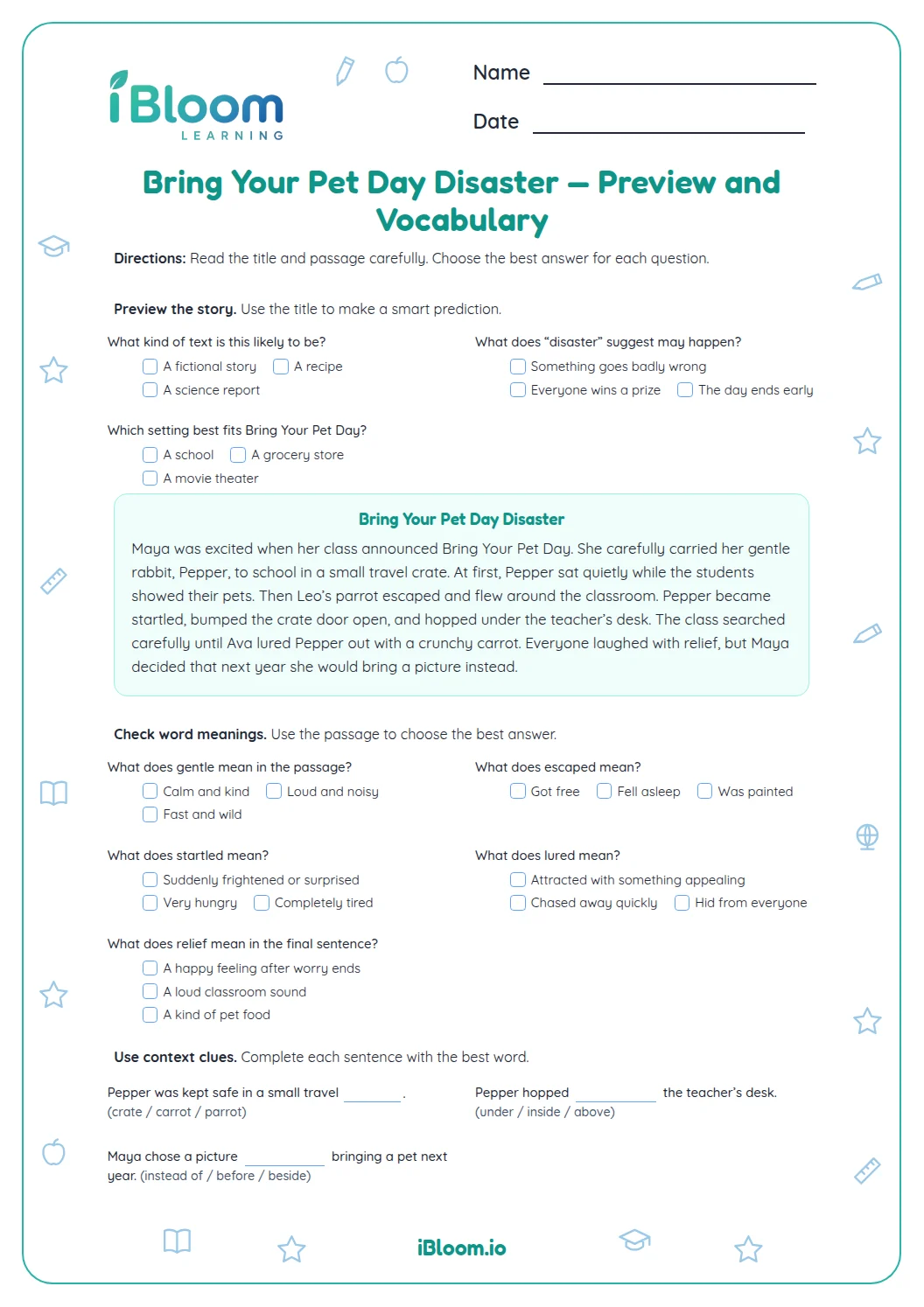
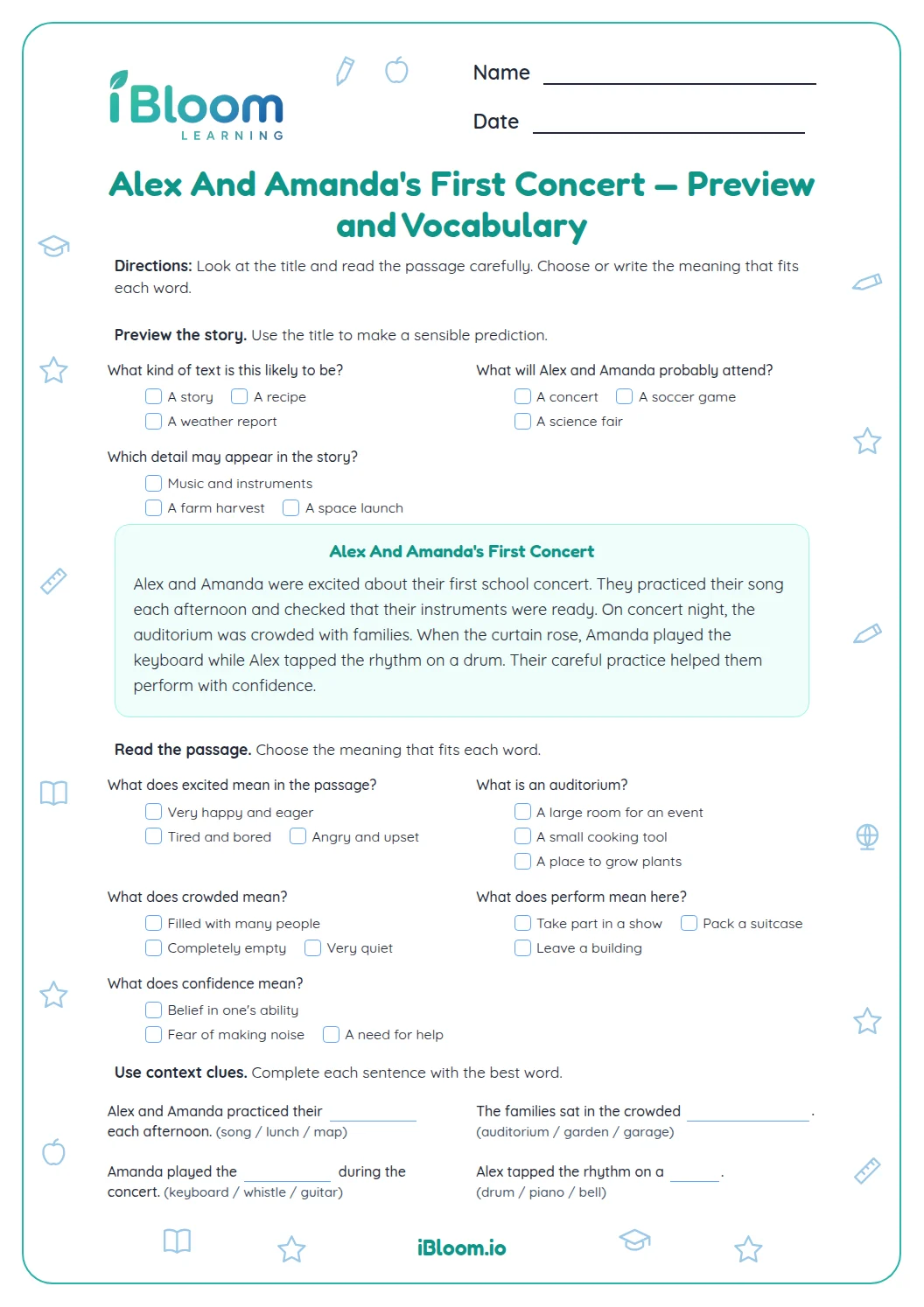
This free printable Grade 5 reading worksheet pairs an original short story, "The Best Vacation Ever," with questions that build two habits: previewing before you read and working out word meanings from context. In Part B, students read only the title and first paragraph and predict how Nora feels about a week at her grandfather's cabin. In Part C, they use the story to define weathered, restless, scowling, glided, cove and dreaded, and to read the simile "tilted like a ship." Part D asks for two written answers. It practices L.5.4a and RL.5.4. The answer key is separate.
Aligned to L.5.4a and RL.5.4
Why preview a story before reading it?
Previewing means using the title and the first lines to guess what a text is about and how it might go. Readers who predict read with a purpose, and they notice when the story confirms or surprises them. Here the title promises "the best vacation ever," but the first paragraph says Nora groans at the idea of a cabin with no signal.
That gap is the point of Part B. Students see that a title can set up an expectation the story then complicates, and they practice backing a prediction with a detail from the text.
How do students work out word meanings from context?
Teach a short routine: reread the sentence, look at the sentences around it, name the clue, then try your meaning in place of the word. Context clues in Grade 5 are often cause-and-effect or comparison clues, as L.5.4a describes, not only a definition nearby.
In this story, the clues are close to each word. Nora "wandered the porch, scowling at the gray lake," which shows what restless and scowling look like. A building that is "sagging" with a porch that tilts is weathered, worn down over time.
- 1"Nora felt restless. She wandered the porch, scowling at the gray lake."
- 2Clue: she wandered and scowled instead of settling down.
- 3Try it: "Nora felt unable to relax." That fits.
- 4Answer: unable to relax
What is on this worksheet?
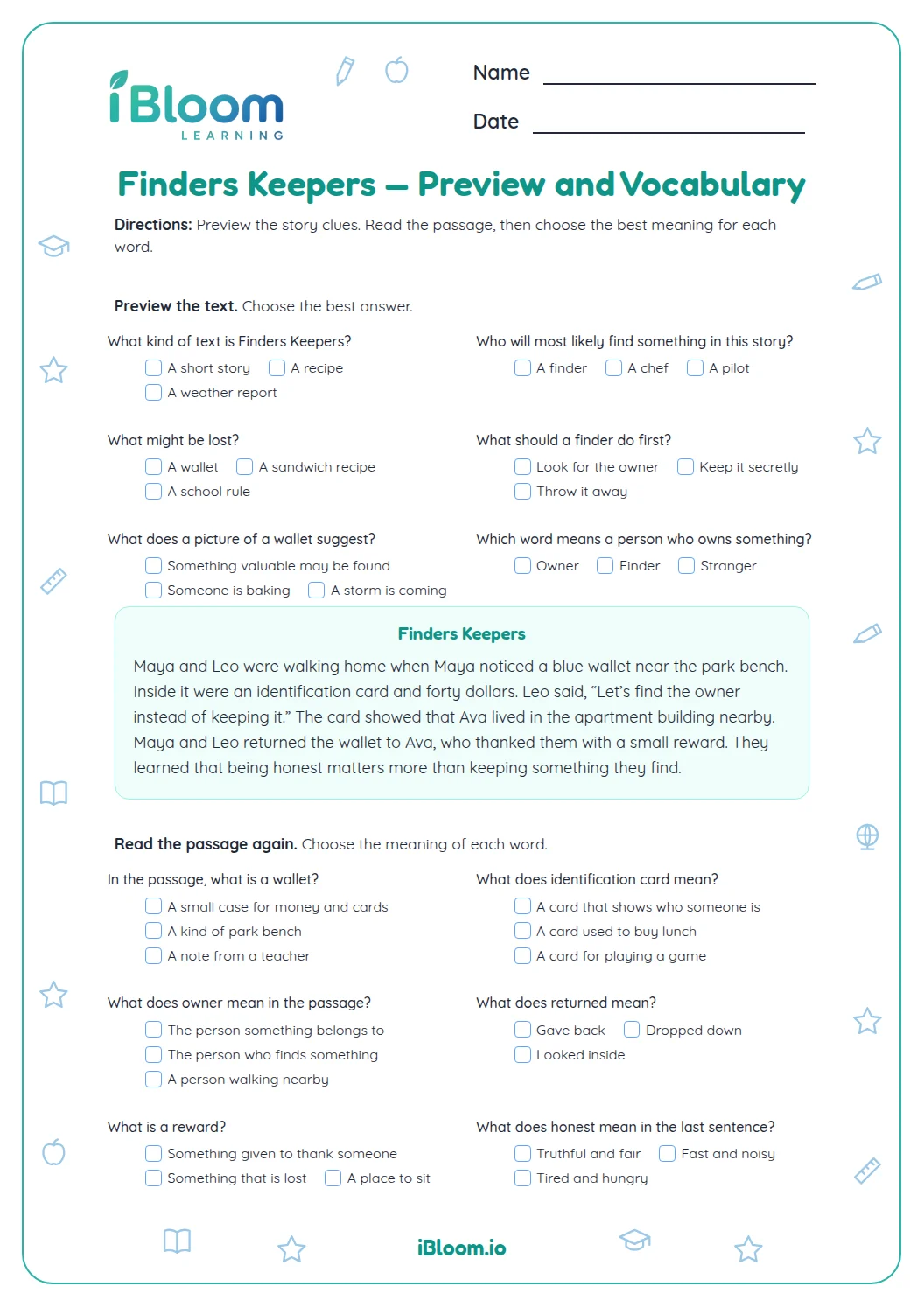
Part A is the story itself: three short paragraphs about the announcement, two rainy days, and a calm morning on the lake. It is written for Grade 5, with sentences of varied length and a few precise words such as drizzled, mist and tumbling.
Part B has three previewing questions answered from the title and first paragraph only. Part C has seven multiple-choice questions about words and a simile. Part D asks students to write a sentence with restless and to explain how Nora's feelings changed, citing one detail.
- Part B: 3 questions, preview and predict
- Part C: 7 questions, word meanings and one simile
- Part D: 2 written answers
- Words: weathered, restless, scowling, glided, cove, dreaded
Why does the sheet include a simile?
Figurative language is part of reading for meaning. "A porch that tilted like a ship" compares the porch to a ship that leans in the waves, so the reader pictures a building tilting to one side. L.5.5a asks Grade 5 students to interpret similes and metaphors in context, and this question gives one clear example.
How to use this worksheet at home or in class
- 1Cover the story below the first paragraph. Read the title and first paragraph aloud, and ask what your child expects.
- 2Have your child complete Part B, then read on to see whether the predictions held.
- 3Read the whole story. Ask your child to underline words that were hard to understand.
- 4Work Part C one word at a time: find the sentence, name the clue, test the meaning.
- 5Let your child write the Part D answers, checking that each has a subject and a verb and uses a detail from the text.
- 6Check with the answer key, and for any missed word, reread the sentence together and find the clue.
Common mistakes and quick fixes
The mistake
Choosing a meaning from memory without checking the sentence, such as picking "proud and happy" for restless because it sounds positive.
The fix
Have your child put each choice in place of the word and reread. "Nora felt proud and happy" does not match the rainy porch.
The mistake
Treating the title as a guarantee, so a child predicts a perfect trip from the first line.
The fix
Point out the details after the title. Ask what Nora's groan and the words "no signal" tell you about her mood.
The mistake
Writing a vague answer in Part D, like "She liked it."
The fix
Ask for a detail: what did she see or do that changed her mind? Add the heron or the otters to the sentence.
Common Core alignment
Most US states use the Common Core standards or a close state version, so this sheet fits Grade 5 vocabulary and literature work in most classrooms.
Use the sentences around a hard word to work out what it means.
On this sheet: Main standard: the seven Part C questions each ask students to use the surrounding sentences to choose a meaning.
Show the official wordingHide the official wording
Use context (e.g., cause/effect relationships and comparisons in text) as a clue to the meaning of a word or phrase.
Work out what words and a simile mean as the story uses them.
On this sheet: The vocabulary questions and the simile question ask for meanings as used in this story.
Show the official wordingHide the official wording
Determine the meaning of words and phrases as they are used in a text, including figurative language such as metaphors and similes.
What to practice next
Make more practice
Further reading
Questions parents and teachers ask
Do students read the whole story before Part B?
No. Part B is meant to be done after reading only the title and the first paragraph, so students make a real prediction. Cover the rest of the story, answer questions 1 to 3, and then read on. If students have already read it all, the questions still work as a check on the opening.
What are the answers to the vocabulary questions?
Weathered means worn down by the weather, restless means unable to relax, scowling means frowning angrily, glided means moved smoothly, a cove is a small, sheltered bay, and dreaded means did not look forward to. The simile means the porch leaned to one side.
What is a simile, and why is there one question about it?
A simile compares two things using "like" or "as." Here the porch "tilted like a ship," so students picture a porch leaning to one side. Grade 5 standards ask students to interpret figurative language in context, and this question gives students one clear example to explain.
Is the story based on a real book?
No. It is an original story written for this worksheet, so there is nothing for students to look up or compare. The characters Nora, Sam and Grandpa Abe appear only here. The story is about 200 words, which is short enough for one sitting but still gives each vocabulary word a clear context.
How should I score the written answers?
Check that the answer is a complete sentence, answers the question, and uses a detail from the story. The key gives sample answers, such as "At first she groaned about the cabin, but after seeing the otters she dreaded leaving." Other correct answers are fine if they cite the lake, the heron, the otters or the calm morning.
Is there an answer key, and how long does it take?
Yes, a separate three-page answer key gives all twelve answers and sample responses for the two written questions. Most Grade 5 students finish in about 20 minutes, including reading the story and writing in Part D. Allow a little longer if students look back at the text.