





About this worksheet
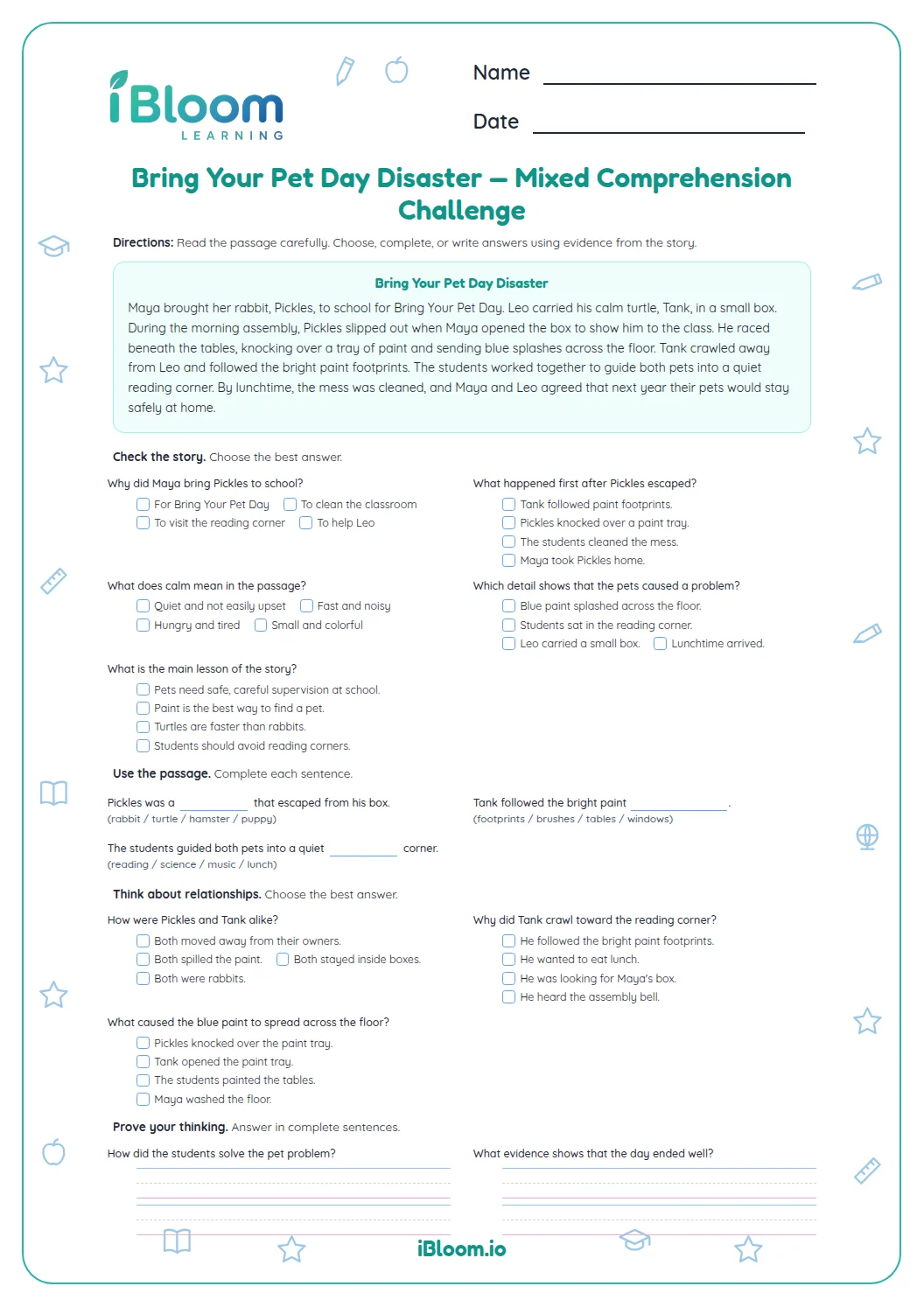
This free printable Grade 5 reading worksheet pairs an original short story, "Bring Your Pet Day Disaster," with questions that ask what it is mostly about and which details prove it. In 205 words, a ferret, a beagle and a rabbit turn a carefully planned pet day upside down until the class works together to fix it. Children choose the main idea and a fitting title, answer five detail questions, sort problem details from solution details, and write the main idea in their own words. It practices Common Core RL.5.2. A separate answer key is included.
Aligned to RL.5.2
What is the main idea of a story?
The main idea is what a text is mostly about, the one big point that all the parts add up to. In a story, the main idea often shows up as the problem and how it gets solved. It is bigger than any single event and smaller than a whole life lesson.
In "Bring Your Pet Day Disaster," a ferret escapes, a beagle howls and a rabbit eats the class plants. Those events are all details. What they add up to is a class that handles each trouble together, and that is the main idea. Question 1 tests exactly this: one wrong choice is a single detail (a ferret escapes), and another covers only the first half of the story (pets ruin a school day).
- 1Problems: Biscuit escapes, Waffles howls, the rabbit nibbles the plants.
- 2Fixes: Priya coaxes Biscuit back, Theo walks Waffles, Hana moves the plants.
- 3Ask: what do the problems and fixes add up to?
- 4The class solves each problem by working together.
- 5Main idea: Teamwork saves Pet Day
How do key details support the main idea?
Key details are the facts and events that prove the main idea. Questions 3 to 7 ask for those details: what Jonah made, what Biscuit knocked over, why Waffles howled, what the rabbit nibbled and how Biscuit was coaxed back. Children look back at the story for each, instead of answering from memory.
Questions 8 and 9 go one step further. Children sort details into problems and solutions, which shows how the story moves: trouble first, then fixes. A child who can tell "Hana moved the plants" (a fix) from "A rabbit nibbled plants" (a problem) understands how the story is built.
What is on this worksheet?
The story fills page 1 as Part A, and 11 questions in three more parts follow on pages 2 and 3.
- Part A, Read: the 205-word story in four paragraphs
- Part B, Main idea: choose the main idea and the best title
- Part C, Key details: five detail questions, then two on problem and solution
- Part D, Write it: state the main idea in one sentence and give two supporting details
- Answer key on separate pages, with sample written answers
Why does Part D ask children to write the main idea?
Choosing an answer from a list shows recognition. Writing the main idea in a sentence shows that a child can sum up a text, which is the habit that makes later summaries and essays easier. The model answer on the key is only one way to say it; any sentence about the class solving the Pet Day problems together is correct.
How to use this worksheet at home or in class
- 1Preview the title with your child: "What do you think can go wrong on a pet day?" Then read the story once, aloud or silently.
- 2Ask for a quick retell in two sentences before looking at the questions.
- 3Do Part B together. For each choice, ask whether it covers the whole story or just one part.
- 4Let your child do Part C alone, with the story open, underlining the sentence that holds each answer.
- 5For Part D, have your child write the main idea first, then pick two details from the story that prove it.
- 6Check with the answer key. If an answer is wrong, find the sentence in the story together and read it aloud.
Common mistakes and quick fixes
The mistake
Picking a single detail as the main idea, such as "A ferret escapes" in question 1, because it is the first exciting event.
The fix
Ask whether the answer covers the middle and the end too. The ferret is only one of three problems, and the story ends with all of them fixed.
The mistake
Writing a main idea from only the first half of the story, such as "Pets ruin a school day."
The fix
Read the last paragraph again. The main idea has to include how the problems were solved, not only that they happened.
The mistake
Mixing up problems and solutions in Part C, such as picking "The ferret escaped" as a way of solving a problem.
The fix
Draw two columns, Problem and Fix. Place each event from the story in a column before answering question 8 or 9.
Common Core alignment
Most US states use the Common Core reading standards or a close state version. For stories, main-idea and summary work falls under the theme standard below.
Find the main idea of a story from how the characters solve their problems, and say it in a sentence.
On this sheet: Main standard: children find the main idea from how the characters respond to the pet day problems, and write it in their own words.
Show the official wordingHide the official wording
Determine a theme of a story, drama, or poem from details in the text, including how characters in a story or drama respond to challenges or how the speaker in a poem reflects upon a topic; summarize the text.
What to practice next
Make more practice
Further reading
Questions parents and teachers ask
What is the main idea of Bring Your Pet Day Disaster?
The main idea is that teamwork saves Pet Day. A ferret escapes, a beagle howls and a rabbit nibbles the class plants, but Ms. Alvarez's class slows down and fixes each problem together. By lunch every pet is safe, and Jonah says they fixed the day by working together.
What is the difference between the main idea and the details?
The main idea is the big point of the whole story. Details are the smaller facts and events that show it. Biscuit escaping is a detail. The class working together to solve every problem is the main idea. A good test is whether an answer covers the beginning, middle and end.
Is the main idea the same as the theme?
They are close but not identical. The main idea says what this story is mostly about: the class saves Pet Day by working together. The theme is the wider lesson, such as working together can rescue a day that goes wrong. Common Core RL.5.2 asks Grade 5 children to find a theme and summarize.
Do my child's written answers need to match the sample exactly?
No. The sample main idea is one way to say it, so accept any sentence that says the class solved the problems together. For the two details, accept any two true events from the story, such as Hana moving the plants or Theo walking Waffles. Ask for details taken from the story.
How hard is the passage for Grade 5?
The story is 205 words in four short paragraphs, with a few harder words such as coaxed and nibbling and mostly familiar events. Most Grade 5 readers can read it independently. If your child struggles, read the story aloud together first and let your child answer the questions on their own.
Is there an answer key, and how long does it take?
Yes, the answer key is on separate pages and shows every correct answer, with model replies for the two written questions. Most children need about 20 minutes, including reading the story. You can split it: read the story and do Part B in one sitting, then Parts C and D in another.