


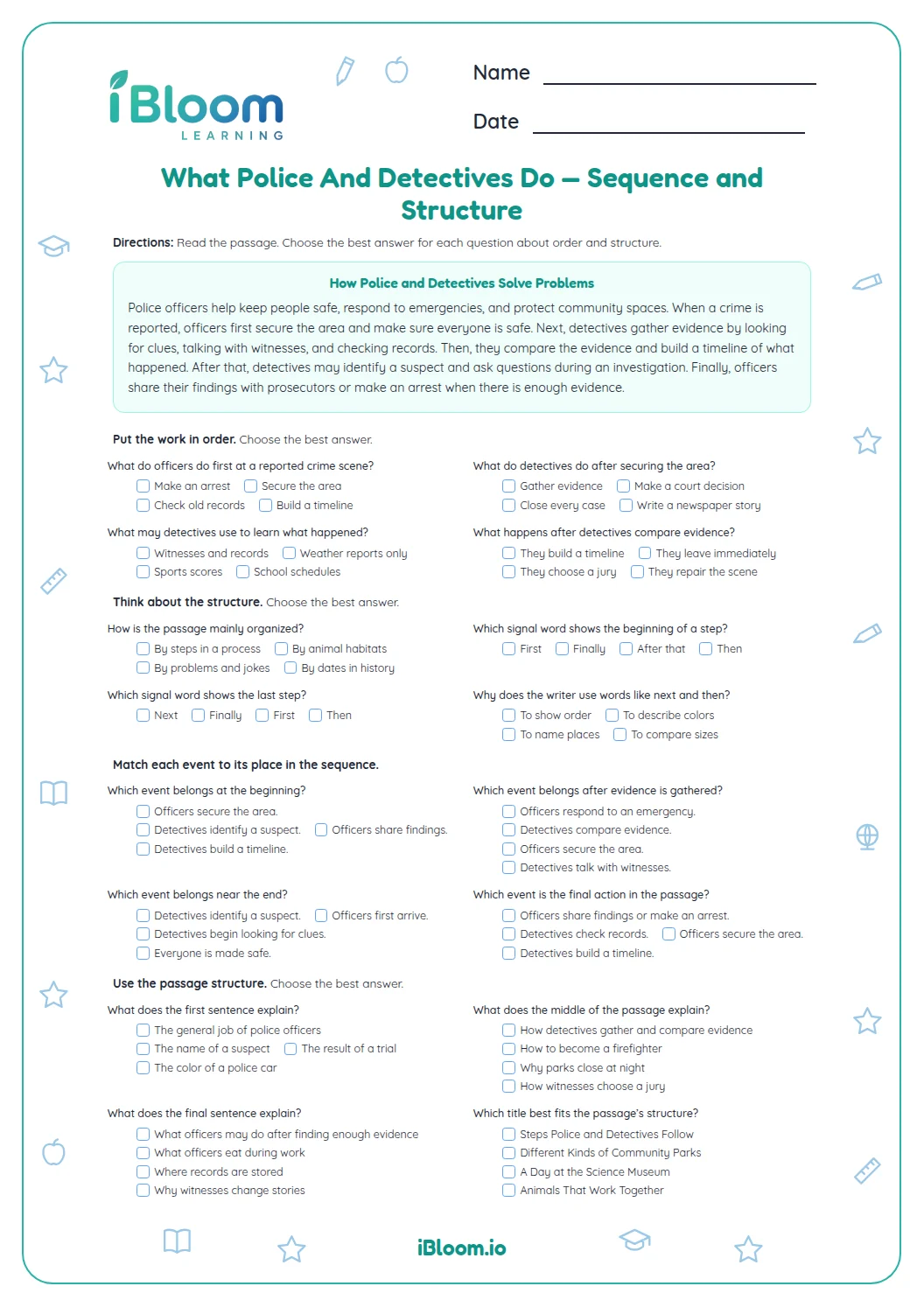
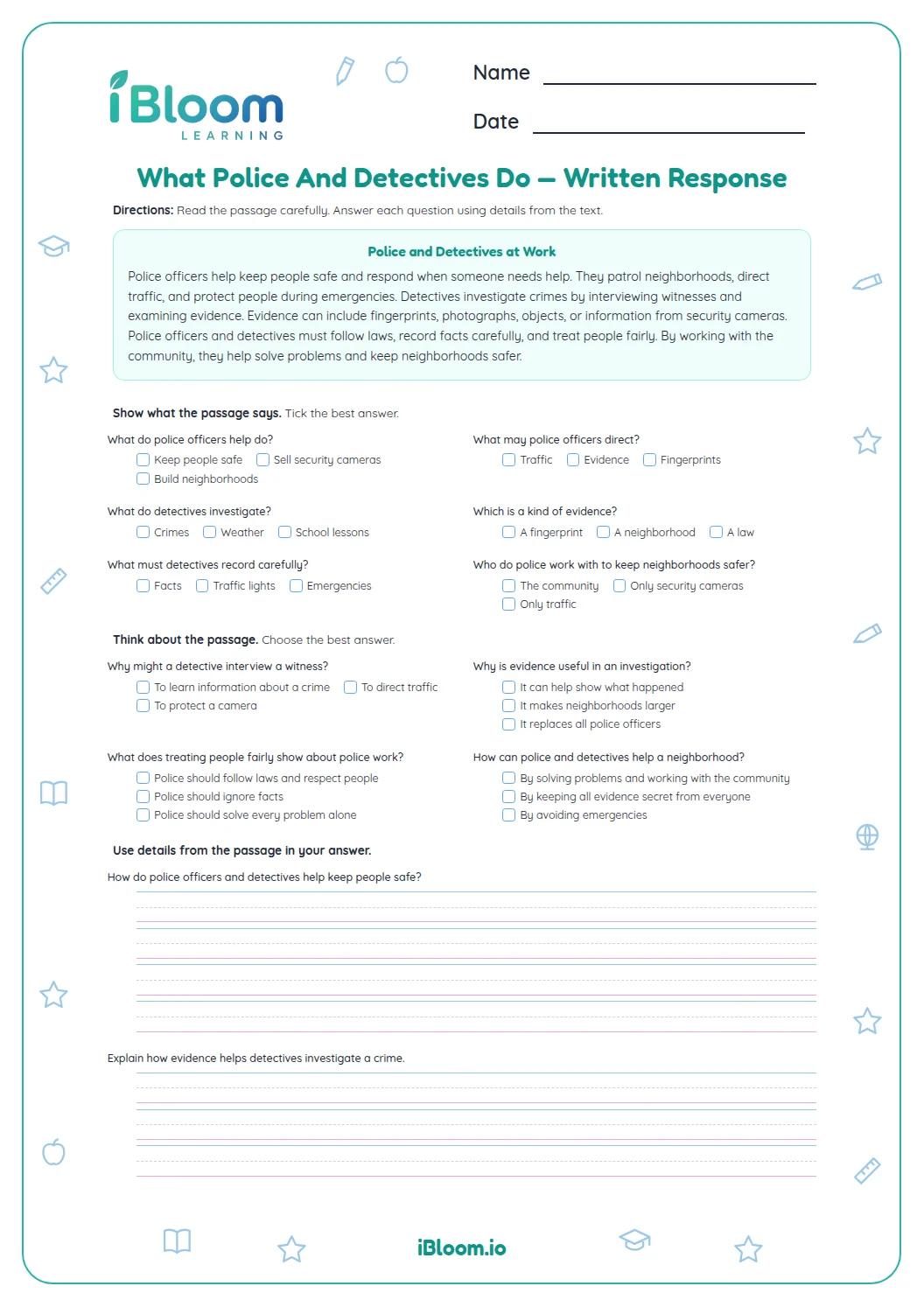
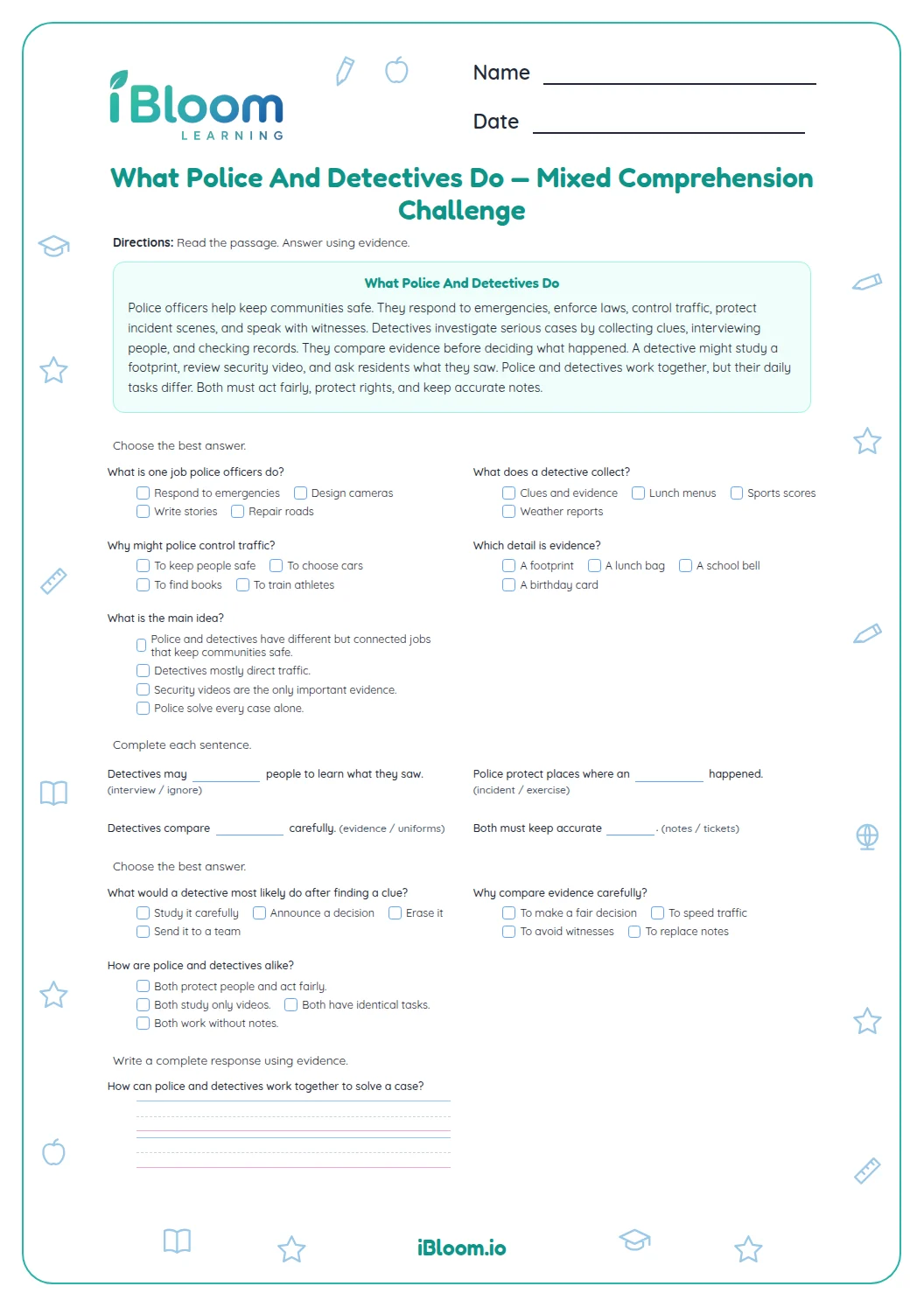



About this worksheet
This free printable Grade 5 worksheet uses “Helping the Community,” a short passage about Detective Maya, Leo, and Officer Lee. Learners infer what clues suggest and choose details that support their thinking. The 14 questions move from witness information to how investigators use evidence. A separate answer key is included.
Aligned to RI.5.1
What is an inference?
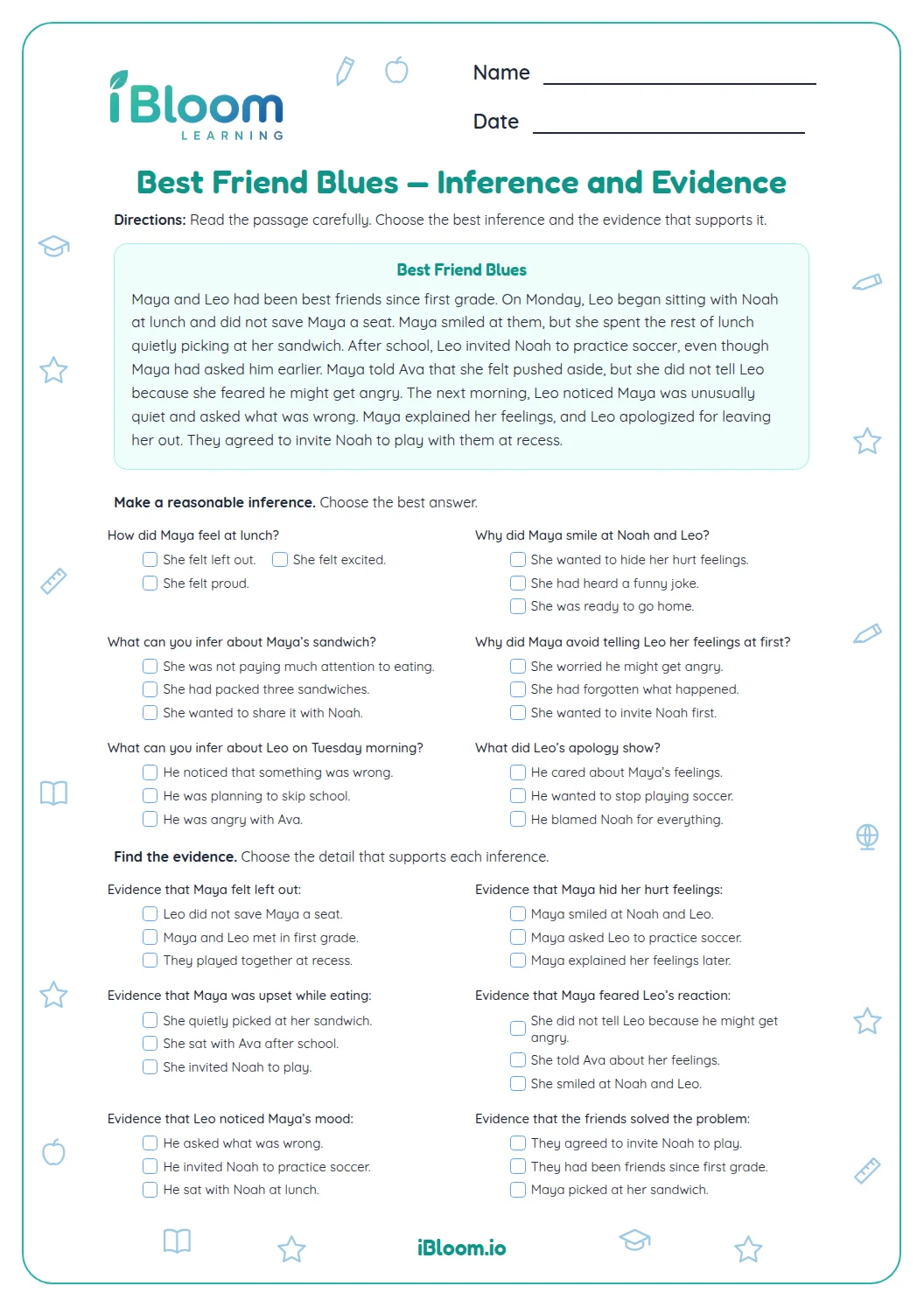
An inference is a reasonable idea a reader forms by combining story details with what the reader already knows. The passage does not directly call Maya observant, but her careful examination of footprints and attention to witness statements support that conclusion.
- 1Maya examines footprints near a broken window.
- 2Inference: Maya is observant.
- 3Evidence: She notices a clue and examines it carefully.
How does evidence strengthen an answer?
Evidence is a specific detail from the passage. A good answer connects that detail to an inference. Maya compares witness accounts with footprints so she can check whether the clues fit together.
What does this story practice?
The 14 questions alternate between drawing an inference and choosing the passage detail that supports it. Learners use Maya’s investigation and the community safety advice as evidence.
How to use this worksheet
- 1Read the passage once to follow the investigation.
- 2For an inference question, combine a passage detail with what you know.
- 3For an evidence question, find the sentence that best supports the idea.
- 4Check that the evidence answers the specific question.
- 5Use the answer key to review each inference and its supporting detail.
Common mistakes and quick fixes
The mistake
Treating a guess as an inference without a story clue.
The fix
Point to the detail that makes the idea reasonable.
The mistake
Choosing a true detail that does not answer the question.
The fix
Check that the evidence supports the specific inference being asked about.
The mistake
Adding a motive the passage never supports.
The fix
Use only what the character says or does and explain what that detail suggests.
Common Core alignment
The questions pair each inference with a relevant detail from the story.
Draw an inference from the story and support it with accurate details.
On this sheet: Learners draw inferences from the informational passage and choose accurate details that support each conclusion.
Show the official wordingHide the official wording
Quote accurately from a text when explaining what the text says explicitly and when drawing inferences from the text.
What to practice next
Make more practice
Further reading
Questions parents and teachers ask
What is an inference in a story?
An inference is a reasonable conclusion based on story details and what a reader knows. The passage does not directly call Maya observant, but her careful search and attention to footprints support that idea. Learners practice connecting conclusions to specific evidence.
What is the difference between a detail and evidence?
A detail is information in the passage; it becomes evidence when it supports a particular answer. Maya sees footprints by a broken window and compares them with witness accounts. That evidence helps her check whether the clues fit together.
What happens in “Helping the Community”?
Detective Maya examines footprints near a broken store window while Officer Lee speaks with Leo, a nearby witness. Maya records Leo’s account and compares it with other statements and the footprints. The passage also describes police safety advice for families at a community meeting.
How can a child support an inference?
Choose an answer that follows from a passage detail, then find the detail that supports it. Maya is observant because she examines footprints and compares them with witness accounts. The questions alternate between an inference and its evidence.
Why does Maya compare witness accounts with footprints?
She compares accounts with footprints to check whether different clues fit together. The passage says she did not decide what happened from one clue alone. Questions 5 and 6 ask learners to connect that inference with the supporting detail.