



About this worksheet
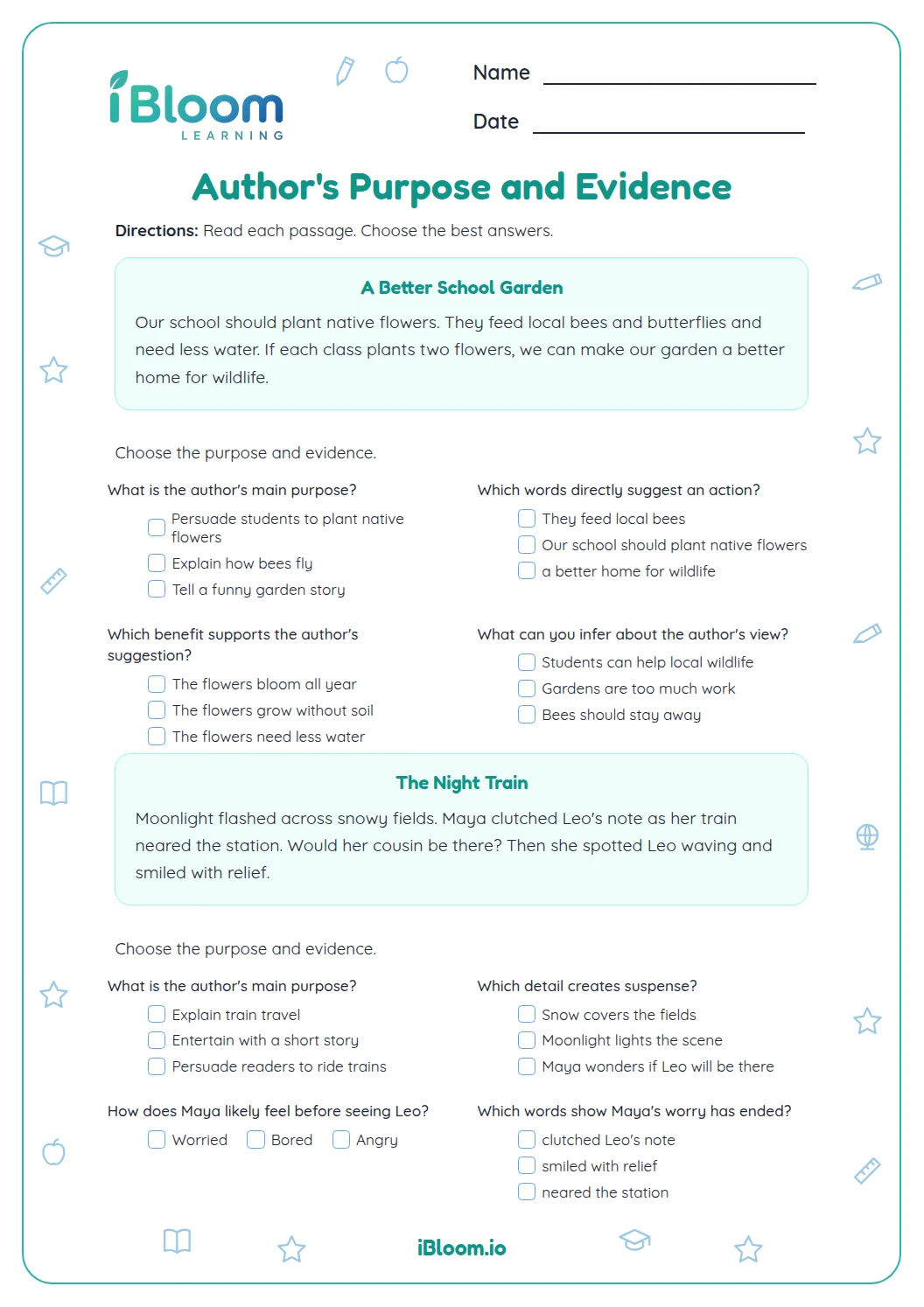
This Grade 5 printable opens an author’s purpose sequence with an original informational passage about city trees. Children identify why the author wrote it, use context to understand words such as sapling and runoff, and connect details to the author’s points. A final response asks them to name one benefit and one care need from the passage. The questions practice CCSS RI.5.4 and RI.5.8.
Aligned to RI.5.4 and RI.5.8
How can you identify an author’s purpose?
Look at the topic, details, and ending of the whole passage. In this text, explanations of shade, soil, runoff, and planning show that the author aims to explain city trees and their care.
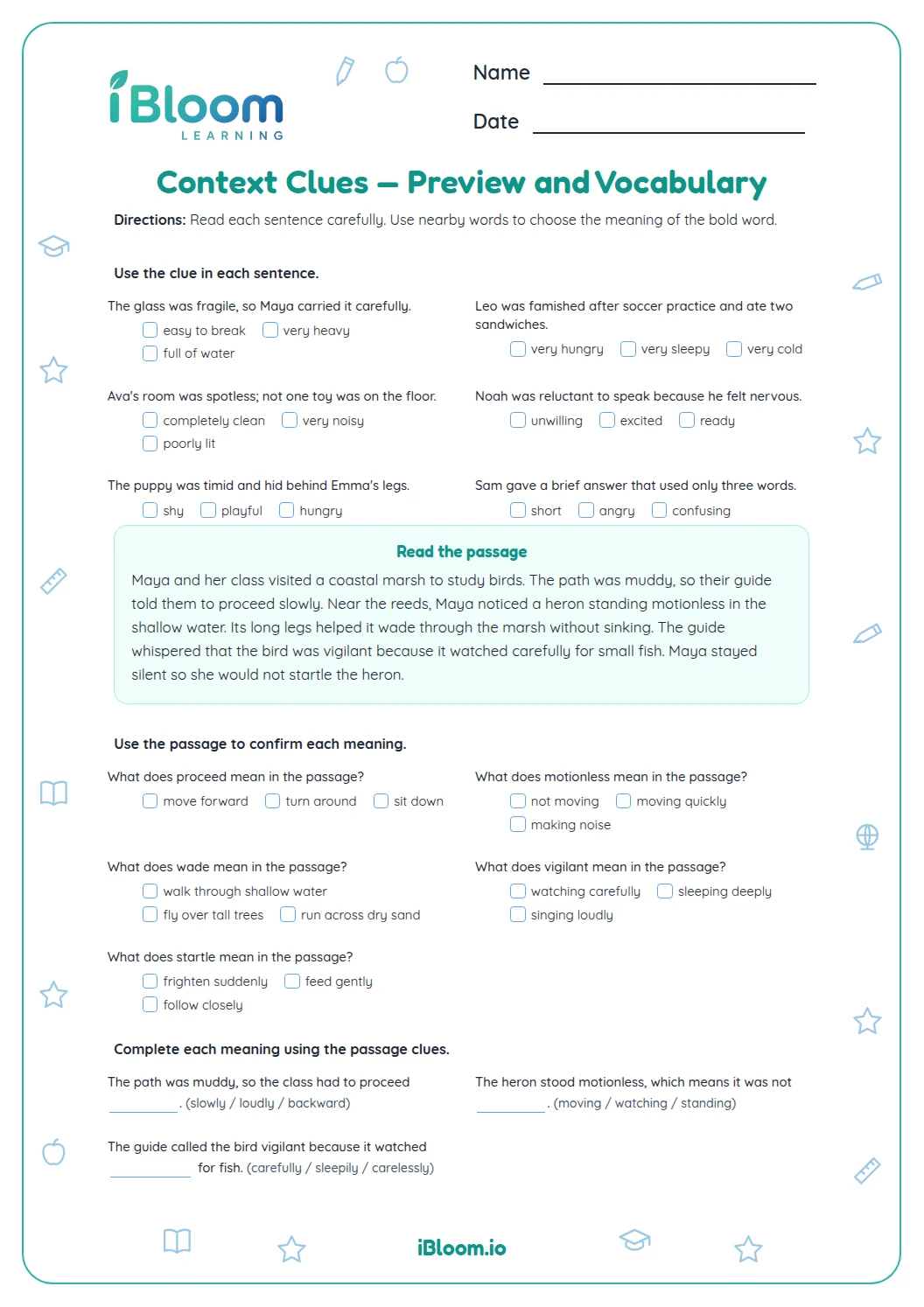
How do context clues help with vocabulary?
Reread the sentence around an unfamiliar word. The passage calls a newly planted sapling a tree that needs years to grow a broad crown, which points to a young tree. Nearby references to rain and bare pavement help explain runoff.
Which details support the author’s points?
For example, leaves release water vapor that cools nearby air. This detail supports the point that trees can make a city block more comfortable. The passage also notes that volunteers water young trees during dry weeks.
How to use this worksheet
- 1Read the title and skim the passage once.
- 2Read each question and return to the paragraph that contains the clue.
- 3For vocabulary, test the meaning in the sentence.
- 4Use specific passage details to support the final response.
- 5Check answers with the separate answer key.
Common reading mix-ups
The mistake
Choosing a purpose from one sentence only.
The fix
Check the topic and details across the whole passage.
The mistake
Guessing sapling without using nearby clues.
The fix
Connect “newly planted” and “grows a broad crown” to a young tree.
The mistake
Giving an opinion instead of evidence.
The fix
Name a detail the author actually includes.
Common Core alignment
The questions use context to determine word meanings and connect evidence with the author’s points.
Use context to determine the meaning of words and phrases in an informational text.
On this sheet: Students use passage context to explain sapling, species, runoff, and mature.
Show the official wordingHide the official wording
Determine the meaning of general academic and domain-specific words and phrases in a text relevant to a grade 5 topic or subject area.
Explain how reasons and evidence support points in an informational text.
On this sheet: Questions connect specific tree details with the author’s points about benefits and planning.
Show the official wordingHide the official wording
Explain how an author uses reasons and evidence to support particular points in a text, identifying which reasons and evidence support which point(s).
What to practice next
Make more practice
Further reading
Questions parents and teachers ask
What is the author’s purpose in the passage?
The author mainly explains benefits of city trees and the planning and care they need. Details about shade, soil, runoff, and space show how trees help and what communities consider when planting them. Students can use these repeated ideas to explain what the author wants readers to understand.
How does the passage help readers understand sapling?
It says a newly planted sapling may need years of care before it grows a broad crown. Those nearby clues show that a sapling is a young tree. The answer key lists this meaning. The same clues also distinguish a sapling from a mature tree later in the passage.
What does runoff mean in this passage?
Runoff is water that flows over land after rain. The passage contrasts leafy areas with bare pavement and says trees can slow the water, giving context for the word. Readers can use the sentence about leafy areas and bare pavement to check their meaning.
Does the author say trees solve every city problem?
No. The final paragraph says one tree cannot solve a city’s heat or pollution problems. It then explains that many well-placed trees can still improve neighborhoods, showing the author’s measured explanation. This balance helps readers identify the author’s purpose as explanation rather than an absolute claim.
What is an example of evidence in the passage?
The passage says tree leaves release water vapor that cools nearby air. This detail supports the point that trees can make a city block more comfortable. Children can point to this sentence when answering an evidence question. A response should name the detail and explain how it supports the point being made.