


About this worksheet
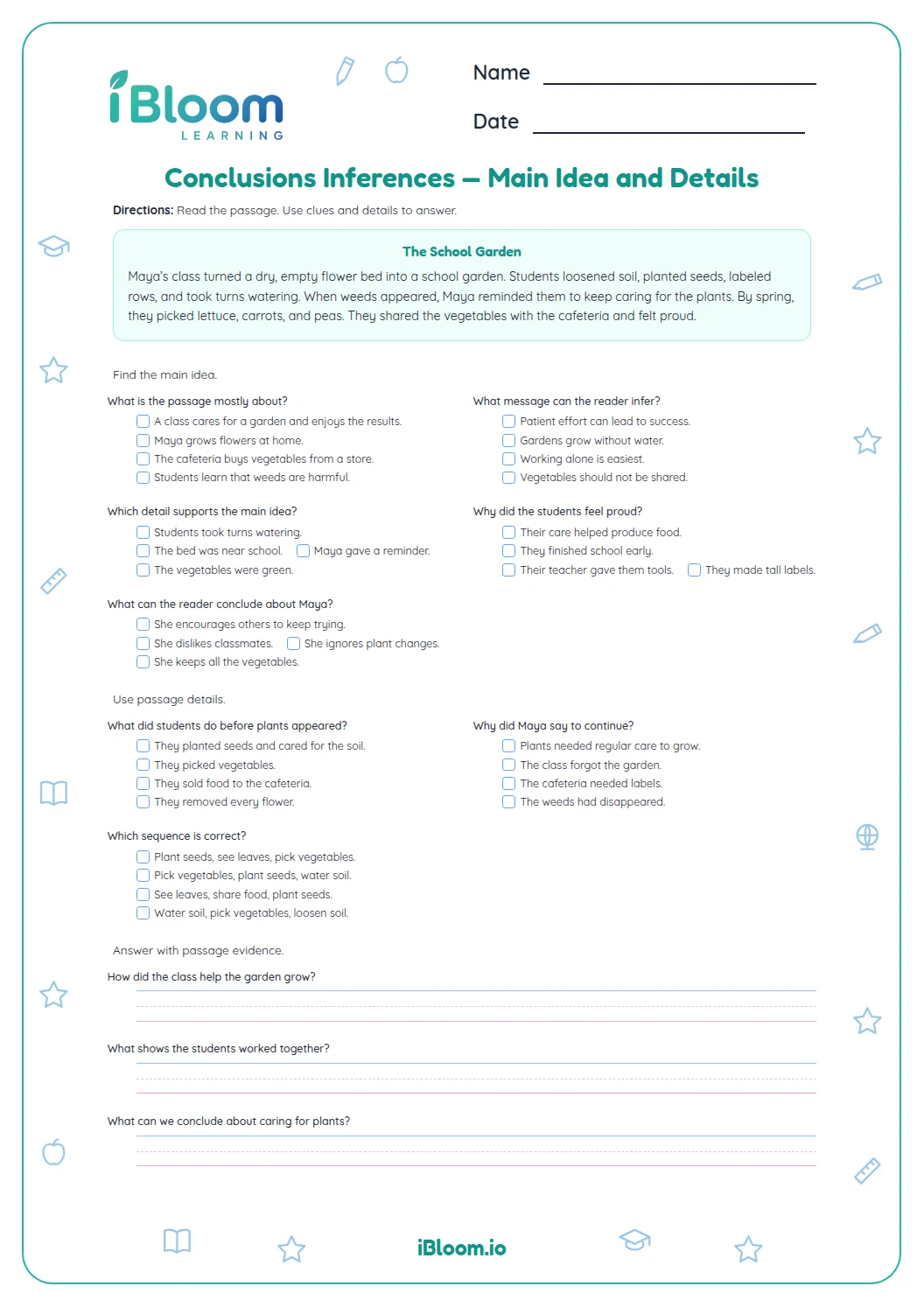
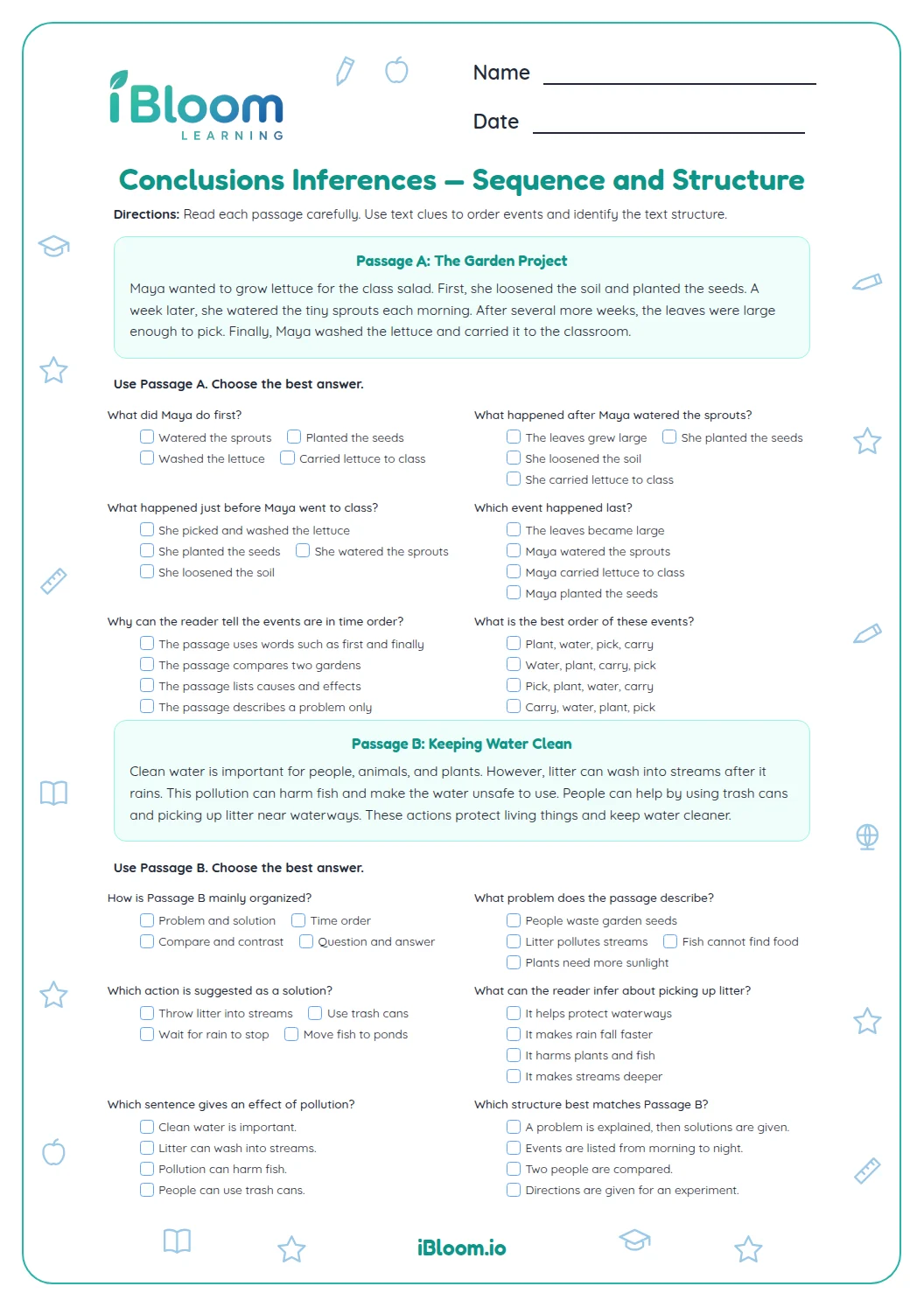
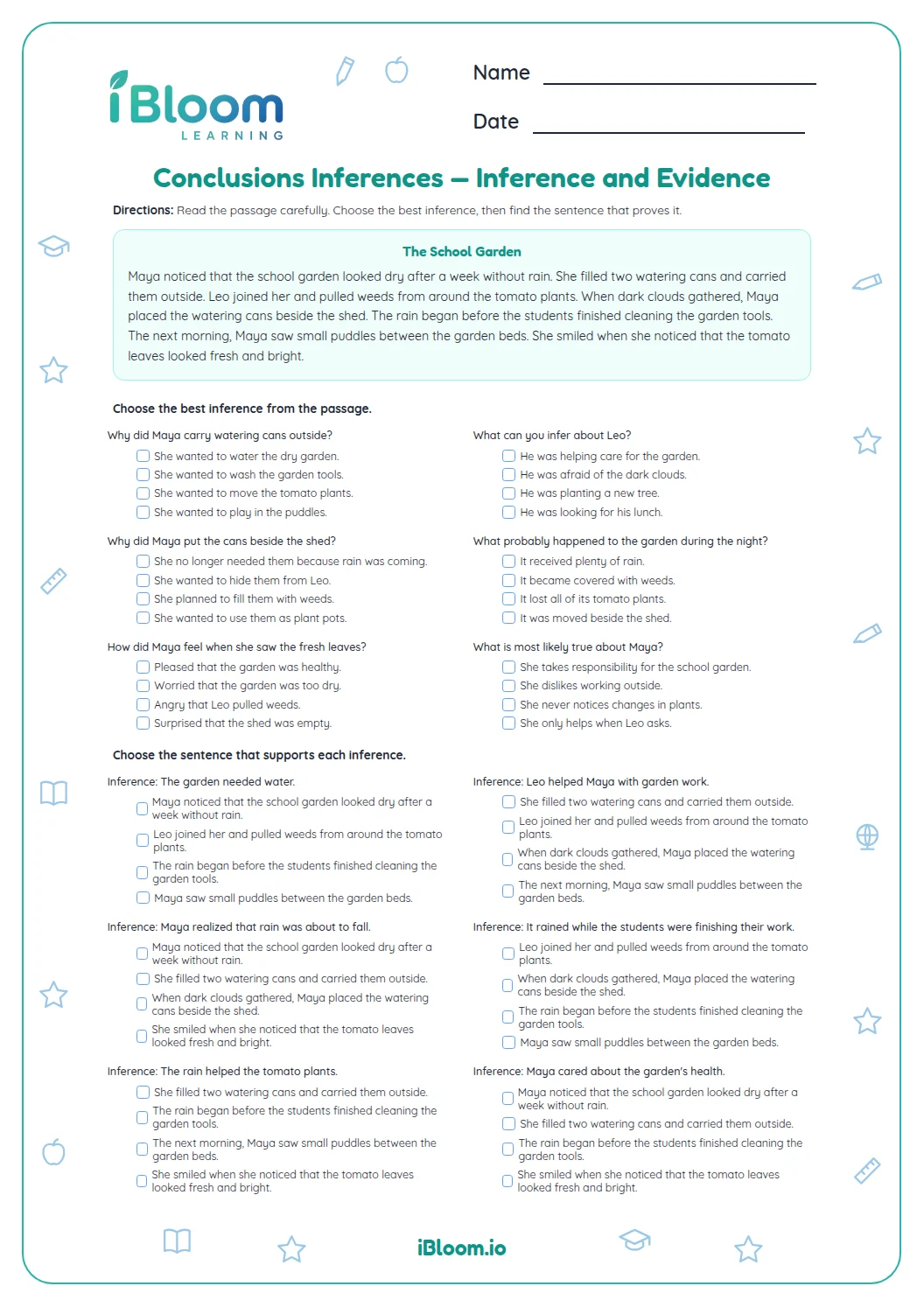
This free Grade 5 printable pairs an original informational passage, “A Cooler Schoolyard,” with 14 questions about main idea, key details, author’s purpose, and summary. Students use the council’s observations and choices as evidence, then consider what belongs in a concise summary. A separate answer key supports review. It practices CCSS RI.5.2.
Aligned to RI.5.2
How do details support a main idea?
A main idea brings together details from across a text. In question 1, students identify the central point: the school council studied a hot yard and planned ways to add shade.
- 15) They took measurements for a week. → evidence of investigation
Which details matter most?
Keep facts that explain the problem, response, or outcome. Question 10 shows that the project continues because the council plans to compare temperatures next year.
- 1Question 5: The students measured temperatures for one week; this detail shows they investigated the problem.
What belongs in a summary?
A summary combines the central idea with only the strongest details. Question 14 names the students’ study and their plan to cool the yard without repeating every measurement or option.
How to use this worksheet
- 1Read the passage once to understand the schoolyard problem and response.
- 2For a main-idea question, consider which choice fits the whole passage.
- 3For a detail question, return to the sentence that gives the evidence.
- 4For purpose, ask what the author is explaining to readers.
- 5For a summary, keep the central idea and important events; leave out minor details.
Common mistakes and quick fixes
The mistake
Choosing one interesting fact as the main idea.
The fix
Ask what several details in the passage have in common.
The mistake
Repeating a detail without explaining its connection.
The fix
Name the main idea first, then say how the fact supports it.
The mistake
Including every event in a summary.
The fix
Keep the problem, the response, and the central outcome.
Common Core alignment
This worksheet practices the following grade-level skill.
Connect the passage’s main idea to details that support it.
On this sheet: Connect the passage’s main idea to details that support it.
Show the official wordingHide the official wording
Determine two or more main ideas of a text and explain how they are supported by key details; summarize the text.
What to practice next
Make more practice
Further reading
Questions parents and teachers ask
What is the main idea of “A Cooler Schoolyard”?
The passage explains how a student council studied an overheated schoolyard and chose ways to add shade. Temperature checks, crowded shade, and the mix of trees and shade sails support that central idea. Question 1 asks students to identify it.
How many details should support a main idea?
Use the details that best explain the central point, rather than collecting every fact. This worksheet asks students to identify several details, including the week of temperature checks and the shade needed during lunch. Each one should connect to the council’s investigation.
What is the difference between a main idea and a detail?
The main idea is the broad point developed across a passage; a detail is one specific fact or event. The temperature readings are details. The council’s effort to understand and improve the yard is the larger idea they support. A detail is specific; a main idea links several details together.
How should a student write a summary?
State the central idea and include only the most important supporting events. Question 14 summarizes the students’ study and shade plan. A short summary can leave out a minor fact such as the school’s name. The passage gives enough evidence to state both the problem and the school’s response.
Why does the passage mention trees and shade sails?
The choices show how the school balanced a long-term plan with a need for shade right away. Trees could eventually provide shade and bird homes, while shade sails covered more of the yard as the trees grew. This contrast explains the final plan.