


About this worksheet
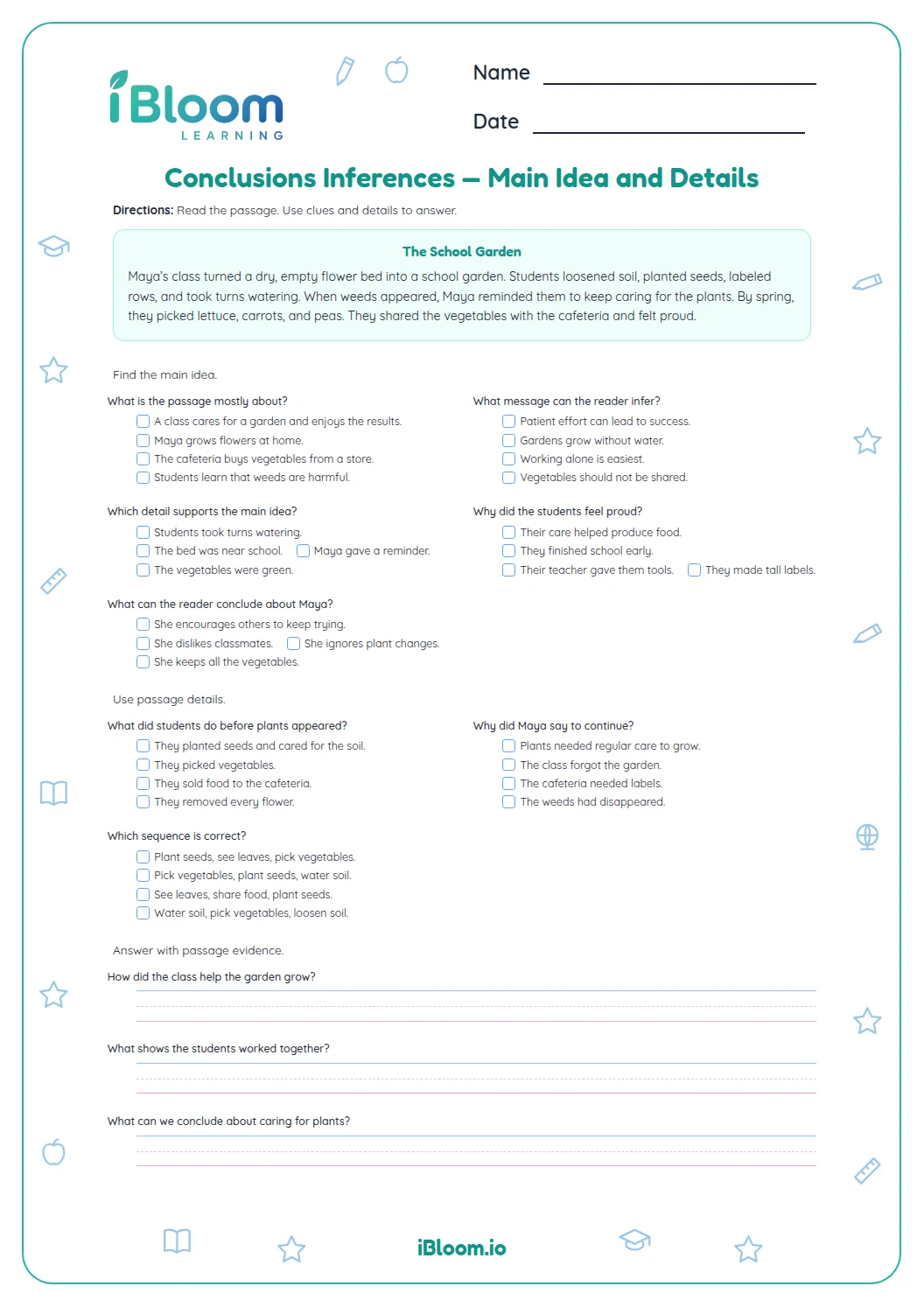
This Grade 5 reading comprehension worksheet uses an original passage about students who turn an unused school roof into a garden. Students identify the main idea, distinguish it from supporting details, infer word meaning from context, and write a summary using evidence. Fifteen questions follow the passage, with a separate answer key and a sample written summary.
Aligned to 5.RI.2
How can a reader find the main idea?
Ask what the whole passage is mostly explaining. A main idea is broad enough to connect several details. It is not just one interesting fact or a personal opinion.
- 1The passage describes a roof garden from its planning through its results.
- 2Main idea: Students turned an unused roof into a useful garden.
Which details support an answer?
Choose details that directly explain the main idea. The students planted vegetables and flowers, collected rainwater, and used the roof garden in several ways. A detail should come from the passage and help explain the larger idea.
What belongs in a summary?
A summary names the main idea and includes only the most important details. Leave out small facts that do not help explain the passage. Use your own words while keeping the author’s meaning. Question 12 gives students practice combining the roof-garden idea with key evidence.
How to use this worksheet
- 1Read the passage once to learn its topic.
- 2Reread and mark details that explain the roof garden’s purpose.
- 3State the main idea in one sentence.
- 4Choose two or three details that support that idea.
- 5Write a concise summary in your own words and check it against the passage.
Common mistakes and quick fixes
The mistake
Using one detail as the main idea.
The fix
Ask whether the answer covers the whole passage.
The mistake
Adding an opinion not stated by the text.
The fix
Point to the words or events that support the answer.
The mistake
Listing every event in a summary.
The fix
Keep only details that explain the main idea.
Common Core alignment
Students determine a nonfiction main idea, connect it to supporting details, and summarize.
Determine a nonfiction text’s main idea and explain how details support it.
On this sheet: Determine a nonfiction text’s main idea and explain how details support it.
Show the official wordingHide the official wording
Determine two or more main ideas of a text and explain how they are supported by key details; summarize the text.
What to practice next
Make more practice
Further reading
Questions parents and teachers ask
What does the main idea worksheet include?
Students read an original passage about a fifth-grade roof garden and answer 15 questions about its main idea, key details, vocabulary, and summary. Question 12 asks for a written summary. The separate four-page answer key provides expected answers and sample responses.
How can a student find the main idea?
Ask what idea connects the passage as a whole, rather than choosing one detail such as the rain barrel or the flowers. In this passage, students build a garden that serves the school in several ways. The questions then ask which details support that larger idea.
How long will the passage and questions take?
About 30 minutes allows time to read the three-paragraph passage, answer the selected-response questions, and write responses using details. A student can mark useful evidence during the first read and return to those sentences when explaining the main idea or writing a summary.
Can this worksheet be completed independently?
Yes. The questions refer to details in the passage, and the key includes sample language for responses that can vary. Students should check that their main idea covers more than one event and that each detail they use actually appears in the roof-garden passage.
What if a response is only one detail?
Ask the student to reread the passage and notice what several details have in common. The planting boxes, rain barrel, care schedule, and harvest all connect to the larger roof-garden project. A main idea should cover that shared point; a single detail can support it.
Is there an answer key for written responses?
Yes. The separate key lists the expected answers and gives sample wording for the summary and main-idea responses. Other wording is acceptable when it accurately states the passage’s idea and uses relevant details. The worksheet has four printed pages, with a matching four-page key.