
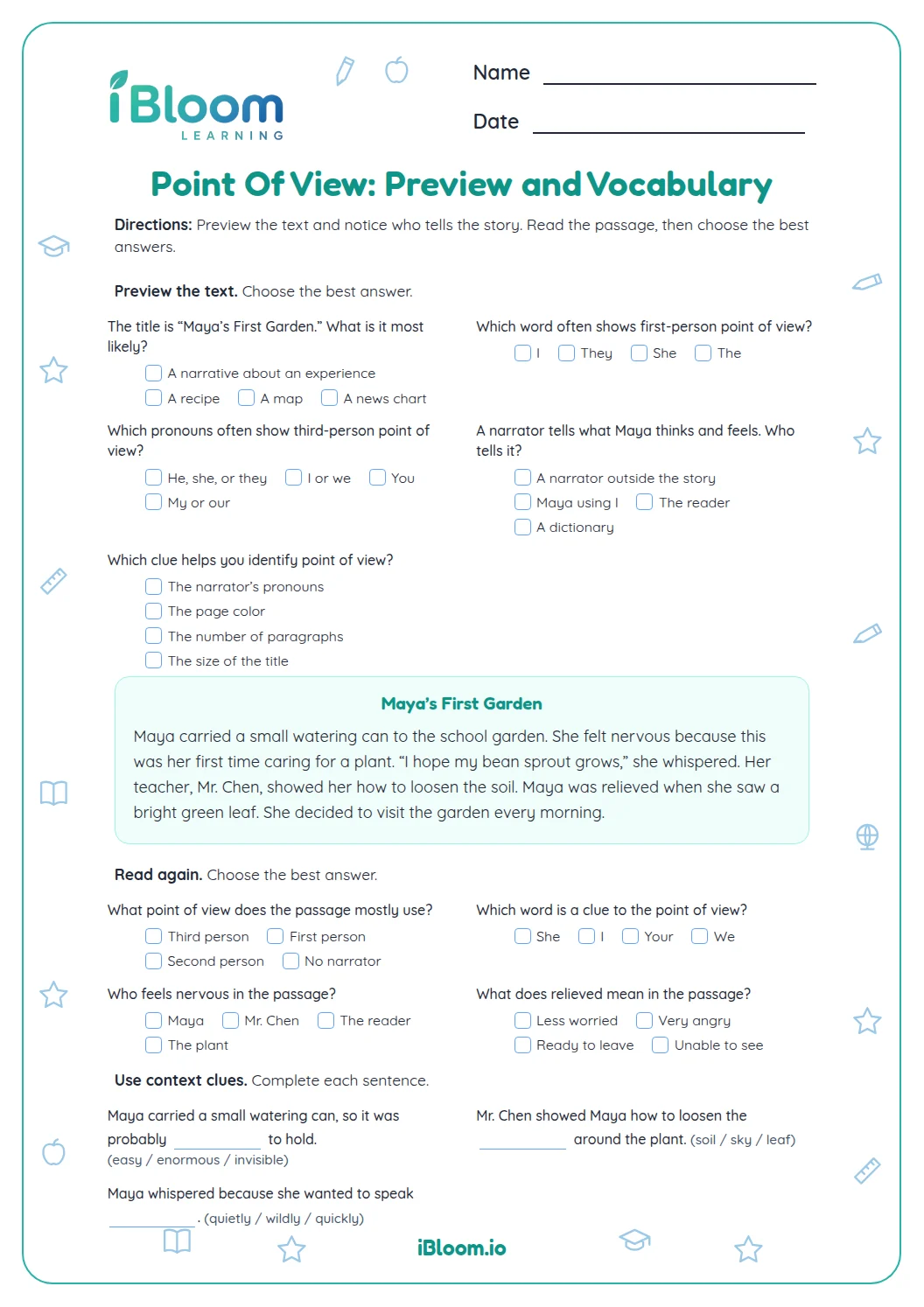
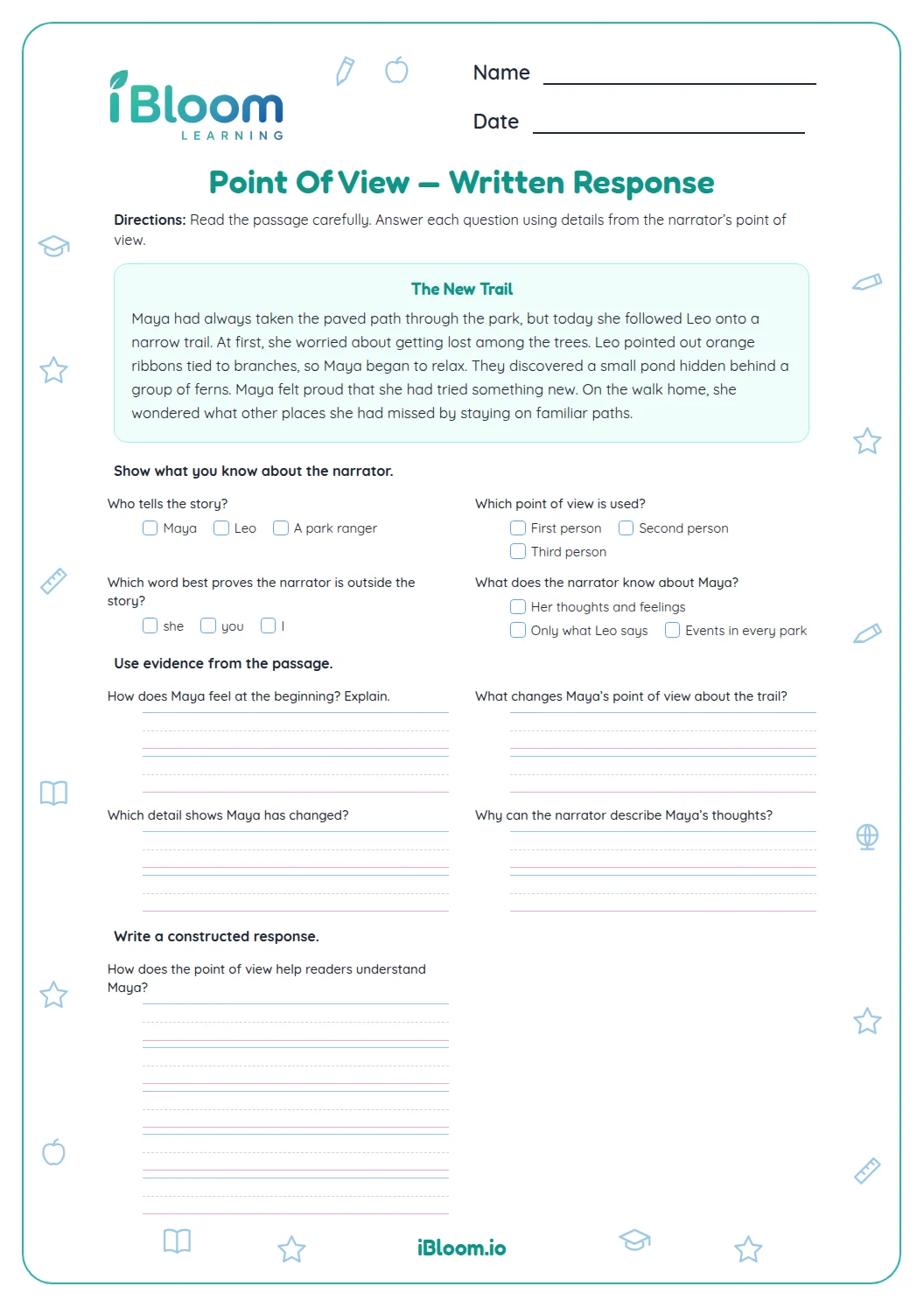
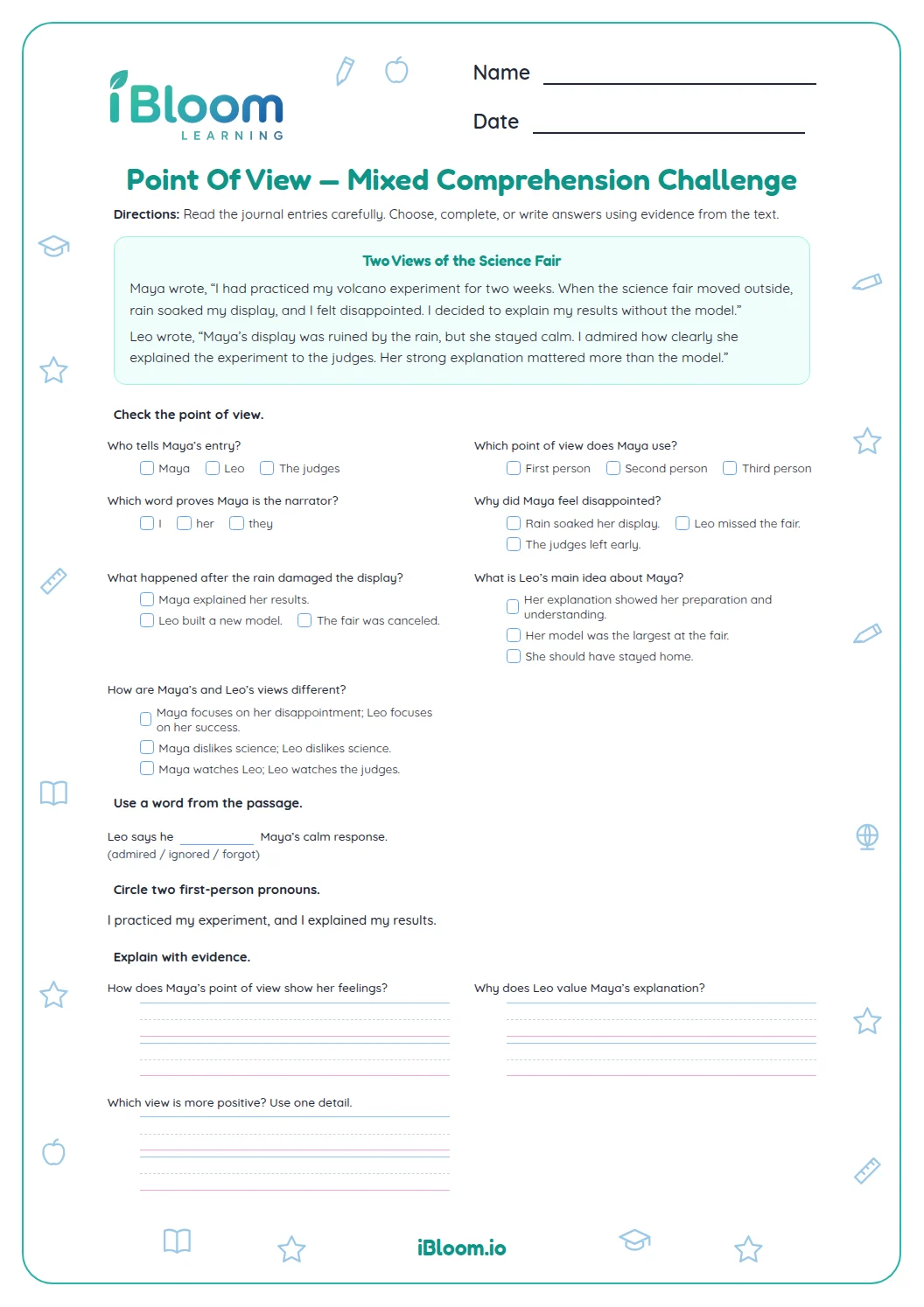
About this worksheet
This free printable Grade 5 worksheet gives students focused practice with point of view and main idea. It includes 16 questions that move from recognition to application, with clear directions and a separate answer key. The page aligns with RI.5.2: Identify the passage’s main idea and select details that support it.
Aligned to RI.5.1
What will learners practice?
The worksheet has 16 questions arranged in increasingly demanding parts. Each part focuses on a distinct way to use point of view and main idea.
For example, question 1 asks: “{qs[0]["prompt"]}” The answer key gives a concise check for every item.
- Part A builds recognition of point of view and main idea.
- Later parts ask learners to apply the idea and explain a choice.
How can students work through point of view and main idea?
Read the complete prompt first, then look for the detail that signals point of view and main idea. Reread the sentence or model before choosing an answer.
How should families review the answers?
Part D asks students to answer in their own words and quote accurate evidence. “Rain sank into the garden instead of crossing the path” supports the idea that the garden helped manage rain.
How to use this worksheet
- 1Read the directions and name the skill in your own words.
- 2Complete Part A carefully, checking each prompt before answering.
- 3Move through the later parts in order and use evidence from the item.
- 4Quote a passage detail that supports each evidence-based answer.
- 5Choose one response and explain how you reached it.
Common mistakes and quick fixes
The mistake
Answering before rereading the full item.
The fix
Read the whole sentence or model again, then point to the clue that supports the answer.
The mistake
Choosing an answer because it looks familiar.
The fix
Check that the choice fits the exact meaning and wording in the prompt.
The mistake
Skipping a check after finishing.
The fix
Use the key to review every response and explain any correction.
Curriculum alignment
Students quote passage details when explaining the narrator’s perspective and the rain garden’s effect.
Quote accurate passage details to explain the narrator’s view and the garden’s effect.
On this sheet: Questions 11–14 ask students to quote accurate words and details when explaining the narrator’s view and the garden’s effect.
Show the official wordingHide the official wording
Quote accurately from a text when explaining what the text says explicitly and when drawing inferences from the text.
What to practice next
Make more practice
Questions parents and teachers ask
What point of view does the passage use?
The passage uses first-person point of view. The narrator describes the class project with words such as “I,” “our,” and “we,” which show a personal account. Questions 11–14 ask learners to quote evidence from the text. Have the learner point to the clue in the worksheet and explain the choice.
What is the main idea?
A class creates a rain garden that catches roof water and helps rain soak into the soil. Details about planting and water sinking into the garden support this central idea. Students can distinguish those key points from smaller facts. Have the learner point to the clue in the worksheet and explain the choice.
How many questions are included?
There are 14 questions in four question parts, with a separate three-page answer key after the three-page worksheet. The questions cover viewpoint, main idea, supporting details, and written evidence from the passage. Have the learner point to the clue in the worksheet and explain the choice.
How does the narrator’s perspective change?
At first, the narrator imagines a muddy hole that will be difficult to care for and wonders whether the class can help. After seeing rain sink into the garden, the narrator feels proud. Students quote the passage to support this answer.
What detail best shows the garden helped?
The passage says rain sank into the garden instead of crossing the path. That result supports the idea that the garden helped manage rainwater. Students can copy the sentence as evidence and explain how it supports the idea. Have the learner point to the clue in the worksheet and explain the choice.