




About this worksheet
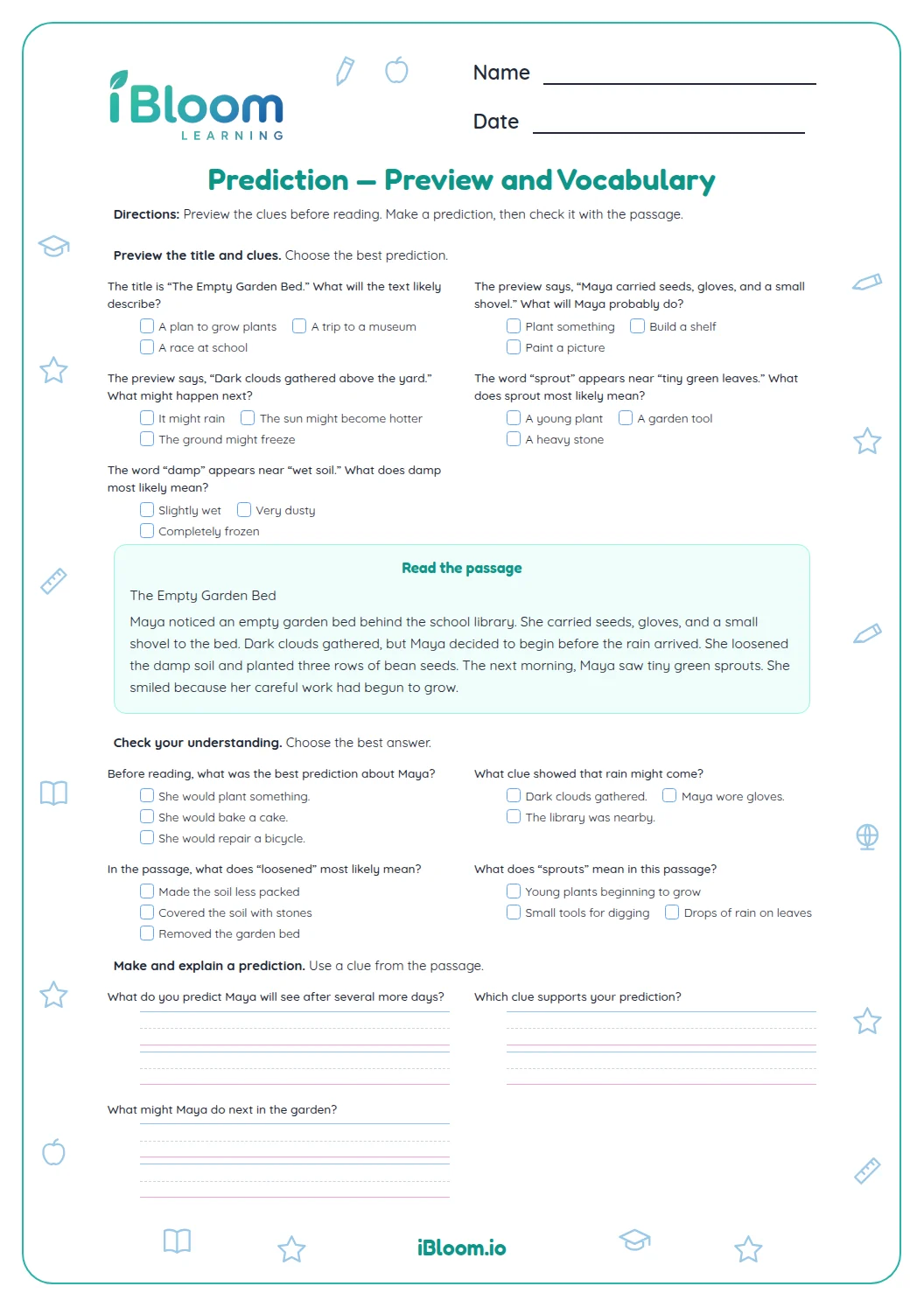
This free Grade 5 reading worksheet builds prediction skills through an original story about Maya and Eli solving a problem in a school garden. Children answer 14 questions: three multiple-choice predictions, nine fill-in prompts about passage clues, and two written responses that ask them to explain what may happen next with story details. A separate answer key includes model responses for the open-ended predictions. It practices Common Core RL.5.1.
Aligned to RL.5.1
How do readers make a supported prediction?
Readers combine story details with what those details suggest. A prediction is about a likely next event, while evidence is the passage detail that makes it reasonable.
For question 1, Eli goes to ask the caretaker about two stakes after the board tips. That clue supports predicting they will attach the sign more securely.
- 1Clue: The wind tipped the board.
- 2Clue: Eli went to ask for garden stakes.
- 3Prediction: They will use the stakes to secure the sign.
Which passage details support an answer?
Part C asks children to complete statements with details the story states directly. In Part D, use one or two details to explain a prediction. A brief quotation or accurate paraphrase connects the evidence to the idea.
What makes a written prediction complete?
Part D asks readers to name what may happen next and connect it to evidence. The answer key offers samples, but another possibility can work when the story supports it.
How to use this worksheet
- 1Read the passage once to understand the problem.
- 2Reread the final paragraph and mark details that suggest what may happen next.
- 3For multiple choice, eliminate outcomes the passage does not support.
- 4Complete the evidence blanks with a precise event or detail from the story.
- 5For the two written predictions, state the outcome and explain the clue behind it.
- 6Check the key, accepting other evidence-based responses.
Common mistakes and quick fixes
The mistake
Making a prediction from personal preference alone.
The fix
Find a passage event that makes the outcome likely.
The mistake
Repeating the question without explaining evidence.
The fix
Add a story detail that supports the prediction.
The mistake
Treating a possible event as certain.
The fix
Use words such as may or likely when the story has not confirmed it.
Common Core alignment
This worksheet asks readers to explain ideas with details from a story.
Support predictions and explanations with accurate text details.
On this sheet: Children use details from a story to explain likely next events and character choices.
Show the official wordingHide the official wording
Quote accurately from a text when explaining what the text says explicitly and when drawing inferences from the text.
What to practice next
Make more practice
Further reading
Questions parents and teachers ask
What does prediction mean in this worksheet?
A prediction is a reasonable idea about what may happen next, based on clues already in the story. Children choose likely outcomes, point to evidence, and write predictions that connect details such as the tipping board and Eli’s request for stakes.
Does the answer have to match the sample exactly?
No. The answer key gives model responses for the four written questions. Accept another prediction when it fits the passage and the child names relevant evidence. The story leaves the next step open, so children use clues to choose a plausible outcome rather than recall a stated ending.
How many questions are included?
There are 14 questions after the passage: three multiple-choice predictions, nine fill-in clue prompts, and two written responses. The answer key includes a model for each open-ended item. Readers can check the board, puddle, rain, and stakes details directly in the passage.
How can I help without giving away the answer?
Ask your child to find a sentence that matters, then ask what that detail makes likely. The fill-in prompts focus attention on key clues before the two written predictions. This keeps the reasoning tied to events in the story. The answer key also accepts other plausible evidence.
Why does the worksheet ask for evidence?
Children can point to the board tipping, the visitors following the sign, or Eli seeking stakes as relevant clues. The final two questions ask them to connect those details to a likely next step, using evidence from the passage. The key shows two sample answers.
Can children give different predictions?
Yes. A prediction can vary from the model if it makes sense with the story and uses an accurate detail as support. The key gives sample responses for the two written questions, and the other answers are stated in the passage.