




About this worksheet
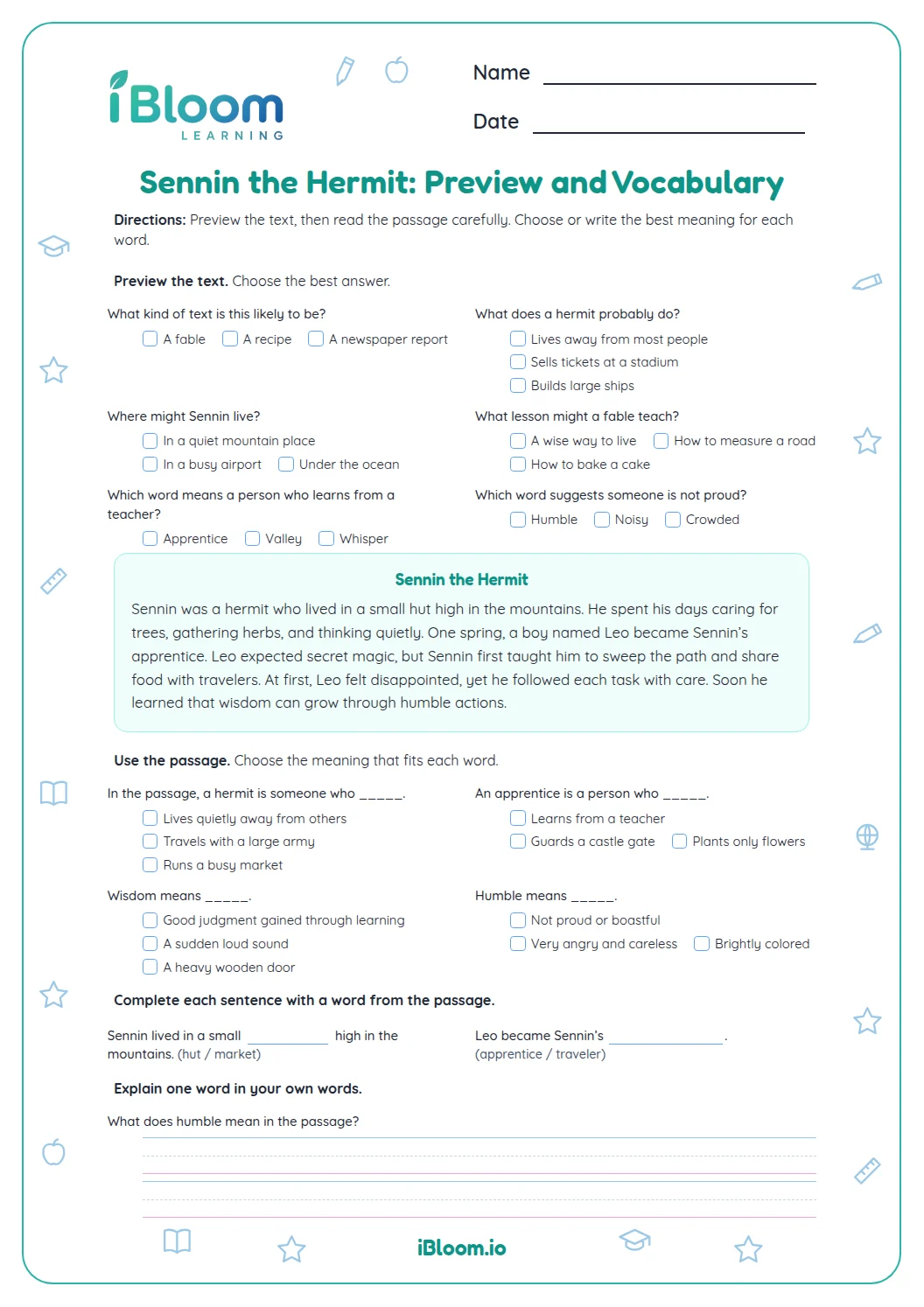
This Grade 5 printable pairs the Sennin fable with 14 mixed comprehension questions. Children locate details, track sequence, infer a word’s meaning, and explain an idea with evidence. It practices CCSS RL.5.1 and includes a separate answer key. The passage follows a traveler who receives Sennin’s blanket and meal, then returns to help Sennin and the villagers.
Aligned to RL.5.1
Which details can readers find directly?
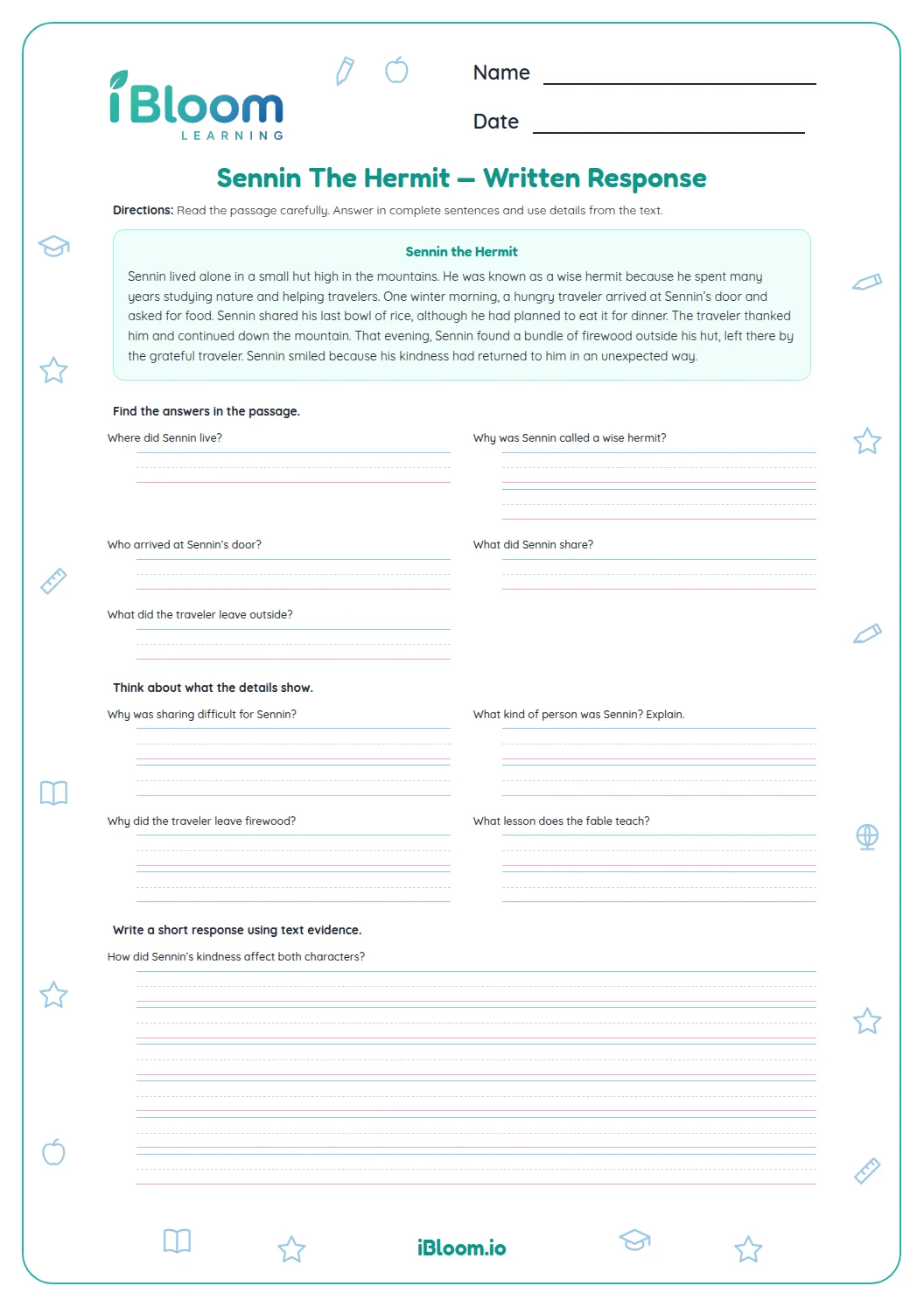
Questions 1–4 and 14 ask readers to locate details about Sennin and the traveler. Question 13 asks students to quote “simple meal,” the passage’s words for the food Sennin shared.
How can readers track what happened first?
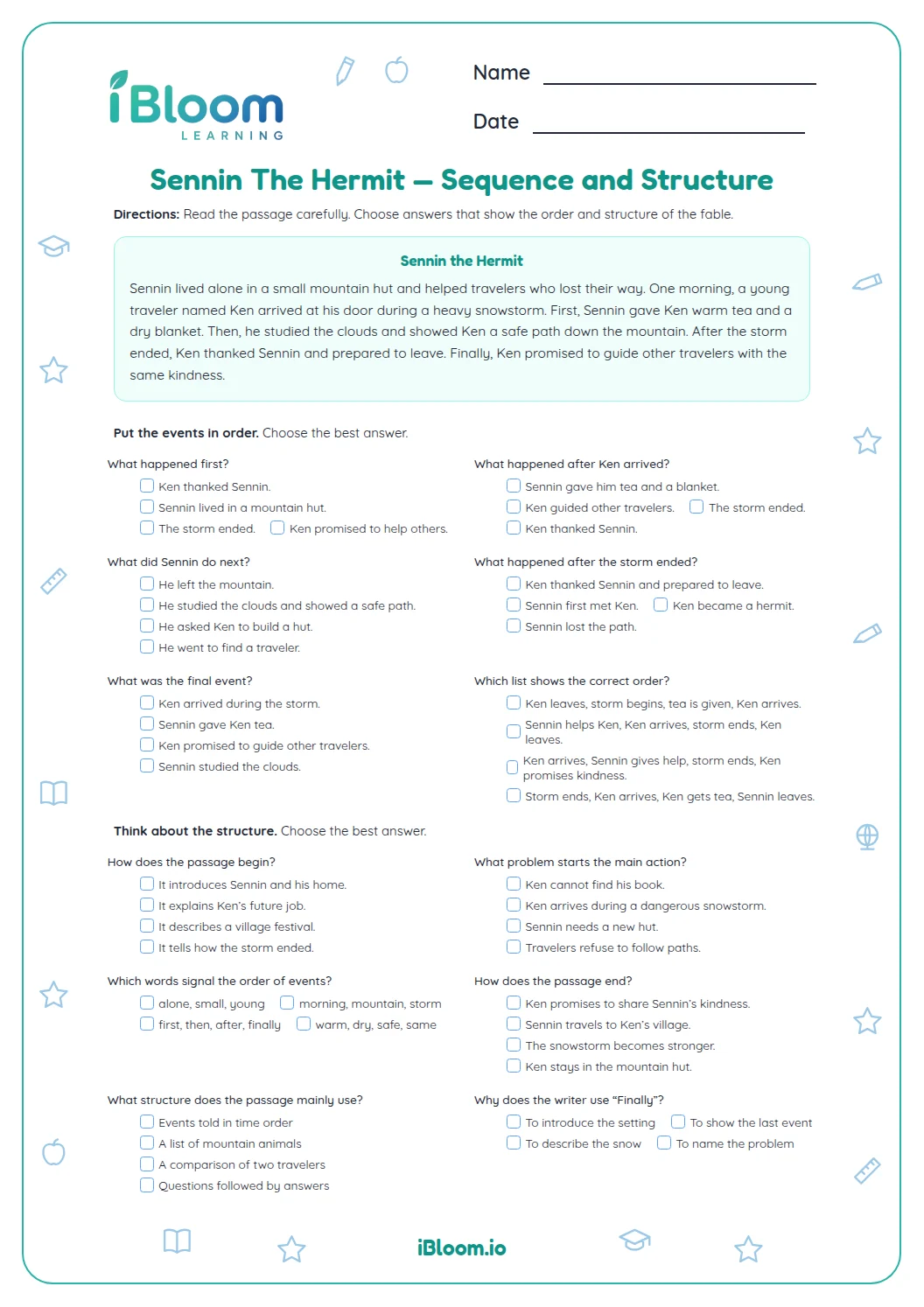
Follow the story in time order. Question 5 asks readers to place three events: Sennin shares food first, the traveler returns with supplies, and villagers then help one another.
How can one detail support an inference?
Questions 9–12 test how readers connect the traveler’s actions and Sennin’s words with the community’s change. The choices distinguish interpretations supported by the passage from ideas it does not support.
How to use this worksheet
- 1Read once to understand who is traveling and why.
- 2Reread the sentence around a question before answering.
- 3For sequence, mark the events in the order they happen.
- 4For an inference, name a clue and explain what it suggests.
- 5For a why or how question, identify the story detail that supports your choice.
Common mistakes and quick fixes
The mistake
Using a guess instead of a passage detail.
The fix
Find the sentence that gives the clue, then connect it to the answer.
The mistake
Mixing up the order of events.
The fix
Retell the story with first, next, and last before choosing.
The mistake
Giving an inference without evidence.
The fix
Add one action or line from the passage that supports the idea.
Common Core alignment
This worksheet gives focused practice with the reading and math skills described below.
Use details from a story to explain explicit ideas and inferences.
On this sheet: Use details from a story to explain explicit ideas and inferences.
Show the official wordingHide the official wording
Quote accurately from a text when explaining what the text says explicitly and when drawing inferences from the text.
What to practice next
Further reading
Questions parents and teachers ask
What does this Sennin the Hermit: Grade 5 Comprehension Worksheet worksheet practice?
It pairs focused reading comprehension practice with a short story written for this page. Children can reread the passage, point to a detail, and use that detail to support each answer in their own words. The questions move from direct details to explaining ideas.
Can a student use the passage while answering?
Yes. The passage stays available on the worksheet, so students can return to it as they work. Rereading a sentence or paragraph can help them check a detail before choosing an answer or explaining an idea. They can underline a clue before responding.
What is included in the answer key?
The key gives an answer for every question. For responses that can be phrased in different ways, it provides a sample; students may use other wording when it is accurate and supported by the passage. An adult can accept another clear answer with evidence.
How can an adult use the written responses?
Ask the student to point to the sentence or event that supports the response. A short oral explanation can help them connect the evidence to the idea before they write or select their final answer. This makes the reasoning visible without requiring a long response.
How long should the worksheet take?
Plan for about 20 minutes, with extra time if the student rereads the story or discusses an answer. The pace depends on reading fluency and how much explanation each response needs. Students can complete the questions independently or talk through selected items with an adult.