


About this worksheet
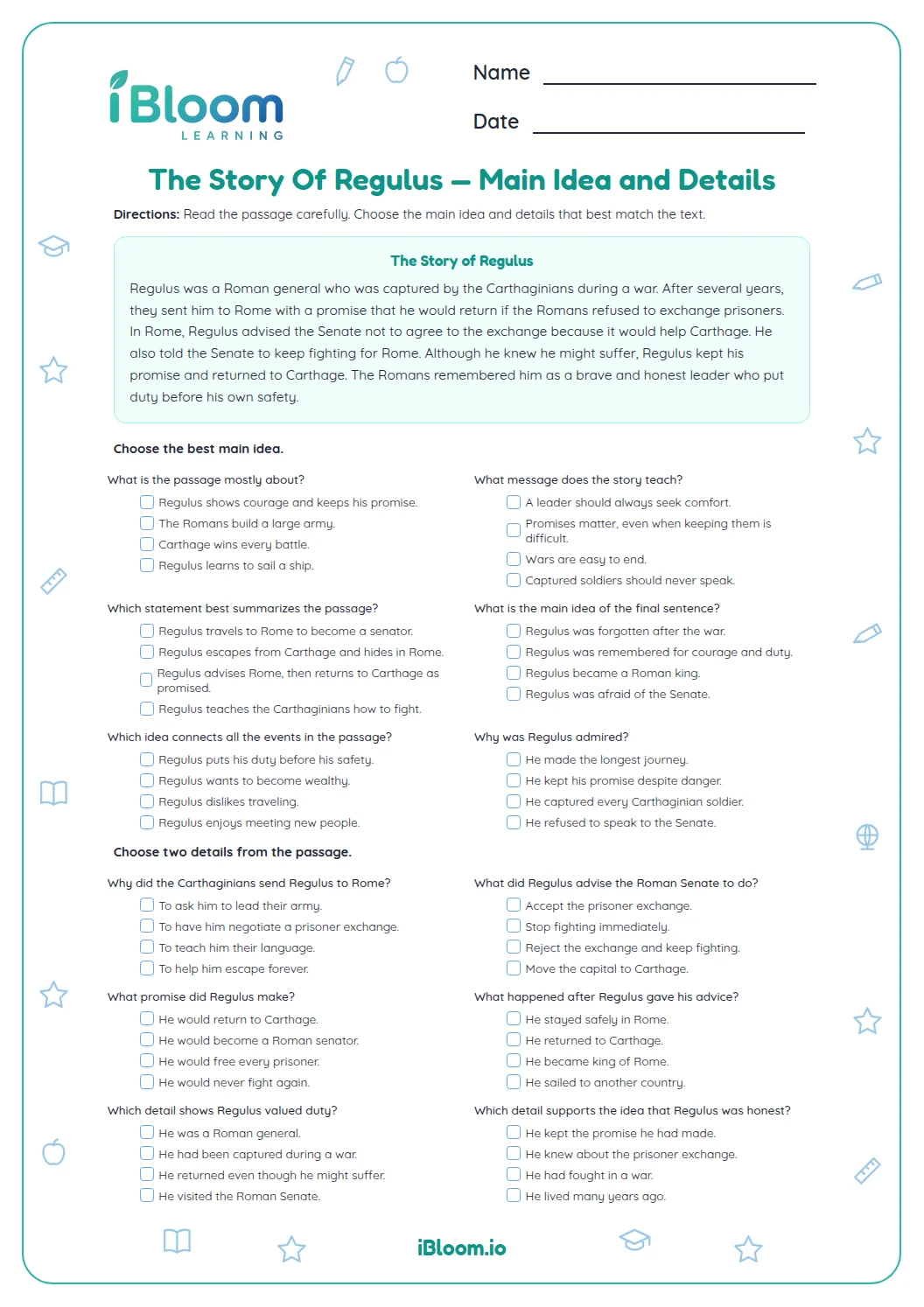
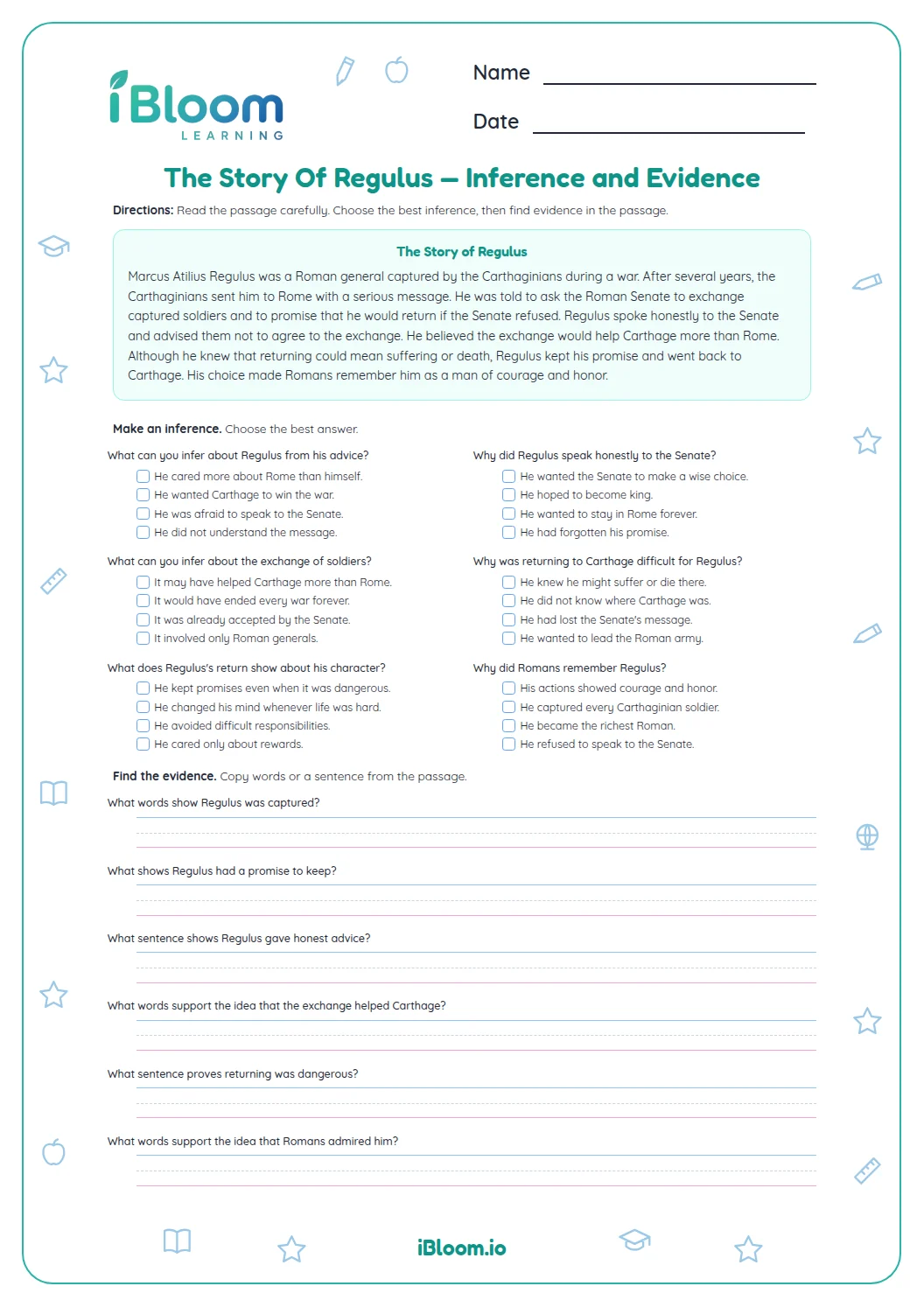
This Grade 5 reading page introduces the tale of Regulus with an original passage about his promise to return to Carthage. Learners work out vocabulary from context, recall key events, make inferences, and support a response with evidence. The answer key includes sample responses for open-ended questions. It practices RL.5.1 and L.5.4.A.
Aligned to CCSS.ELA-LITERACY.RL.5.1 and CCSS.ELA-LITERACY.L.5.4.A
How to use context clues
A context clue is a nearby word, action, or explanation that helps readers infer a word’s meaning. For “proposal,” the passage explains that the Romans could exchange prisoners and then decide whether to do so. That context points to an offer or plan for consideration.
Readers should test a possible meaning in the sentence. If the sentence still makes sense with that meaning, the clue is likely strong.
- 1The Senate followed his counsel and refused the proposal.
- 2“Counsel” is advice; the Senate follows it by making a decision.
Read for events and evidence
The passage moves from Regulus’s capture, to his mission to Rome, to the Senate’s decision, and finally to his return. Tracking this sequence helps answer questions about cause and effect.
For an inference, combine a detail with what it suggests. His family wanted him to stay, yet he returned after promising to do so. This supports the inference that he valued keeping his word.
How to use this worksheet
- 1Read the passage once for the main events.
- 2Read it again and underline the words around “proposal,” “counsel,” and “disappointed.”
- 3For detail questions, point to the sentence that gives the answer.
- 4For the last questions, state an idea and connect it to one passage detail.
- 5Use the answer key to compare reasoning; written responses can vary.
Common mistakes and quick fixes
The mistake
Choosing a familiar dictionary meaning without checking the sentence.
The fix
Try the choice in the sentence and check whether nearby events support it.
The mistake
Giving an inference with no passage detail.
The fix
Name one action or statement from the text, then explain what it suggests.
The mistake
Choosing a word meaning that does not fit the sentence.
The fix
Reread the sentence and nearby details, then test the meaning in context.
Curriculum alignment
This worksheet focuses on the skill named in its title. The standard below describes the work children practice.
Quote accurately from a text when explaining what it says and when drawing inferences.
On this sheet: Learners answer literal and inferential questions and use details from the passage to support responses.
Show the official wordingHide the official wording
Quote accurately from a text when explaining what the text says explicitly and when drawing inferences from the text.
Use context as a clue to word meaning.
On this sheet: The opening questions ask students to infer the meanings of words from how they are used in the passage.
Show the official wordingHide the official wording
Use context (e.g., cause/effect relationships and comparisons in text) as a clue to the meaning of a word or phrase.
What to practice next
Make more practice
Questions parents and teachers ask
Who was Regulus?
He was a Roman commander captured during a war with Carthage. The passage is an original Grade 5 retelling written for this activity. Its context supplies clues for the word choices, so learners can return to the text as evidence.
What does “proposal” mean in this passage?
It is a plan or offer for the Romans to consider, involving an exchange of prisoners. The questions move from word meaning to events and inference. Readers should look back at the paragraph named by the question before choosing an answer.
Why does the passage describe Regulus’s return as costly?
He gave up the chance to stay safe in Rome and returned to Carthage, where he expected punishment. The passage says his family hoped he would stay safe, while he chose to return. That contrast supports an inference about what mattered to Regulus.
Are the final written responses all the same?
No. The key gives sample answers. A different response can be correct if it is clear and supported with passage evidence. The key gives sample responses for questions with more than one reasonable answer. A learner may phrase an idea differently and still support it with a passage detail.
What story details support an answer about Regulus?
The passage explains that Regulus promised to return if the exchange failed, advised the Senate, and went back to Carthage after the Senate refused. Those details support answers about his promise and choices. Students can quote or paraphrase one of them when responding to the evidence questions.