



About this worksheet
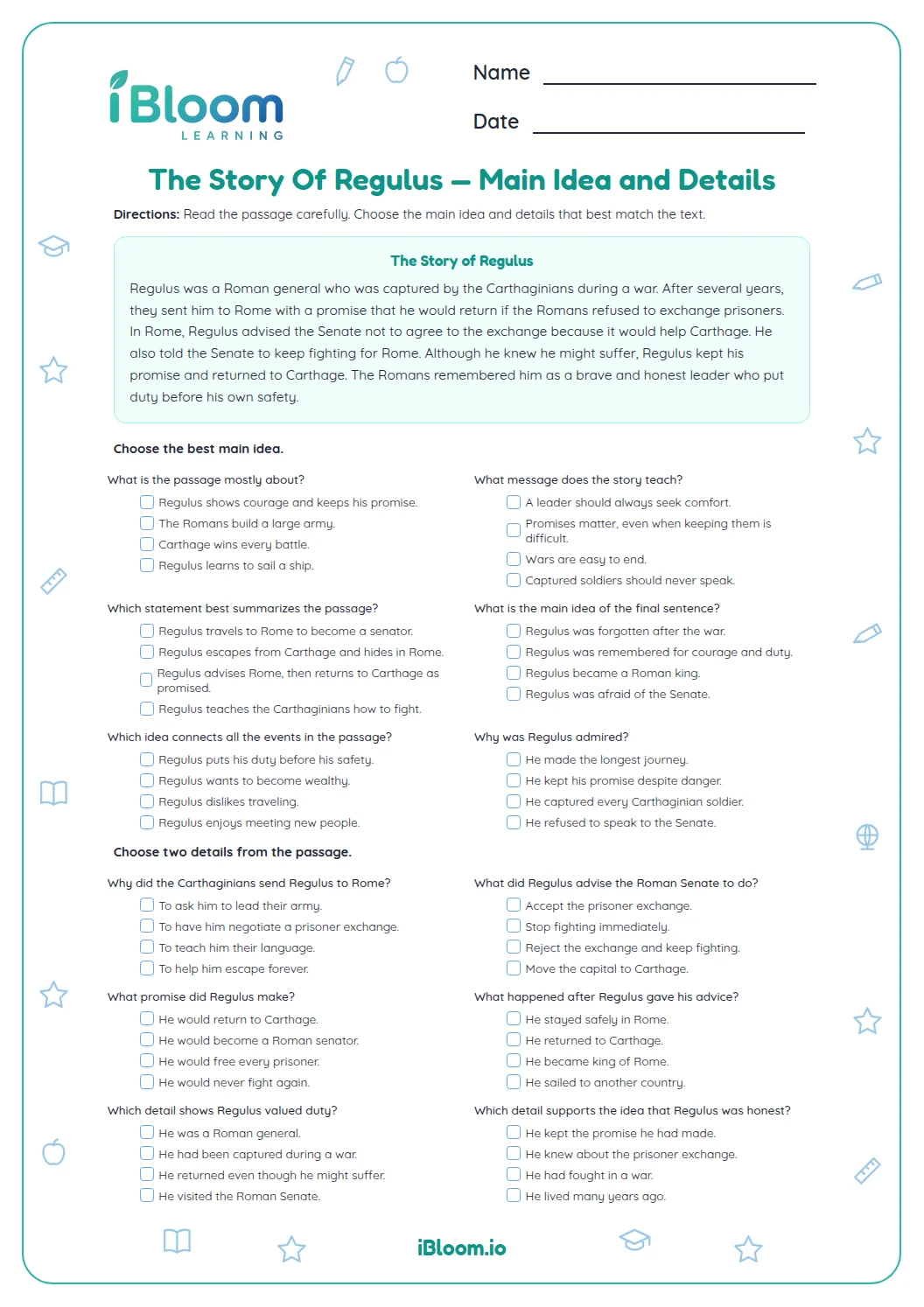
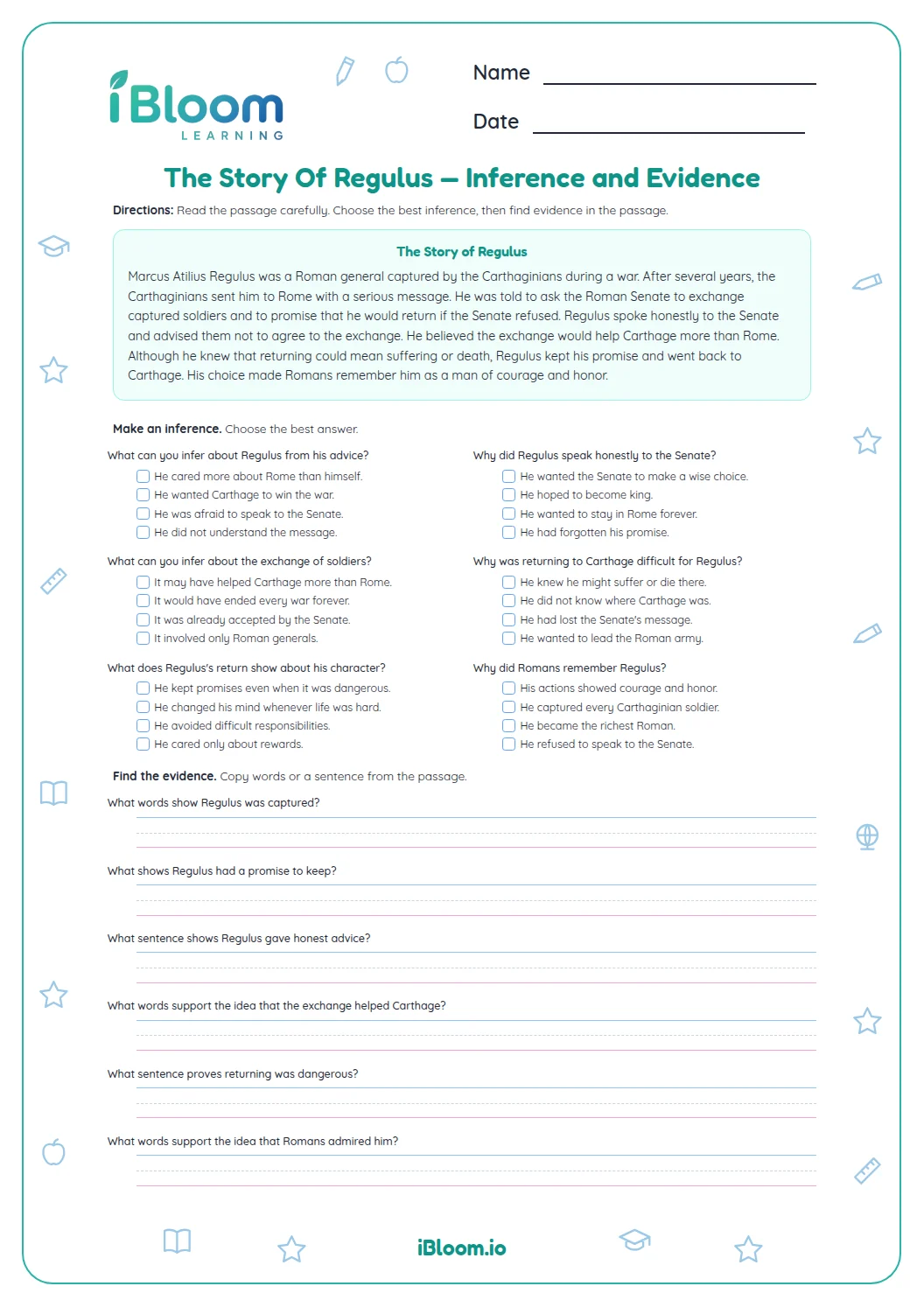
This three-page Grade 5 reading worksheet retells the traditional story of Regulus’s promise to return to Carthage. Students answer two multiple-choice questions and write eight responses about the request, Regulus’s advice, his choice, and a theme supported by story details. A separate key offers sample answers. The work practices CCSS RL.5.1 and RL.5.2 through text evidence, inference, and theme.
Aligned to RL.5.1 and RL.5.2
What happens in the story?
Regulus is sent from Carthage to ask the Roman Senate to exchange prisoners. He promises to return if the Senate refuses. He advises the senators to refuse, then keeps his promise and goes back to Carthage.
How can students support an inference?
An inference connects a character’s action to what it suggests. Regulus’s return, after he knows the Senate refused, supports the idea that he values his promise. A strong response names the action and explains what it shows.
- 1Question: What conflict did Regulus face?
- 2Evidence: He knew the Senate might refuse, which meant he would return.
- 3Response: He had to choose between protecting his freedom and keeping his promise.
How does the story support a theme?
A theme is a lesson or idea developed through events. To explain one, state the lesson and connect it to more than one detail, such as Regulus’s honest advice and his return after the refusal.
How to use this worksheet
- 1Read the passage and note the request and promise.
- 2Answer event questions with a complete thought.
- 3For an inference, name the action that supports it.
- 4State a theme as a lesson, not just a topic word.
- 5Use two story details for the final response.
- 6Compare with the key; sample wording can differ when the evidence fits.
Common slips to check
The mistake
Retelling events without answering the question.
The fix
Begin with a direct answer, then add the detail that supports it.
The mistake
Calling a topic, such as duty, a complete theme.
The fix
Write a lesson about duty, such as keeping a promise can require courage.
The mistake
Using a detail that does not support the claim.
The fix
Explain how the chosen event connects to the trait or theme you name.
Common Core alignment
Quote accurately when explaining a story or drawing an inference.
On this sheet: Students use events in the passage to explain Regulus’s choices and infer his priorities.
Show the official wordingHide the official wording
Quote accurately from a text when explaining what the text says explicitly and when drawing inferences from the text.
Determine a theme from details and character responses.
On this sheet: Students explain a theme using Regulus’s response to the challenge and supporting details.
Show the official wordingHide the official wording
Determine a theme of a story, drama, or poem from details in the text, including how characters in a story or drama respond to challenges or how the speaker in a poem reflects upon a topic; summarize the text.
What to practice next
Make more practice
Further reading
Questions parents and teachers ask
What is the story of Regulus about?
In this traditional story, Regulus promises to return to Carthage if the Roman Senate refuses a prisoner exchange. He advises the Senate to refuse, then keeps his promise and returns. The worksheet asks students to explain his actions and support a theme with details from the passage.
How many written responses are included?
There are eight written responses and two multiple-choice questions. Students explain the Carthaginian request, Regulus’s promise and advice, the choice he faced, and the story’s theme. The key gives concise sample answers that show the kind of evidence a complete response can use.
What is one theme of the Regulus story?
One theme is that keeping a promise can take courage. Regulus gives advice that may cost him his freedom, and he returns after the Senate refuses. Students can support this idea with those events or another lesson that is well supported by the passage.
Do written answers need to match the answer key word for word?
No. The key gives sample wording for responses that may be expressed in different ways. A student’s answer should still address the question and use accurate details from the passage. For the final theme response, the prompt asks for two supporting details.
How can students use evidence in a response?
A clear response gives the answer and then names a story event that supports it. For instance, to explain Regulus’s conflict, students can mention both his freedom in Rome and his promise to return if the Senate refused. The event makes the inference understandable.