

About this worksheet
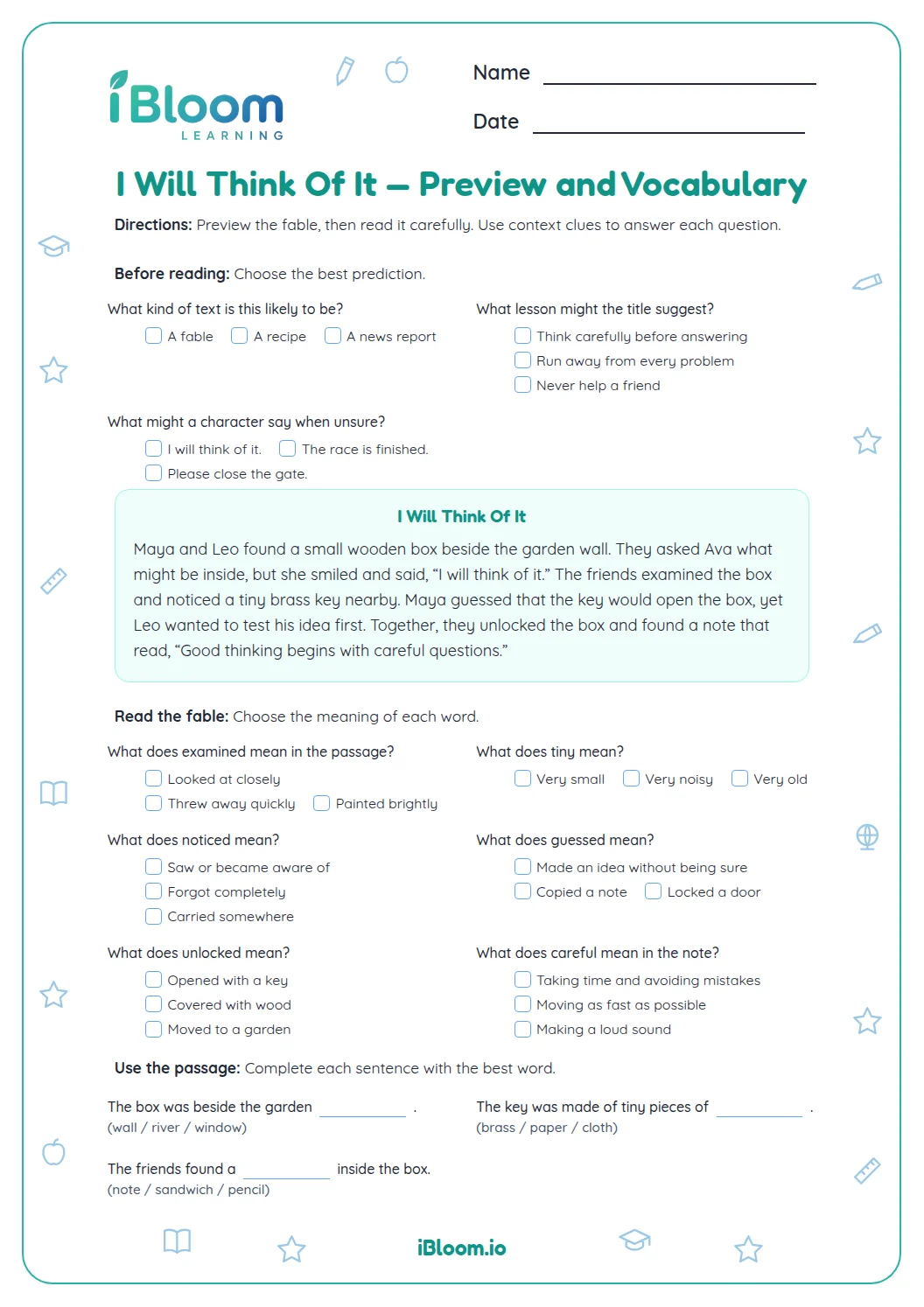
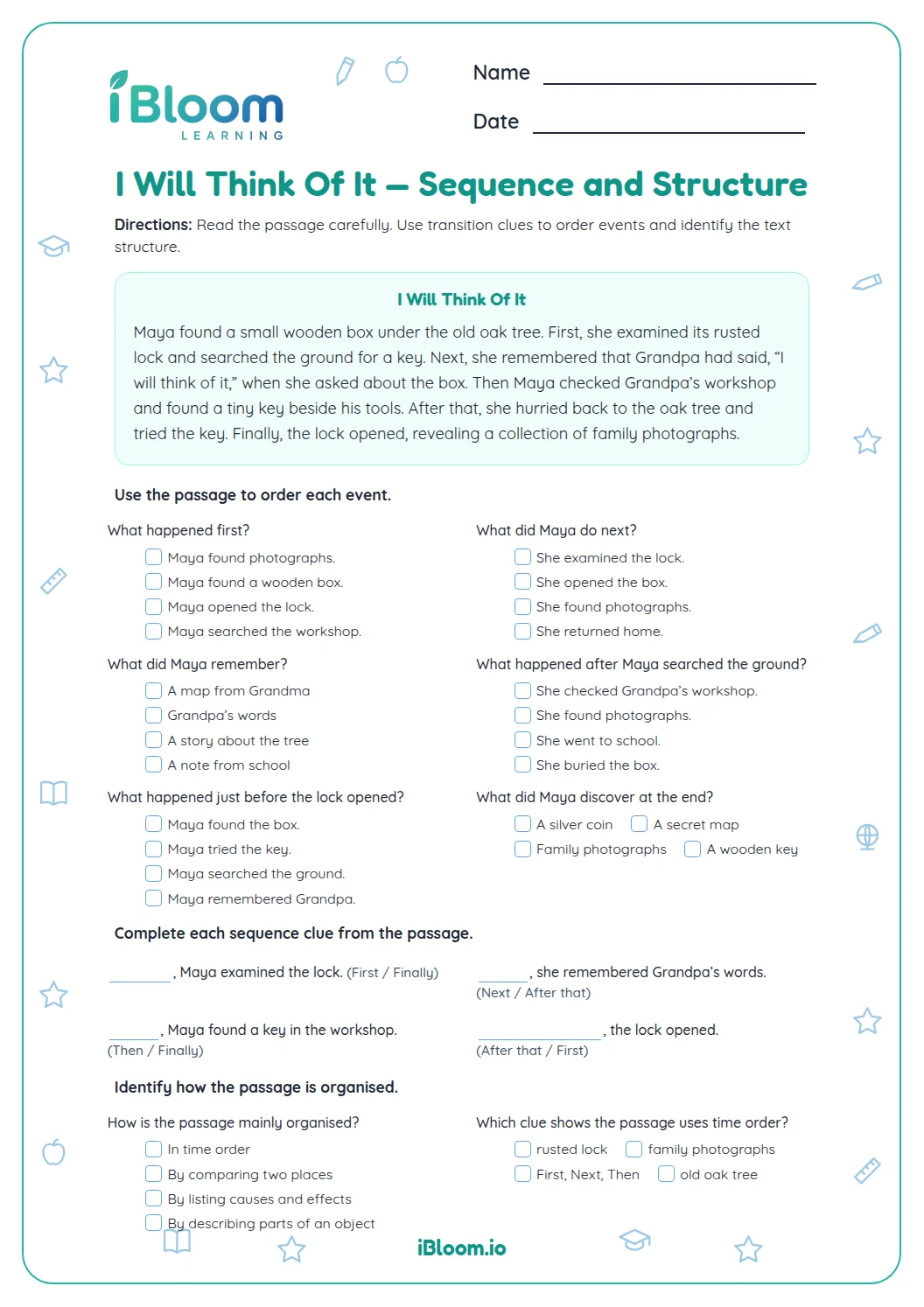
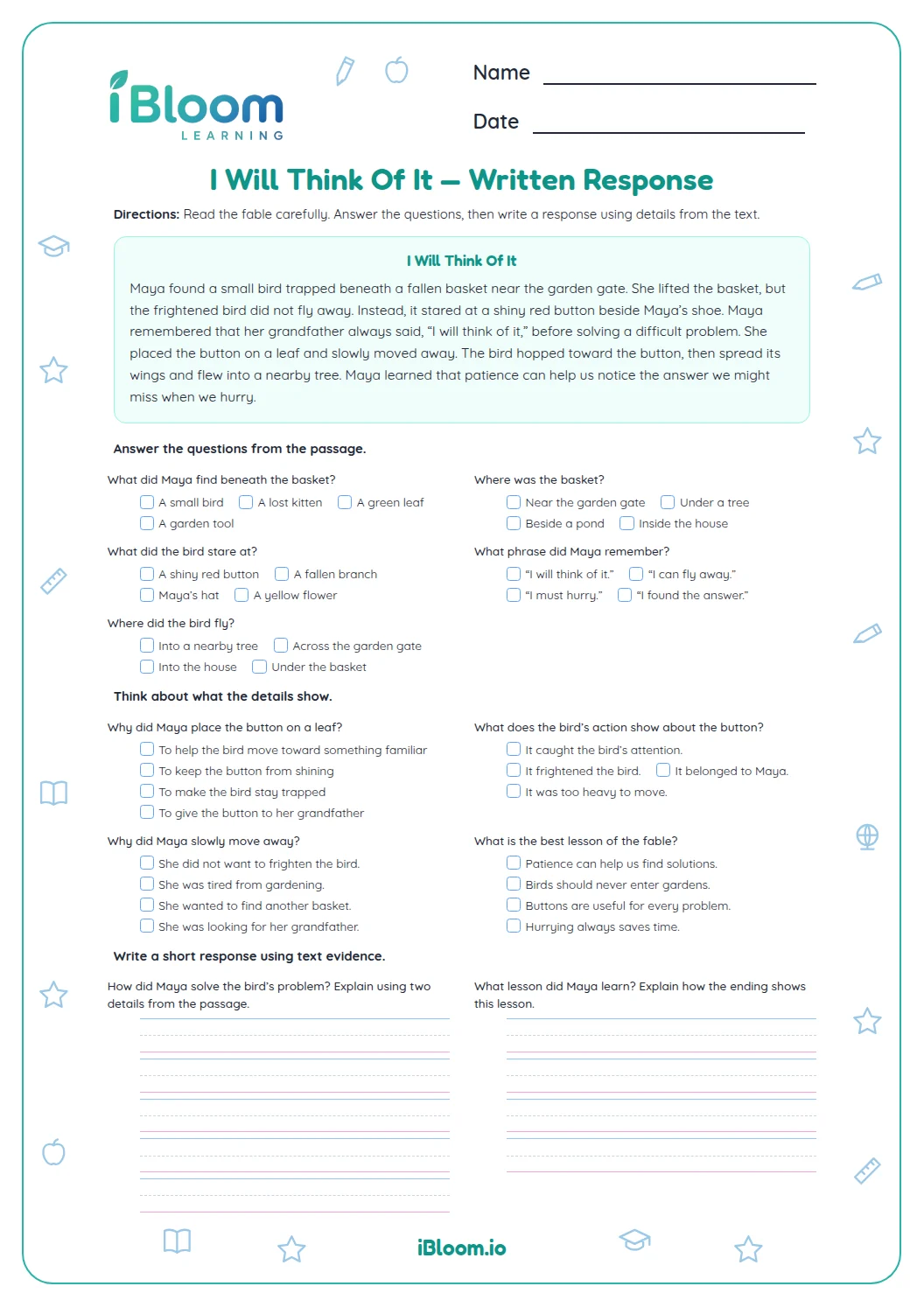
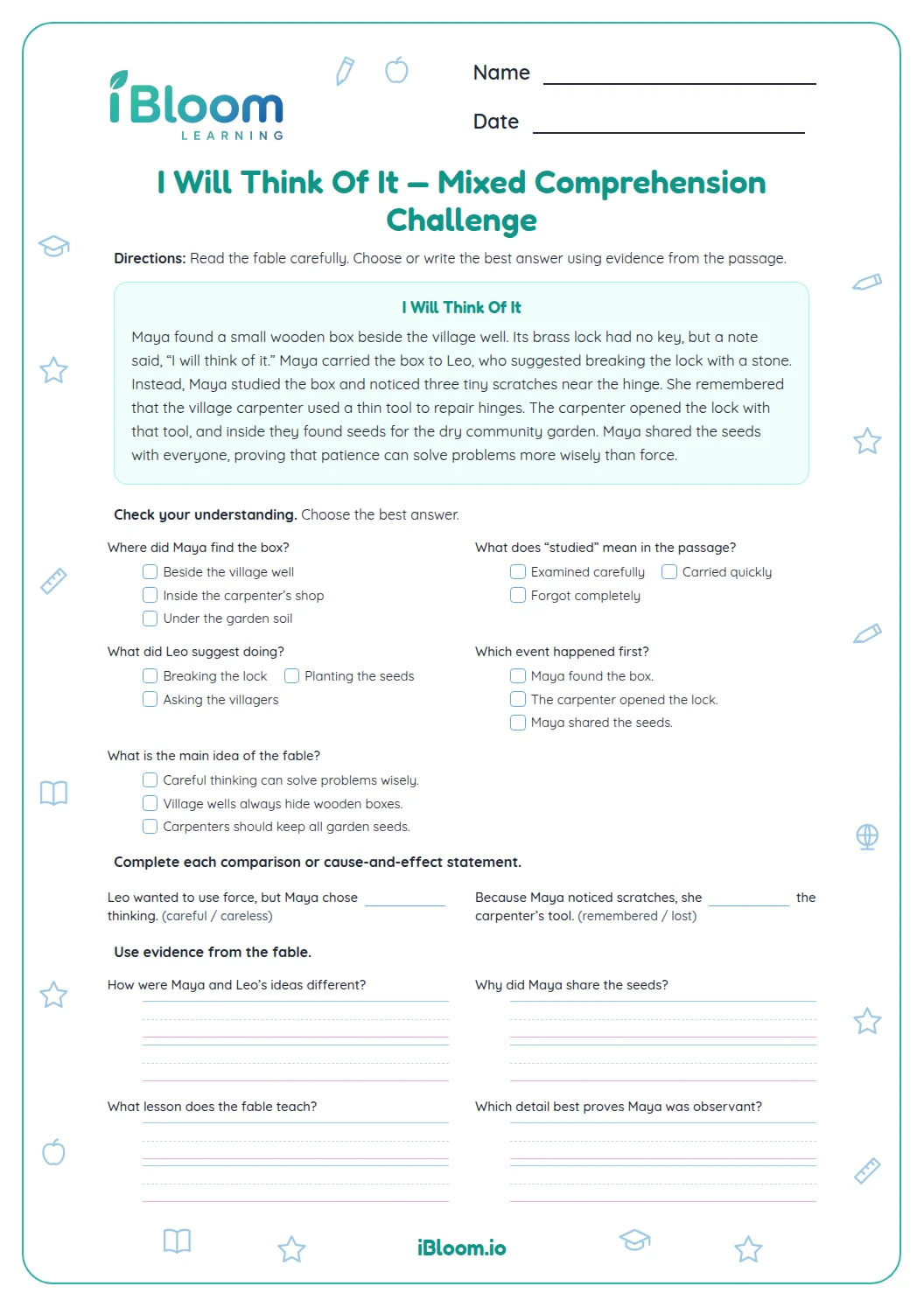
This Grade 5 reading worksheet uses “The Clever Promise,” a story about Maya and Leo helping an injured bird recover. Readers infer why Maya avoids touching it, how Leo’s thinking changes, and what the ending shows about caring for a wild animal. Fourteen questions ask children to connect character actions with precise story details, practicing CCSS RL.5.1. A separate answer key supports checking each response.
Aligned to RL.5.1
What details help readers infer Maya’s traits?
Read what Maya and Leo do, then use those actions as clues. In question 4, Maya checks the bird each morning. That repeated care supports the inference that she is patient.
- 1Clue: Maya checks the bird each morning.
- 2Inference: Maya is patient.
- 3Why it fits: She keeps caring for the bird over time.
How can a reader choose strong evidence?
Choose a story detail that directly supports the idea. “Leo brought fresh water” supports that he helped care for the bird; the garden gate is part of the setting, not evidence of his help.
What makes an inference fit the story?
A strong inference fits both the question and the story. In question 6, Leo first wants to keep the bird, but by the ending he smiles as it flies away. Those events support the idea that he understands the bird belongs in the trees.
How to use this worksheet
- 1Read the story once to follow the events.
- 2Reread the story detail named or suggested in a question.
- 3Separate what the text states from what you infer.
- 4Choose the answer supported by the strongest relevant detail.
- 5Use the key to check each choice against the passage.
Common mistakes and quick fixes
The mistake
Making an inference that contradicts the story.
The fix
Check whether the detail you cite actually happened in the text.
The mistake
Choosing a detail that is true but unrelated.
The fix
Ask whether the detail explains the idea in the question.
The mistake
Retelling without answering the question.
The fix
Begin with a direct answer, then add the supporting clue.
Common Core alignment
The questions pair interpretation with accurate details from a literary text.
Use accurate story details to explain meaning and support an inference.
On this sheet: Readers explain inferences about Maya using precise events and dialogue from the story.
Show the official wordingHide the official wording
Quote accurately from a text when explaining what the text says explicitly and when drawing inferences from the text.
What to practice next
Make more practice
Further reading
Questions parents and teachers ask
What does inference mean in this worksheet?
An inference is an idea a reader reaches by combining story clues with careful thinking. For example, Maya checks the bird each morning without touching it. That detail supports the idea that she is patient and careful. Her repeated visits are the evidence.
How many questions are included?
There are 14 questions after the story. They ask about events, character traits, motives, and evidence. Children can point back to the relevant story detail while checking their reasoning with the separate key, which includes short response guidance. The question numbers follow the reading passage.
How can I help with the multiple-choice questions?
Ask the reader to point to a story detail before choosing an answer. Then ask how that detail supports the choice. This keeps the discussion focused on evidence instead of guessing. The worksheet has one best choice for each question, and the key identifies it.
What counts as strong text evidence?
Strong evidence is a precise detail that supports the answer. If the inference is that Maya respects the bird’s needs, her choice not to hold it is stronger evidence than the unrelated fact that she found it on Saturday. It directly connects to the inference in the question.
Is the passage a traditional fable?
It is a short classroom story with a lesson, rather than a traditional folk fable. The sheet calls it “The Clever Promise.” Readers use the choices Maya and Leo make as clues, then connect those choices to details in the passage. The practice focuses on inference and evidence.
How can I help without giving away answers?
Ask the reader to point to the sentence that led to an idea. Then ask, “How does that detail support your answer?” This keeps the work focused on evidence and helps distinguish a text-based inference from a guess. Look for a sentence that describes an action or choice.