
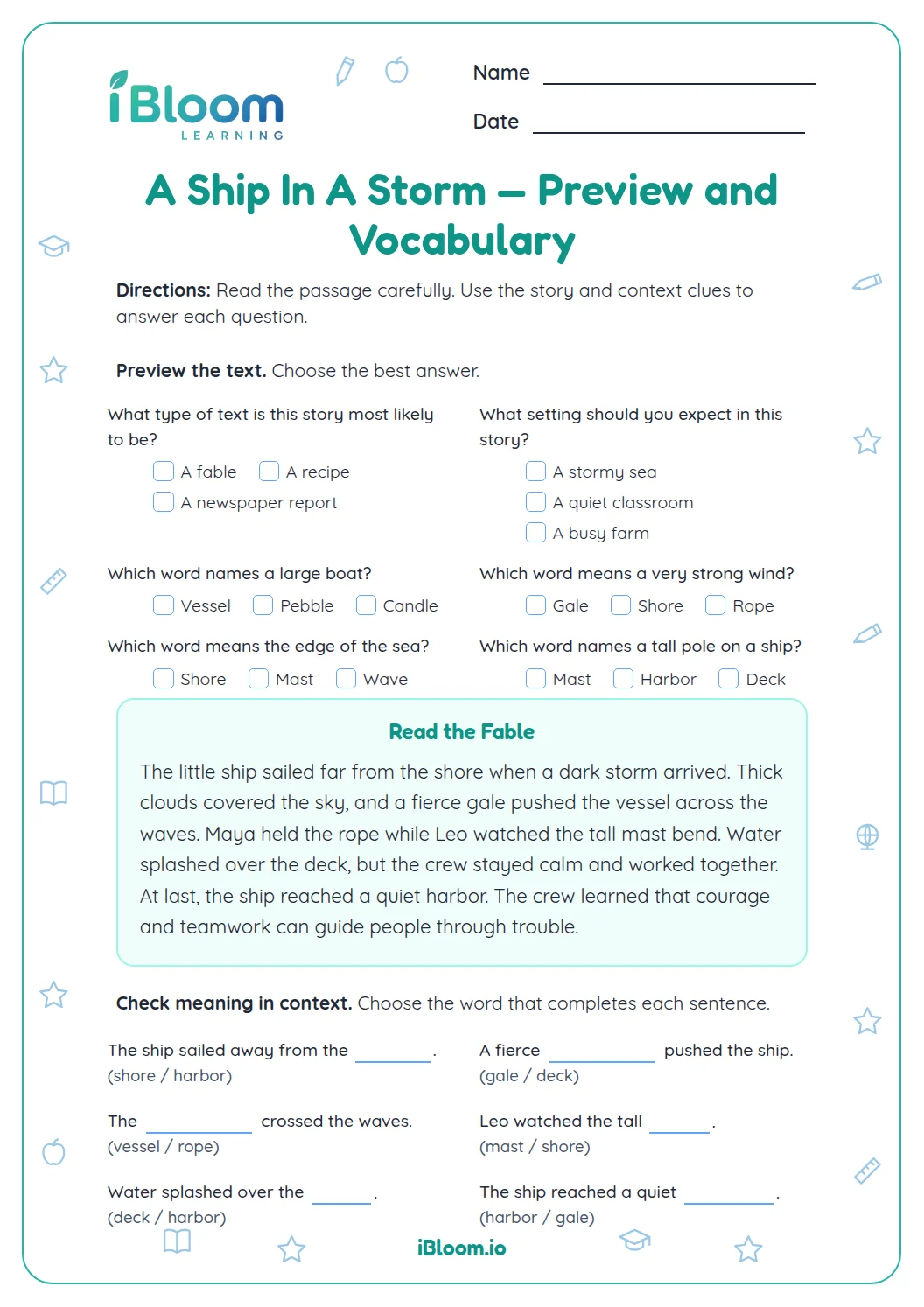
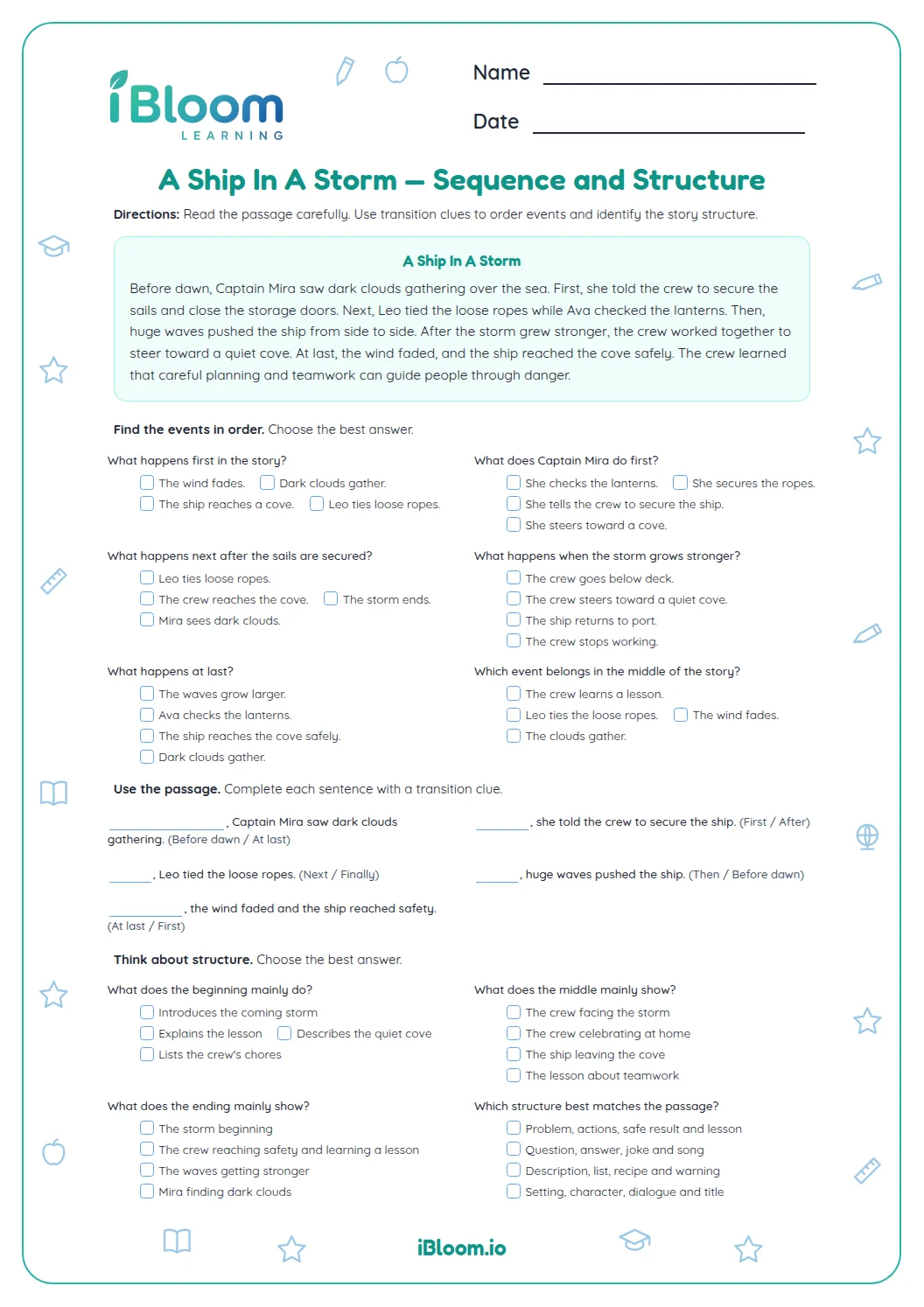
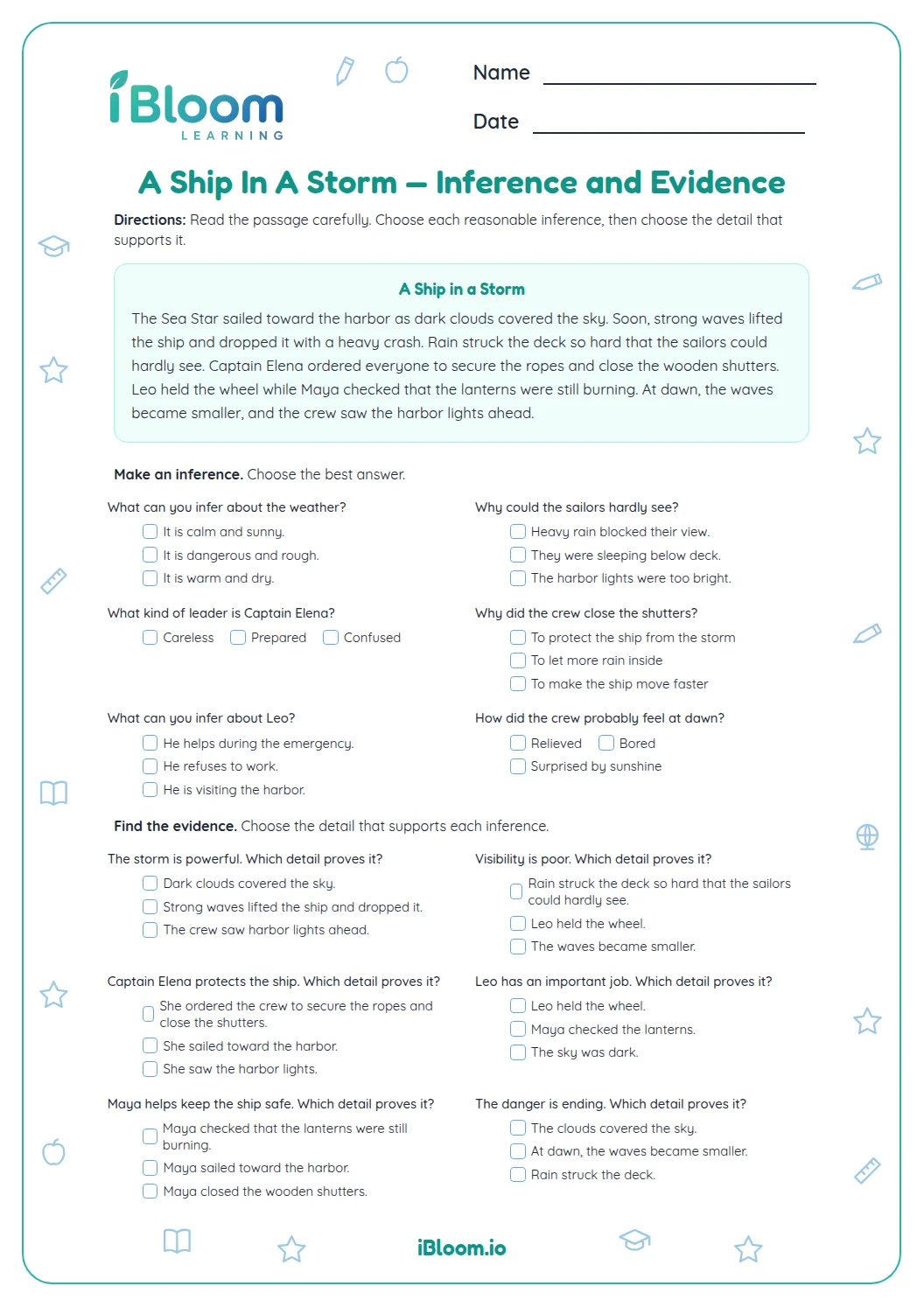
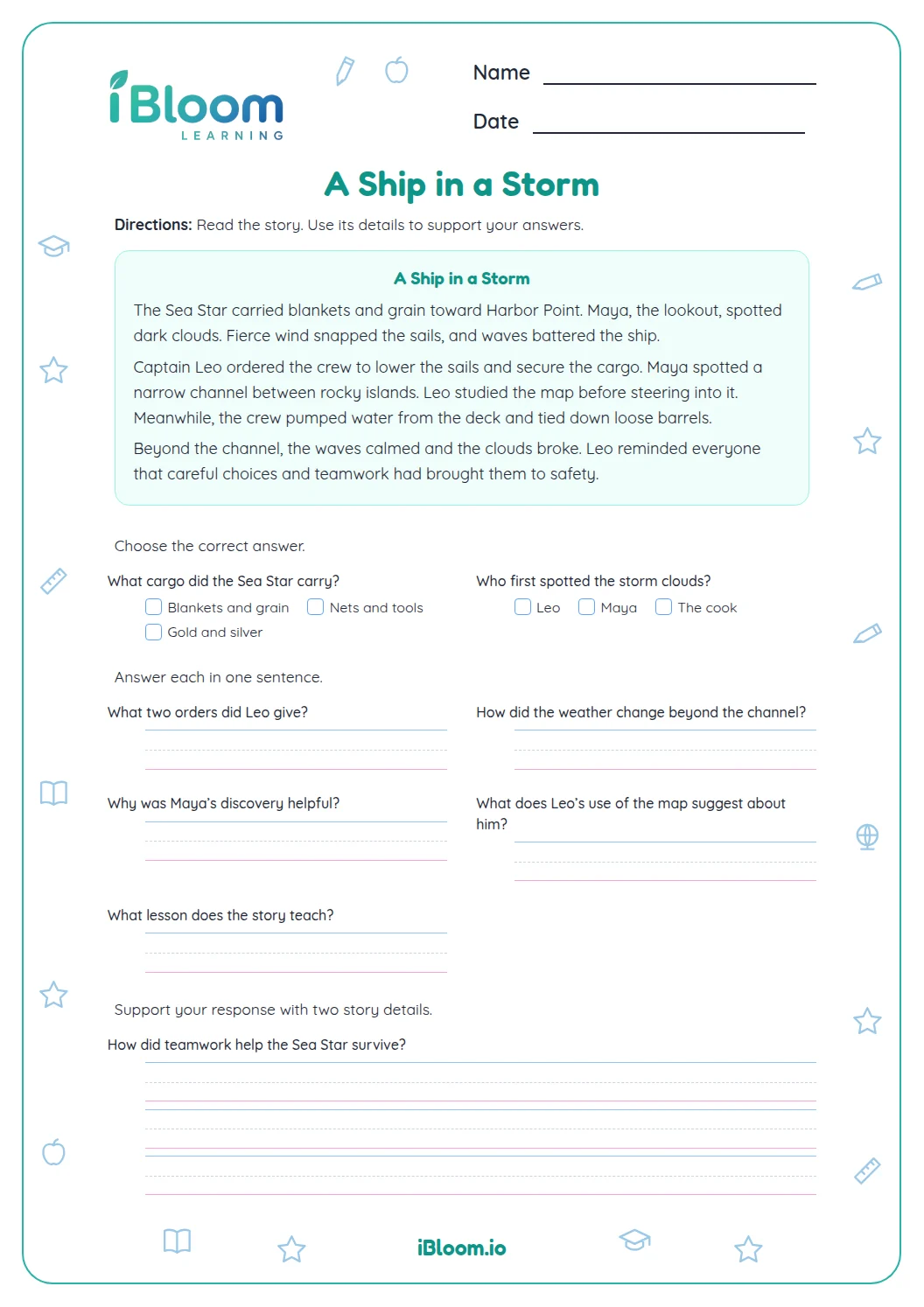

About this worksheet
Readers follow the Gull’s crew through a storm that puts their boat near danger. The questions ask children to distinguish a main idea from supporting details, retrieve evidence, and explain how several details work together. The original passage is written for this worksheet and keeps the focus on a crew solving a problem together.
Aligned to RL.5.1 and RL.5.2
What is on this reading worksheet?
Part B checks the central idea and key evidence choices. Part C asks readers to retrieve specific details. Part D asks them to explain how evidence supports an interpretation or summary.
- Part A: the original passage, “The Lantern on the Gull”
- Part B: 4 multiple-choice questions
- Part C: 4 detail questions
- Part D: 6 written and short responses using passage evidence
How is the main idea different from a detail?
The main idea tells what the passage is mostly about. Details are the events and facts that develop it. In this story, the spare lantern matters because it helps the crew navigate; the rough waves help readers picture the storm but are less central.
- 1Main idea: Eli helps his crew reach harbor safely in a storm.
- 2Supporting detail: He brings the spare lantern from the cabin.
- 3The detail supports the idea because it explains how he helps.
How do I explain evidence?
A strong response names the detail and links it to the idea. Instead of listing “lantern, sail, bell,” explain that the lantern lets Mara see the marker and the crew follows it toward safe water. Part C gives room to make that connection in a sentence.
How to use this worksheet
- 1Read the full passage once before answering.
- 2In Part B, reject choices that describe only one event or contradict the story.
- 3In Part C, return to the passage and locate the exact clue.
- 4In Part D, state your idea and connect it to one or more details.
- 5Use the key as a model; other evidence-based answers may be correct.
Common mistakes and quick fixes
The mistake
Choosing a true detail as the main idea.
The fix
Ask which idea covers the whole passage, not just one sentence.
The mistake
Retelling events without explaining how they support an idea.
The fix
Add a linking phrase such as “This shows…” or “This helps because…”
The mistake
Adding information that the passage never states.
The fix
Point to a phrase in the text before making an inference.
Curriculum alignment
This passage and its questions support Grade 5 reading practice in using evidence, identifying a central message, and summarizing.
Quote accurately from a text when explaining what the text says explicitly and when drawing inferences.
On this sheet: Parts B and C ask readers to locate accurate details and use them to explain the passage.
Show the official wordingHide the official wording
Quote accurately from a text when explaining what the text says explicitly and when drawing inferences from the text.
Determine a theme of a story from details; summarize the text.
On this sheet: Parts A and C identify the central message and produce a summary grounded in the story.
Show the official wordingHide the official wording
Determine a theme of a story, drama, or poem from details in the text, including how characters in a story or drama respond to challenges or how the speaker in a poem reflects upon a topic; summarize the text.
What to practice next
Make more practice
Further reading
Questions parents and teachers ask
Is the passage a traditional fable?
The passage is a short fable-like story about a deckhand who helps his crew during a storm. Eli does not stop the storm; he notices that the lantern is out, finds a spare, and helps the crew navigate toward safe water. The ending highlights his useful choice.
What is the main idea of “The Lantern on the Gull”?
The main idea is that Eli helps his crew reach harbor safely during a storm. The lantern is a supporting detail because it helps Mara see the marker and steer toward the sheltered channel. Other details, including the bell and lowered sail, show how the crew works together.
What is a supporting detail?
A supporting detail is a specific event or fact that helps develop a larger idea. In this passage, Eli bringing the spare lantern supports the idea that he helps the crew. The written questions ask readers to select or explain details and connect them to the central idea.
What grade is this worksheet for?
This worksheet is written for Grade 5. Children read an original story, then answer questions about its main idea, supporting details, and the crew’s response to a challenge. The question parts move from selecting evidence to retrieving details and explaining how those details support an interpretation.
How should children answer the written questions?
Name the idea first, then use one or more events from the passage to support it. For example, readers can explain that Eli helps by finding the spare lantern, which lets Mara see the marker. The separate key offers sample wording; another response can work when the text supports it.
How many questions are included?
There are 14 questions in three question parts, plus the passage in Part A and a separate answer key. Part B has four multiple-choice questions, Part C has four detail questions, and Part D has six evidence and summary responses.