


About this worksheet
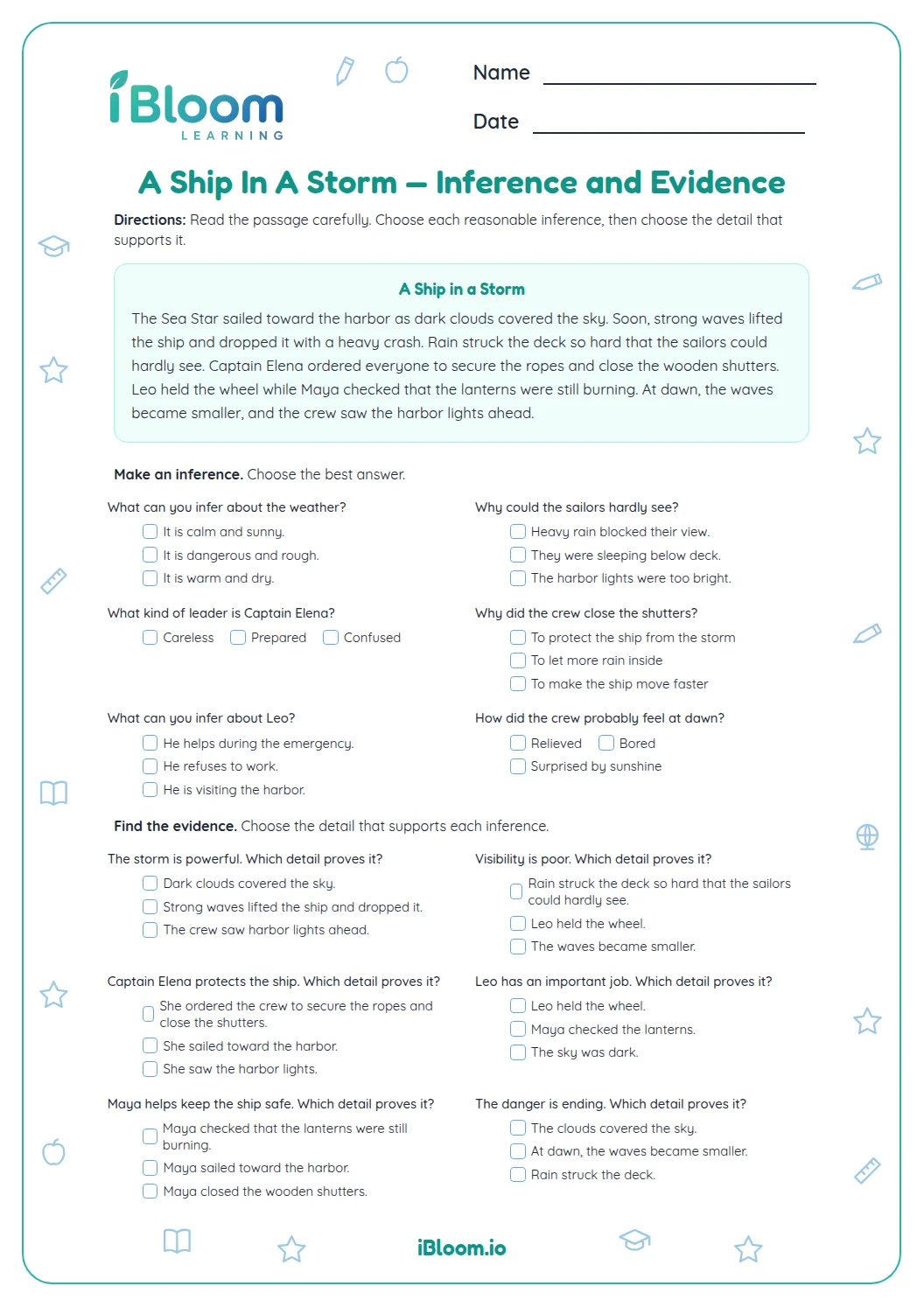
This Grade 5 reading worksheet uses the established “The Bonfire in the Sea” passage. Children answer six inference questions, then select passage details that support conclusions, practicing CCSS RL.5.1. The two question parts move from interpreting character choices and events to locating precise evidence; a separate answer key is included.
Aligned to RL.5.1
How do readers make an inference?
Readers combine a detail the author gives with what they know. The fixed glow and strong tide suggest danger even before the fisherman explains the signal fire.
Question 1 asks why the glow seemed unusual. Its stillness matters because ordinary floating objects move with waves.
- 1Clue: The glow did not drift with waves.
- 2Inference: It was not an ordinary bonfire.
Which detail supports an inference?
A strong answer points to a precise event or description. Question 8 asks for evidence that Leo was curious; his choice to sail toward the glow directly supports that idea.
What does the worksheet ask readers to do?
Part B contains six inferences about the mystery, Leo, Maya’s decision, and the lesson. Part C contains eight choices of evidence from the same passage.
How to use this worksheet
- 1Read the whole passage once for the main events.
- 2For each Part A item, name the clue before choosing a conclusion.
- 3Reread the passage when you begin Part B.
- 4Choose the exact detail that supports the inference, not an unrelated true detail.
- 5Use the answer key to discuss how the clue supports the conclusion.
Common mistakes and quick fixes
The mistake
Choosing a detail that is true but unrelated.
The fix
Ask whether the detail explains the exact idea in the question.
The mistake
Treating a guess as an inference.
The fix
Point to a clue in the passage before settling on a choice.
The mistake
Confusing a character’s feeling with an event.
The fix
Check what the character does or says in the story.
Common Core alignment
This sheet practices close reading by connecting conclusions to details.
Use details from a story to explain an inference.
On this sheet: Use details from a story to explain an inference.
Show the official wordingHide the official wording
Quote accurately from a text when explaining what the text says explicitly and when drawing inferences from the text.
What to practice next
Make more practice
Further reading
Questions parents and teachers ask
What reading skill does this page practice?
The worksheet pairs inferences with details from “The Bonfire in the Sea.” Readers interpret the still glow, the pulling tide, and Maya and Leo’s choices, then locate a passage detail that supports a conclusion. The separate key lists the best choices for all 14 questions.
How many questions are on the worksheet?
There are 14 multiple-choice questions: six ask readers to infer what story events suggest, and eight ask them to select supporting evidence. The passage is printed with the questions, and a separate answer key follows. Students can reread the short story whenever they need to check a clue.
Is the story new for this page?
This worksheet uses the established “The Bonfire in the Sea” passage shared by this story’s practice set. Its questions focus on inference and evidence, while related pages address other reading skills. The answer key is separate, so a parent or teacher can check responses after the student has tried each item.
What does Part B ask?
Part B asks readers to make six inferences about the glow, Leo’s curiosity, Maya’s caution, the fisherman’s signal, and the story’s lesson. Students should connect each answer to a clue rather than guess from one word. Part C then asks them to find evidence directly in the passage.
What does Part C ask?
Part C has eight questions about details that support ideas in the story, including why the glow stayed in place and how help reached the boat. Reread the passage and choose the detail that explains the particular idea in each question. The key identifies one best supporting choice for each item.