


About this worksheet
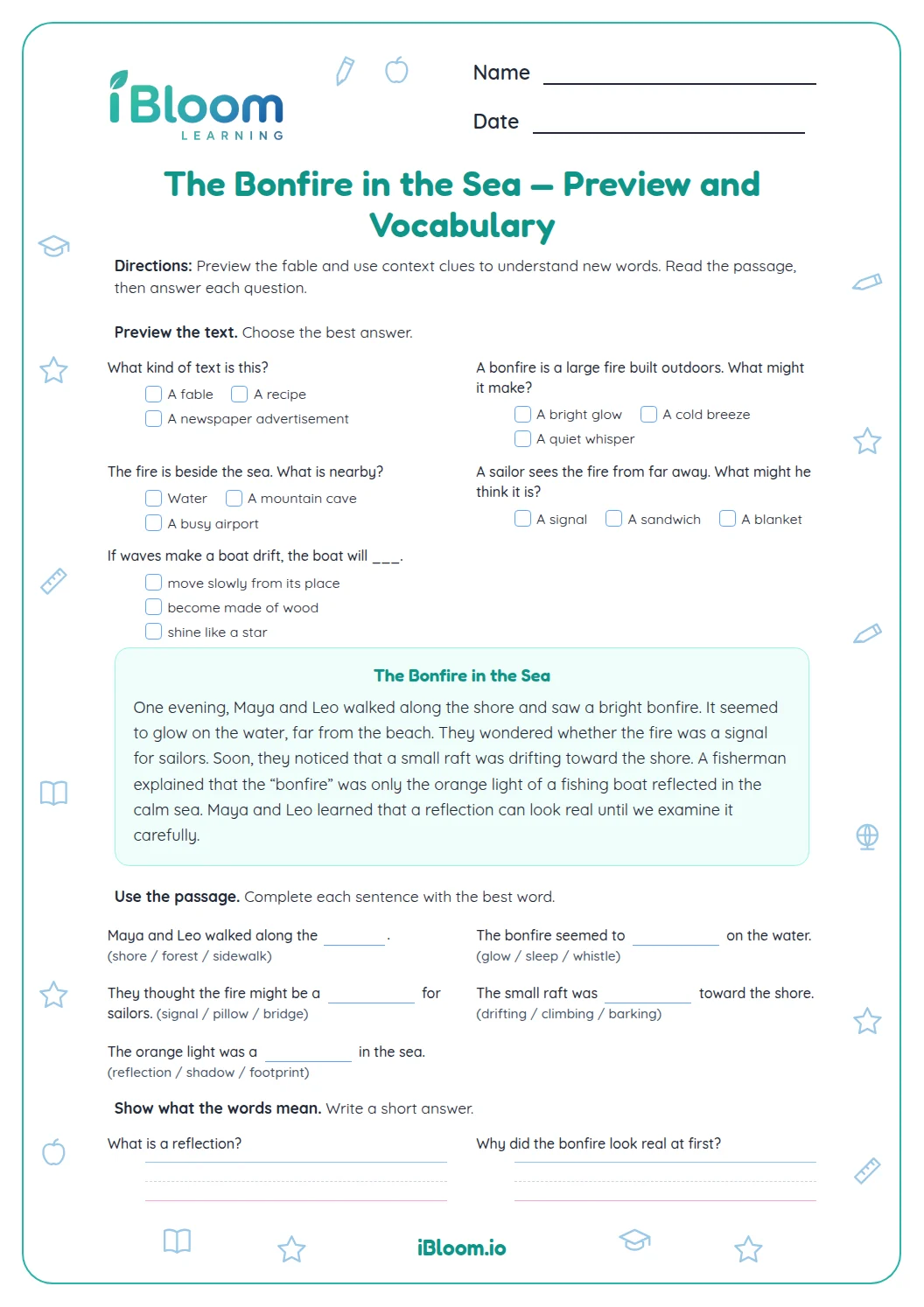
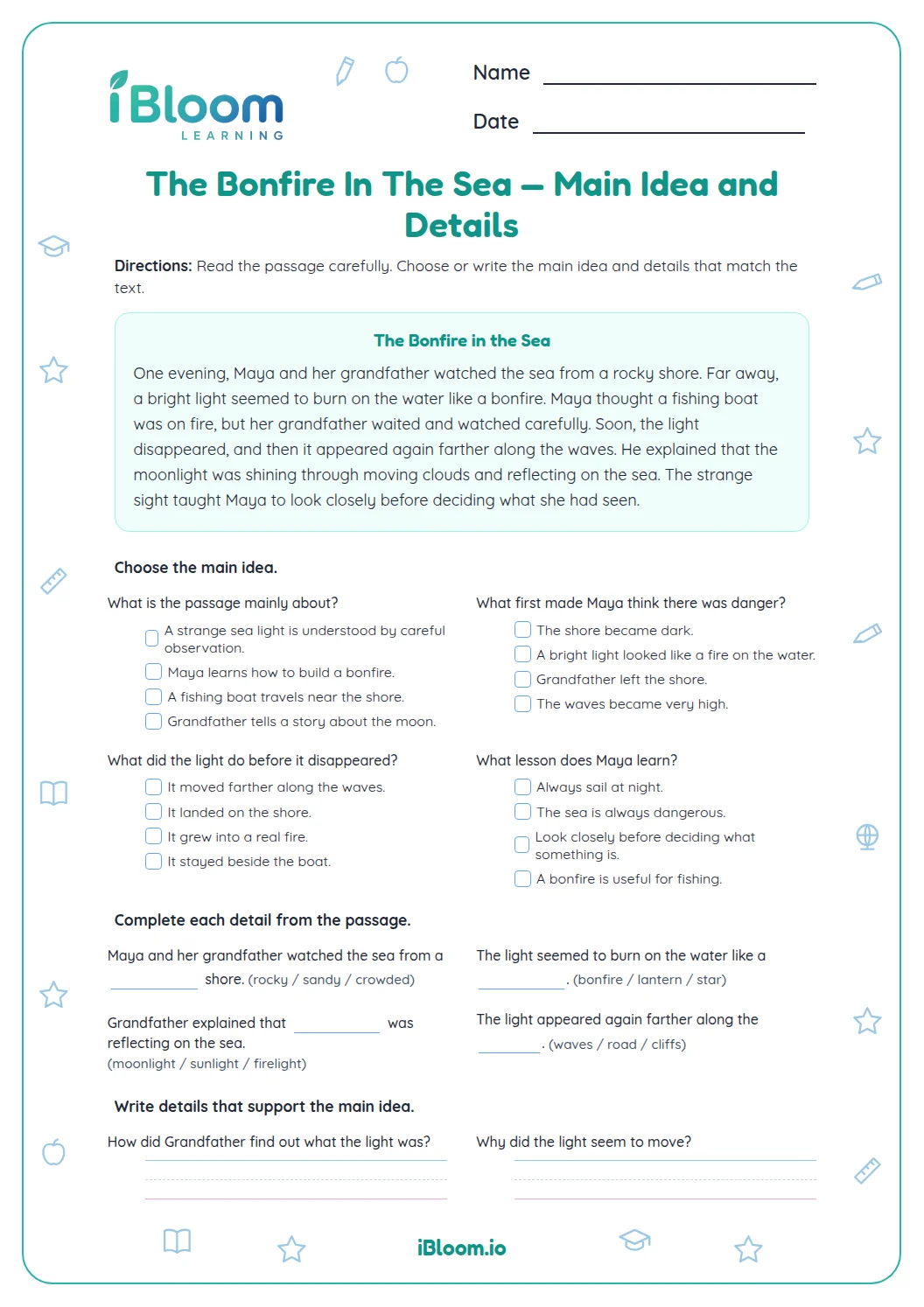
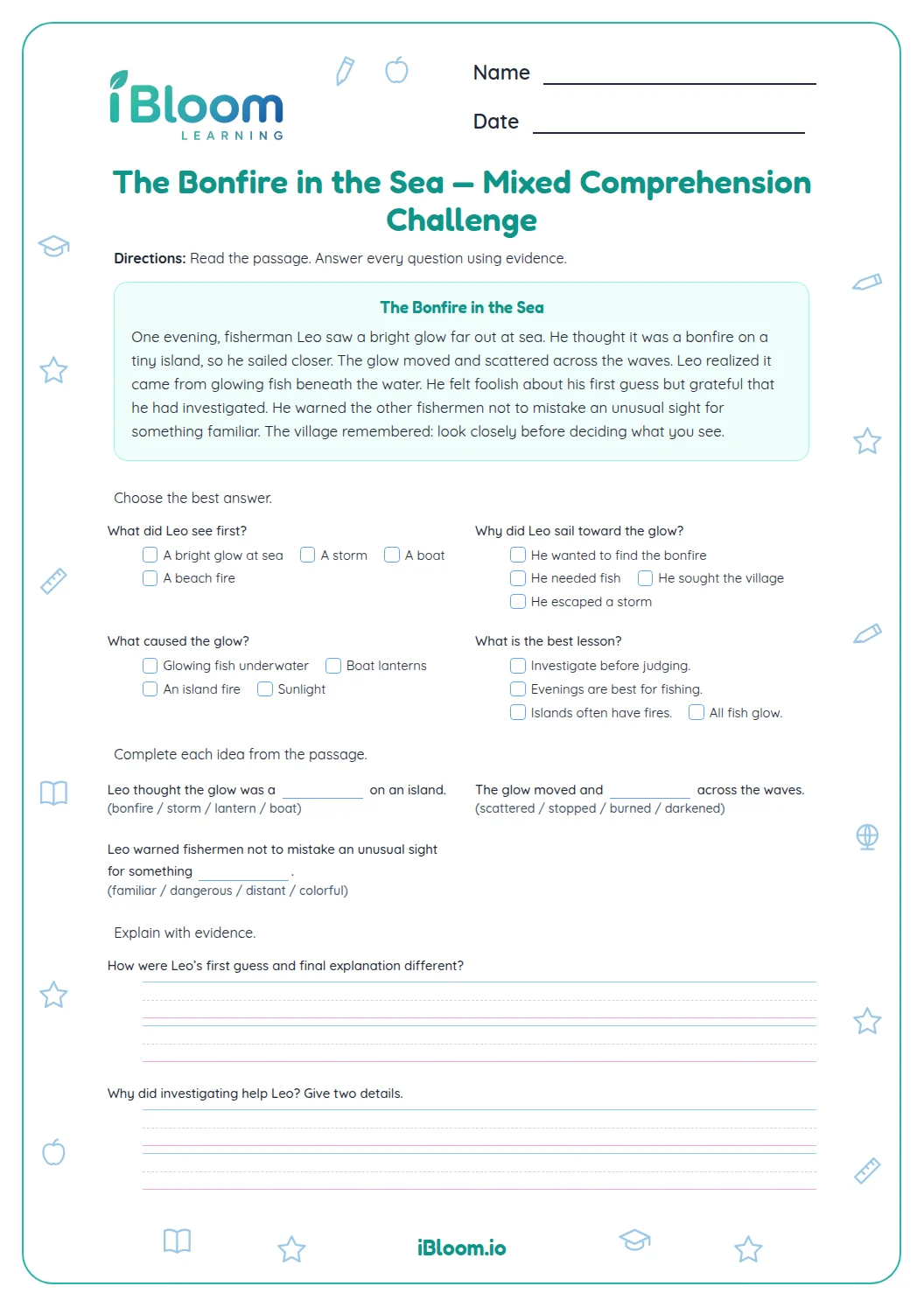
Read an original fable about Leo, who mistakes a glow over the waves for a bonfire. Fourteen questions track the villagers’ response, Maya’s clue, the sailor’s explanation, and Leo’s lesson. Students put events in order and consider how the beginning, build-up, turning point, and ending work together. The answer key gives a choice for every question. The structure questions practice Common Core reading standard RL.5.5.
How do the events unfold?
The story begins with Leo’s mistaken sighting. The villagers’ rush to shore builds the problem, Maya’s observation adds a clue, and the sailor’s explanation resolves the mystery. Questions 1–8 ask students to follow that order and connect events.
- 1First: Leo sees a glow and reports it as a bonfire.
- 2Later: the sailor explains the tiny sea creatures.
- 3The first event introduces the mystery; the explanation comes after the clues.
What happens in the build-up and turning point?
The build-up adds a clue that makes the first guess less certain: the glow moves with the waves. The turning point comes when the sailor explains its source. Questions 9–12 ask students how those moments move the story toward its ending.
How does the ending resolve the story?
Leo learns to investigate before deciding what he sees. That lesson resolves the misunderstanding and connects with the title: the glow looked like a bonfire from far away, but it was not a fire. Questions 13 and 14 ask students to connect clue, lesson, and title.
A close-reading routine
- 1Read the passage once to understand the mystery.
- 2Read it again and mark the glow, Maya’s observation, and the sailor’s explanation.
- 3For event-order questions, locate what happens before and after each clue.
- 4For structure questions, decide whether the detail introduces, builds, turns, or resolves the problem.
- 5Check answers against the passage and the key.
Common sequence and structure mistakes
The mistake
Treating the villagers’ rush as the solution.
The fix
Look for the event that explains the glow; the rush only shows the problem growing.
The mistake
Calling the first sighting the turning point.
The fix
The sighting starts the mystery; the sailor’s explanation changes what the characters understand.
The mistake
Choosing an ending detail without connecting it to the problem.
The fix
Check whether the event resolves the misunderstanding or states what Leo learned.
What to practice next
Make more practice
Questions parents and teachers ask
How many questions follow the passage?
There are 14 questions about the fable. The first set focuses on what happened and in what order. The second considers how clues, the sailor’s explanation, and Leo’s lesson shape the story’s structure. The answer key includes a correct choice for each one.
What is the turning point in the story?
The sailor’s explanation is the turning point because it reveals that tiny sea creatures caused the glow. Before that moment, Leo and the villagers treat it as a possible bonfire. The explanation changes their understanding and leads toward the resolution.
What clue makes Leo’s first guess less certain?
Maya notices that the glow moves with the waves. That detail does not explain the light by itself, but it gives the characters a reason to question whether a bonfire is really out at sea. The sailor later supplies the explanation.
What does Leo learn at the end?
Leo learns to investigate unusual sights before deciding what they are. The lesson follows from his mistake: he guessed that the glow was a fire before checking. Students can point to the sailor’s explanation and Leo’s final choice as evidence.
How does the story explain its title?
The bright sea glow looked like a bonfire to Leo from far away, but the light came from tiny creatures in the water. The title names his mistaken first impression. The ending returns to that image after readers know what caused it.