



About this worksheet
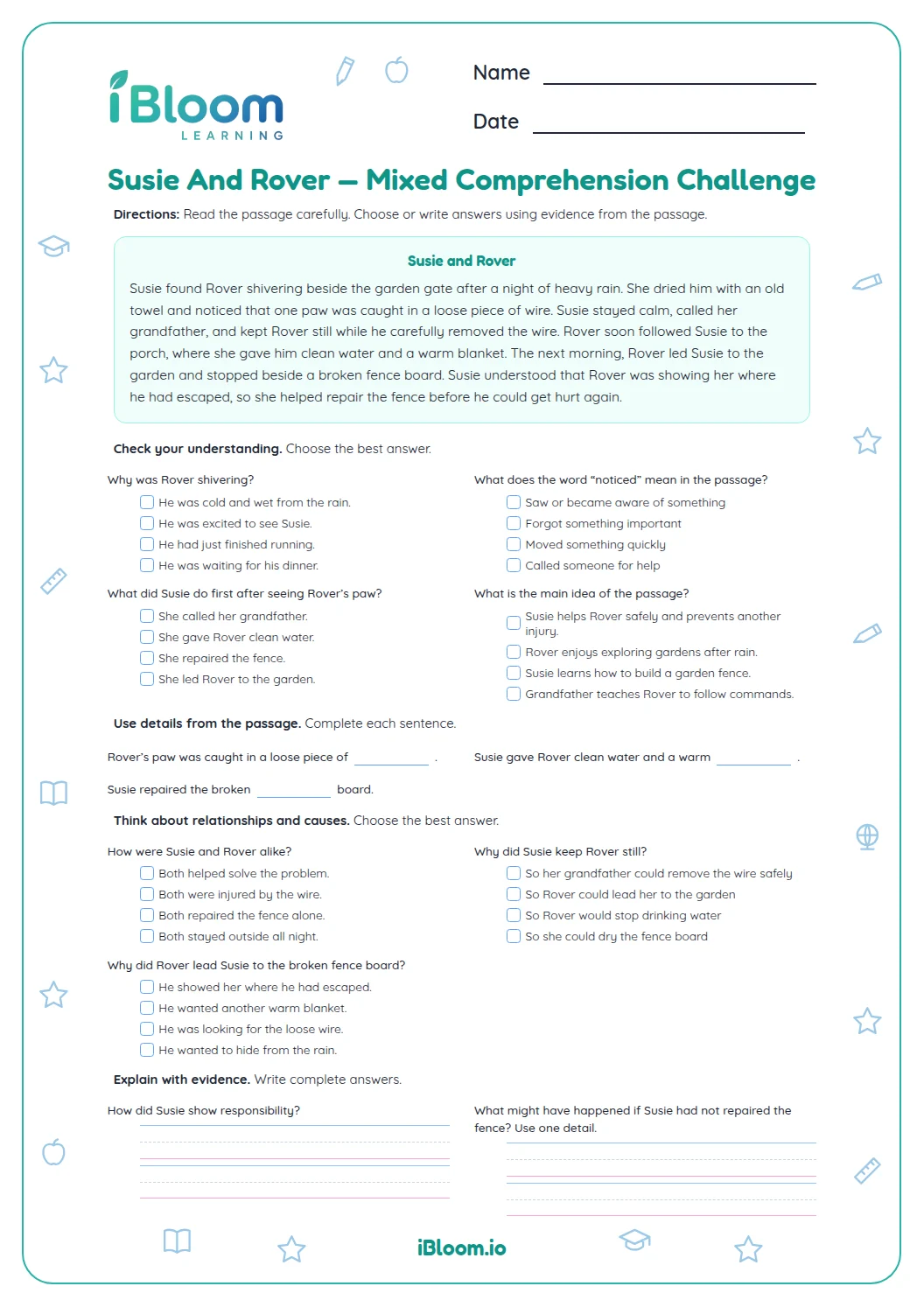
This Grade 5 reading worksheet pairs an original short story about Susie and her dog Rover with 14 comprehension and vocabulary questions. Students recall details, use nearby words to infer meanings, think about a character, sequence events, and explain two responses with story evidence. The separate answer key includes sample responses for open-ended questions.
How can a reader use a context clue?
Look at the sentence around an unfamiliar word. In question 7, Susie “retrieved” the ribbon after the gardener helped her reach it, so retrieved means got back.
How do story details support an inference?
Question 10 asks readers to choose a word that describes Rover. His gentle tug toward the ribbon and bark to alert the gardener support the idea that he is helpful. These actions provide evidence for the character description.
What is included?
The passage is followed by six story-detail questions, three context-clue items, two character questions, one sequencing question, and two written responses.
How can I use this sheet?
- 1Read the whole passage once.
- 2Reread the sentence around a question’s clue.
- 3For a vocabulary word, test each meaning in the sentence.
- 4For written answers, name a detail before explaining what it shows.
Mistakes to watch for
The mistake
Choosing a word meaning that does not fit the sentence.
The fix
Read the sentence again with the choice substituted.
The mistake
Giving an inference without evidence.
The fix
Point to an action or detail that supports it.
The mistake
Mixing up event order.
The fix
Find signal words and retell the events in sequence.
What to practice next
Make more practice
Questions parents and teachers ask
How long is the story?
The passage is a short original story about Susie, Rover, and a ribbon caught on a branch. Students can return to it while answering the 14 questions, which cover story details, vocabulary, character thinking, event order, and two written responses.
What does “retrieved” mean in this passage?
Retrieved means got back. Susie retrieves the ribbon after the gardener brings a stool that lets her reach it. The surrounding actions help readers choose the meaning that fits the sentence instead of guessing from the word alone. This is the meaning used in question 7.
Do the written questions have only one correct response?
No. The answer key gives sample responses for the two open-ended questions. A child may phrase an answer differently if it correctly explains Susie’s problem or how Rover helped, using a detail from the passage to support the response. The key models one acceptable answer.
How can students describe Rover?
Students can choose “helpful” and point to Rover’s actions: he tugs gently toward the ribbon, waits for Susie, and barks so the gardener notices them. Those details support the description more clearly than simply saying Rover is a good dog.
Is an answer key included?
Yes. A separate answer key lists the selected responses and gives sample answers for the two written questions. For those open-ended items, check that the response matches the story, even when the student uses different words from the sample. It also lists the selected responses.