





About this worksheet
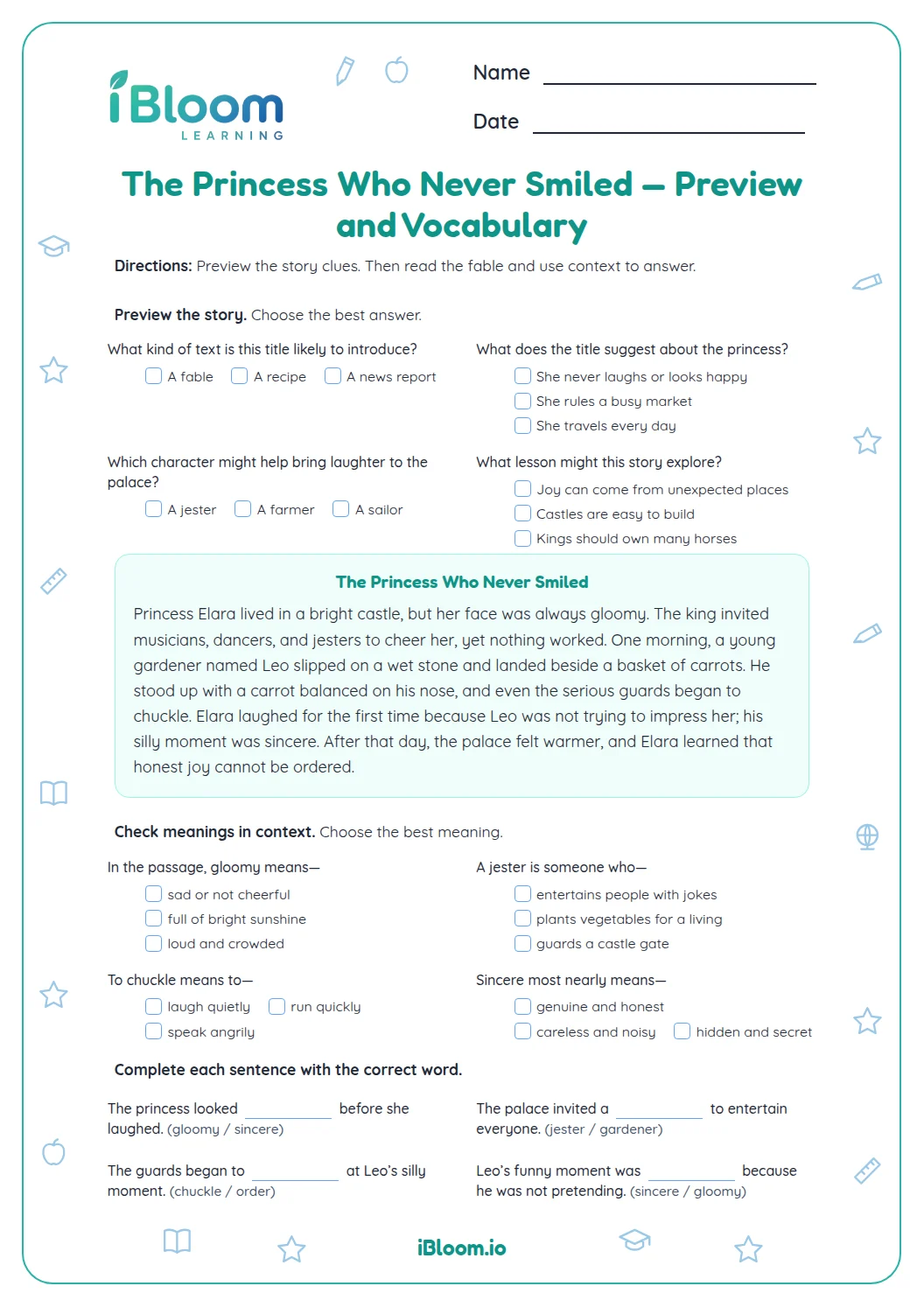
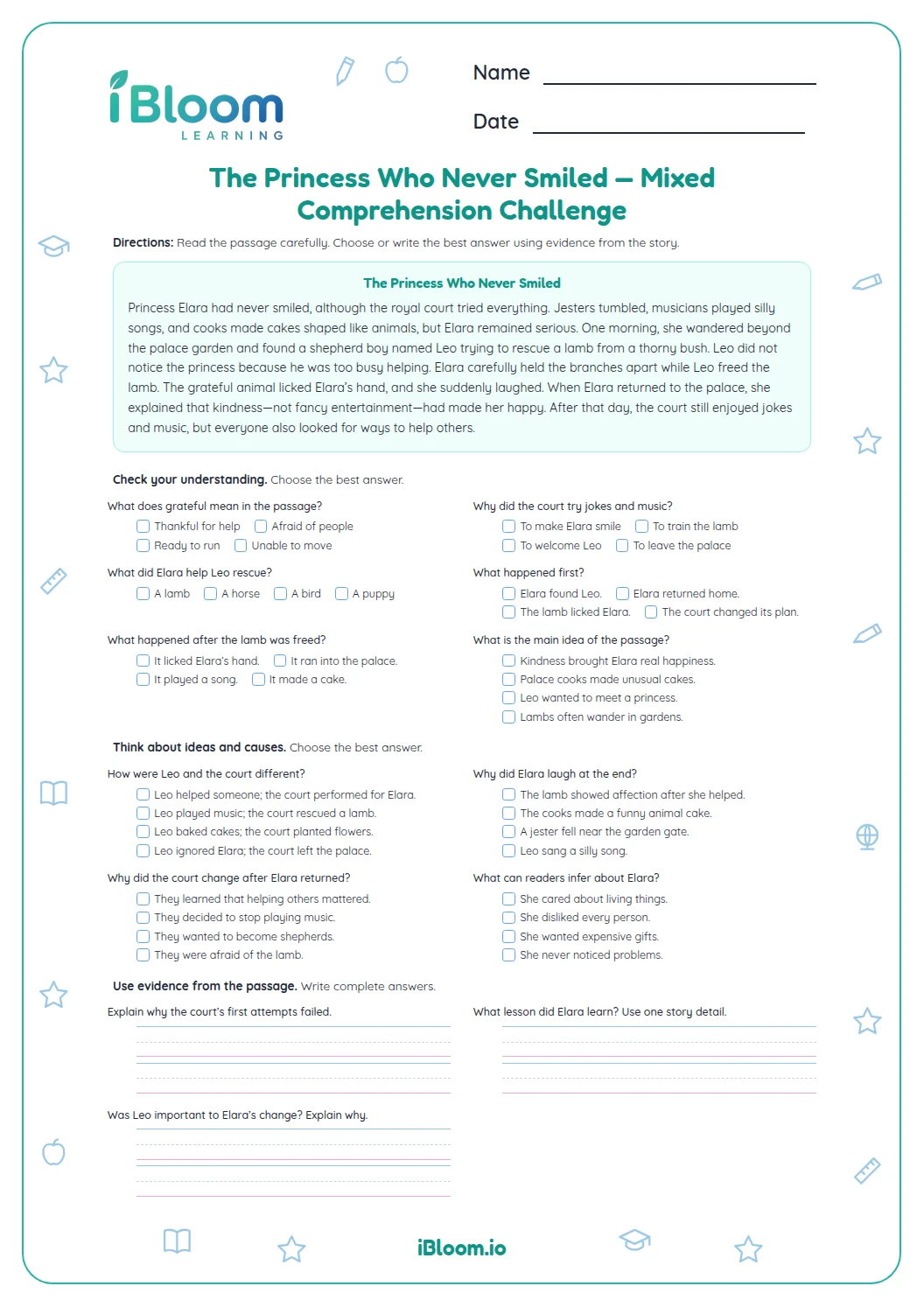
This Grade 5 reading worksheet pairs an original fable passage with 16 questions about inference and evidence. Readers follow Princess Elara as a small act of care changes how she feels about the palace garden. Questions ask students to infer what characters feel or want, select details that support an inference, and explain a conclusion in their own words. The separate answer key includes concise model responses. It practices Common Core RL.5.1.
Aligned to RL.5.1
What clues explain Elara’s change?
Elara does not react to performances, but she responds when she helps a bird in trouble. Readers compare those events to infer what matters to her.
How does the worksheet practice evidence?
Several questions ask students to choose a detail that supports an inference. Other questions invite a short written explanation.
What is one supported inference?
The reader can infer that Elara is caring because she fetches a basket and helps move the nest to safety.
- 1Clue: Elara holds a basket while the gardener moves the nest.
- 2Inference: She is willing to help and cares about the nest.
How to use this worksheet
- 1Read the passage once to follow the events.
- 2On each question, find the sentence or action that gives a clue.
- 3Separate what the story states from what you infer.
- 4For written answers, name the inference and include a supporting detail.
- 5Check the answer key and return to the passage when an answer is uncertain.
Mistakes to watch for
The mistake
Choosing a guess that has no story clue.
The fix
Point to an action or sentence that supports the conclusion.
The mistake
Repeating a detail without explaining what it suggests.
The fix
Add a sentence that connects the detail to a feeling or motive.
The mistake
Treating a character’s feelings as facts the passage states directly.
The fix
Use phrases such as “This suggests” when the reader is drawing a conclusion.
Common Core alignment
This worksheet practices Grade 5 reading comprehension through text evidence.
Use details from a story to explain an inference.
On this sheet: The questions connect character inferences with details in the passage.
Show the official wordingHide the official wording
Quote accurately from a text when explaining what the text says explicitly and when drawing inferences from the text.
What to practice next
Make more practice
Further reading
Questions parents and teachers ask
What is an inference in this story?
An inference is a conclusion supported by clues in the text. Elara helps the gardener gather apples, then smiles and says she feels happy to help someone who needed her. Those details support the idea that helping others matters to her.
Where should students find evidence?
Students should return to the passage and point to a character’s words or actions. For example, Elara gathers the scattered apples before the gardener slips. That action supports an inference about her willingness to help; a guess without a story detail is not enough.
Do students have to use the exact answer-key wording?
No. The key offers model responses, and a student may phrase an answer differently. The response should still make a reasonable inference and connect it to a detail from the story. Ask the student to show which sentence or event supports the idea.
How does the passage show Elara’s feelings changing?
At first, musicians, storytellers, and jesters do not cheer Elara. After she helps the gardener, she smiles and begins visiting the garden each morning. Students use those events to infer what brings her happiness, while noticing she still does not smile at every performance.
How many questions are on the printable?
The worksheet has 16 questions about the passage, including character inferences, story details, and the lesson suggested by events. The answer key is separate. Students can reread the passage while working so their conclusions stay connected to the text. Rereading one relevant event can help students explain their reasoning.
Is the answer key included?
Yes. A separate answer-key page follows the passage and questions. It provides correct choices and model responses for questions with more than one acceptable wording. Use it after the student responds, then revisit the passage together to locate the supporting detail.