


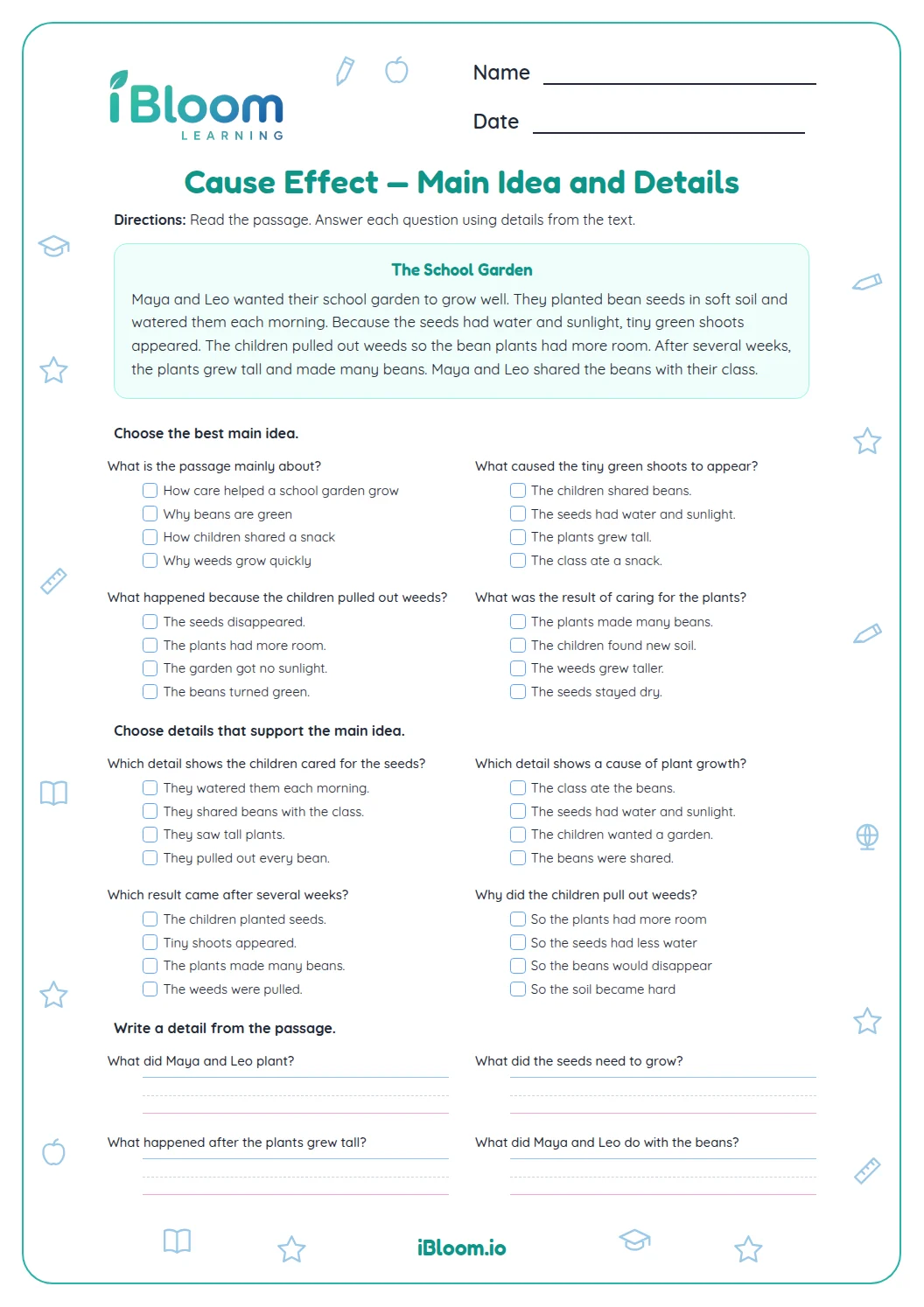

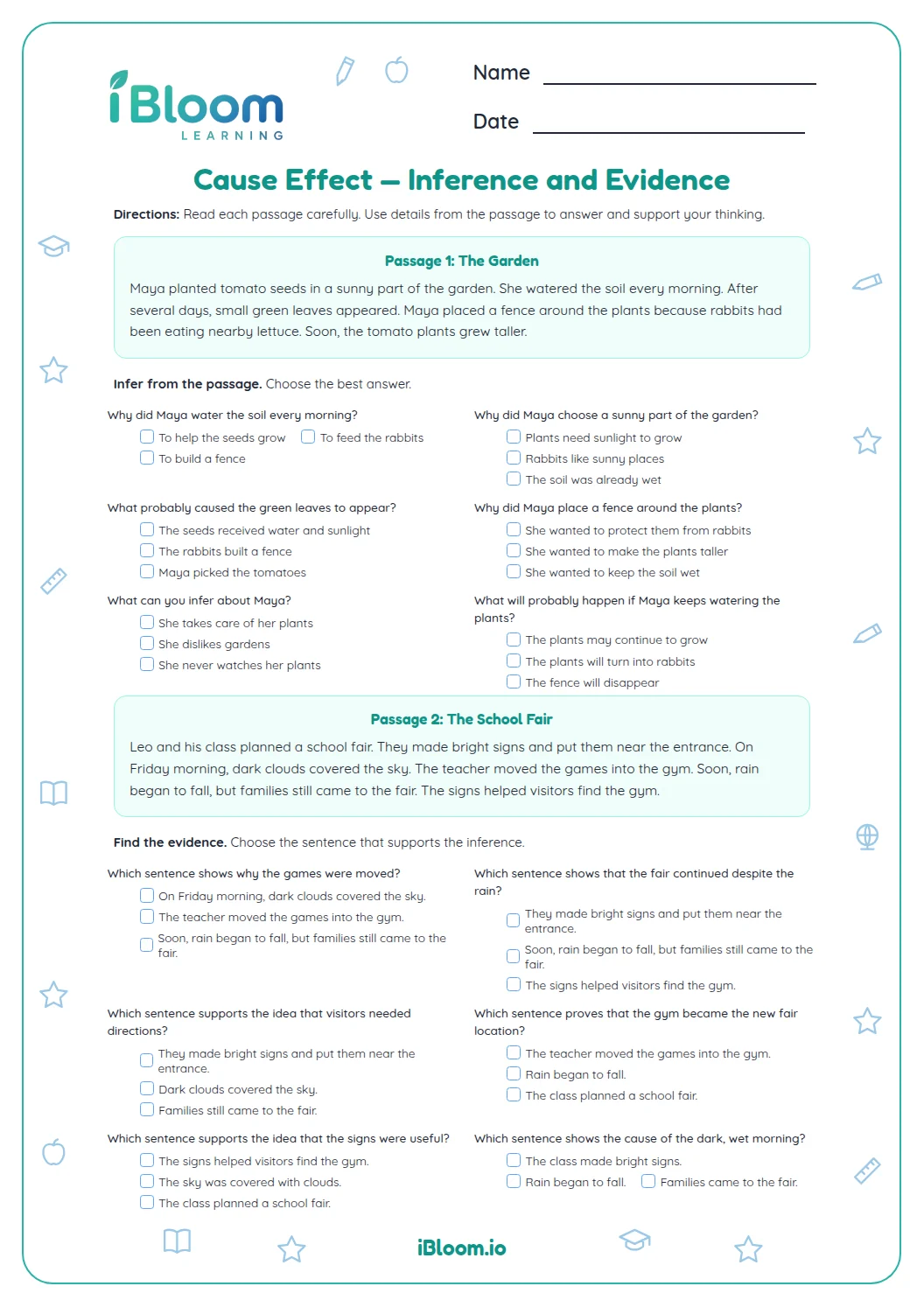
About this worksheet
This free printable reading worksheet helps Grade 3 readers connect the main idea of a how-to text with the steps that support it. The original passage explains how to start a bean seed in a clear cup. Ten questions ask children to identify the overall purpose, find important details, order planting steps, and explain why those steps matter. The passage is Part A; the questions are Parts B, C, and D. The practice supports Common Core RI.3.2 and RI.3.3. A separate answer key provides exact answers and a model for the final explanation.
Aligned to RI.3.2 and RI.3.3
How do you find the main idea of a how-to text?
Ask what the reader will be able to do after following all the directions. Here, the cup, soil, seed, and water belong to one process: starting a bean seed. An answer about only the cup leaves out most of the passage.
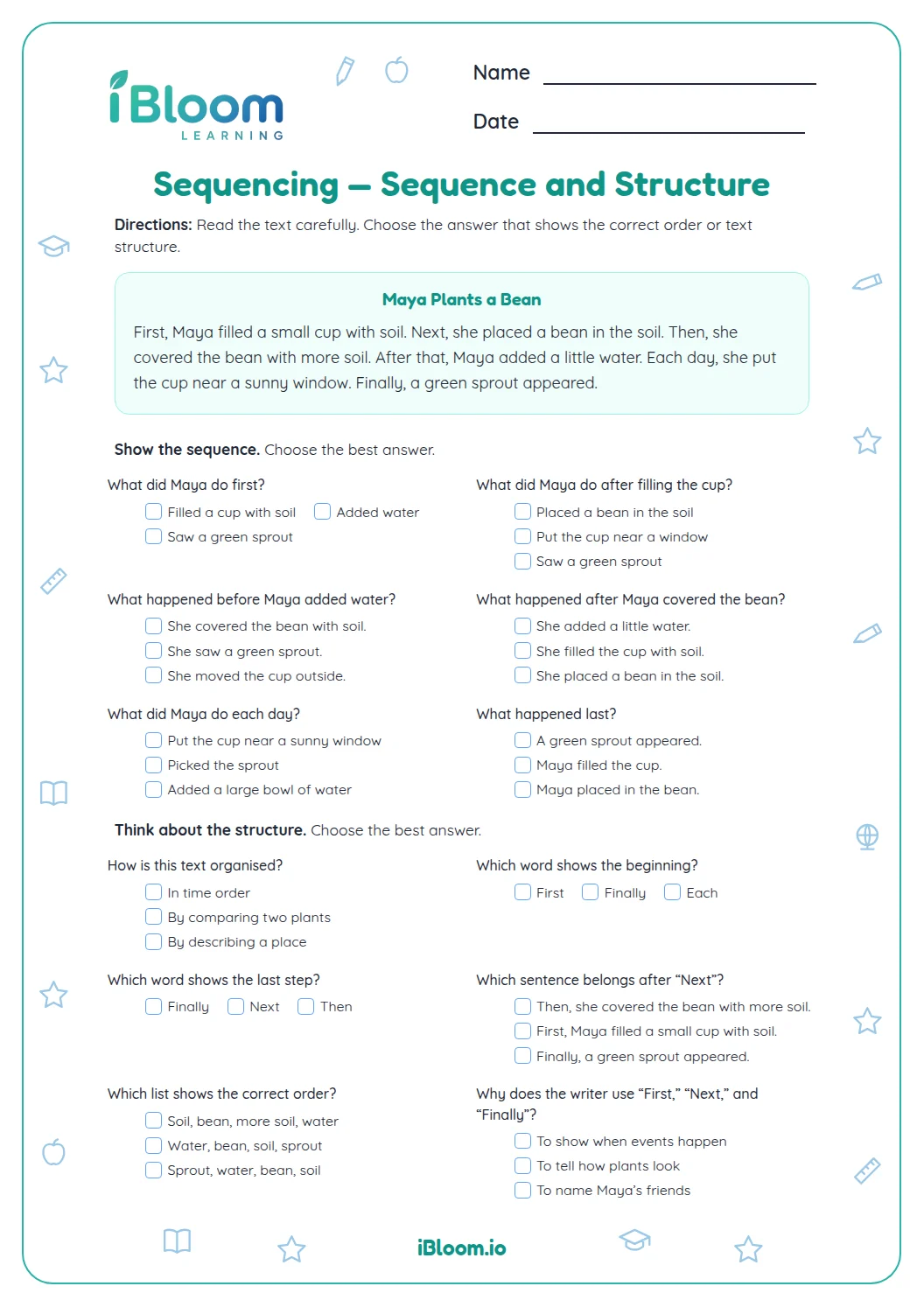
Part B gives five choices to make about the text. Children select the main idea, a useful detail, the first step, a reason for a step, and a suitable title. Encourage them to return to the passage before marking an answer.
How can a detail explain why the order matters?
A sequence is more than a list of actions. Some actions prepare for later ones. The passage puts soil in the cup before the seed goes in because the seed needs a place to rest.
Part C asks for four short answers about what happens before or after another step. Children return to the directions to identify water, soil, the seed, and a bright spot. The time words in each question help them connect the actions.
- 1Question 4: Why put soil in the cup before adding the seed?
- 2The soil gives the seed a place to rest.
- 3That detail explains why filling the cup comes before planting.
What makes a strong final explanation?
Part D asks how checking the soil helps the reader grow a seed. A useful answer connects a stated detail to the purpose: checking tells the reader when to add water.
The key gives one model sentence. Accept a different sentence that uses the passage accurately and explains the connection. Have the child point to the line about soil feeling dry before revising an unclear answer.
How to use the worksheet
- 1Read the passage title and predict which process the directions will explain.
- 2Read Part A, pausing at First, Next, Then, and Finally.
- 3Complete Part B and point to a supporting sentence for each choice.
- 4Use the passage to answer the four short questions in Part C.
- 5Write the Part D explanation, then compare its meaning with the model answer.
Mistakes to check together
The mistake
Choosing “How to fill a cup” as the best title.
The fix
Check whether the title covers planting and caring for the seed as well as filling the cup.
The mistake
Putting the seed in the cup before adding soil.
The fix
Reread the First and Next sentences; the soil is already in the cup when the seed is added.
The mistake
Writing “It helps” for the final explanation.
The fix
Name the action and its purpose: checking the soil tells you when water is needed.
Common Core alignment
Identify the main idea and explain how planting details support it.
On this sheet: Questions 1, 2, 5, and 10 connect the procedure to its main idea.
Show the official wordingHide the official wording
Determine the main idea of a text; recount the key details and explain how they support the main idea.
Describe the order of steps in a seed-starting procedure.
On this sheet: Questions 3, 4, and 6–9 ask readers to track steps and their relationships.
Show the official wordingHide the official wording
Describe the relationship between a series of historical events, scientific ideas or concepts, or steps in technical procedures in a text, using language that pertains to time, sequence, and cause/effect.
What to practice next
Make more practice
Further reading
Questions parents and teachers ask
What grade should use this reading worksheet?
This version is written for Grade 3 readers. Its short informational passage explains a familiar planting process, and the ten questions move from selecting answers to explaining a detail. Read the passage aloud with a child who needs help, then let the child locate evidence and answer the questions.
Does the passage count as Part A?
Yes, the passage is Part A. Part B contains five multiple-choice questions about the main idea, details, and sequence. Part C has four short answers about the steps. Part D ends with one written explanation connecting the soil-checking detail to the purpose of growing a seed.
How should my child answer the sequencing questions?
Your child should use the before and after clues to find each answer in the passage. For example, soil goes into the cup before the seed. The four short answers can be a word or a brief phrase. Rereading is encouraged because the task checks understanding of the procedure.
Must the final answer match the key word for word?
No, the final explanation can use the child’s own words. It should say that checking the soil helps the reader know when to water the seed. The answer key labels its response as a sample so you can compare the idea and evidence without requiring identical wording.
Do we need to plant a real seed?
No, all the information needed for the questions is in the passage. A cup and seed can make a useful follow-up activity with an adult handling drainage holes. For the worksheet itself, children need only a pencil, the printed passage and questions, and time to reread the directions.