



About this worksheet
This Grade 3 printable uses an original 160-word story about Nia planting bean seeds with her grandfather. Students answer direct detail questions, track the order of events, infer a character trait and lesson, and point to evidence in the text. Part A focuses on details and sequence; Part B asks readers to infer and support answers with story clues. A separate key includes concise answers and sample responses.
Aligned to RL.3.1 and RL.3.2
How do readers track what happened first and next?
Part B begins with direct details, then asks readers to follow what Nia and Grandpa do as they plant the seeds. Words such as “first,” “next” and “a week later” help locate events in order.
For example, they choose a sunny patch and pull weeds before Nia presses the seeds into the soil. Reread the passage around an event to confirm what happened before and after it.
- 1What did Nia and Grandpa do after choosing a sunny patch?
- 2They pulled out the weeds, before Nia planted the seeds.
How can a reader support an inference?
Part B asks readers to infer a trait, understand a lesson and find the details behind those ideas. An inference combines a clue in the passage with what the reader knows; it is not a guess without evidence.
Nia’s careful actions and her daily checks support the inference that she is patient. Students can underline a sentence that supports the answer before writing.
How does the story’s lesson connect to its events?
Nia learns that patience helps while seeds grow and that a label keeps a plan clear. The story shows both ideas: she waits through several days for shoots, and the tilted label helps her spot a problem.
Ask students to explain how the ending grows from earlier events. A clear answer names a lesson and at least one related detail.
How to use this worksheet
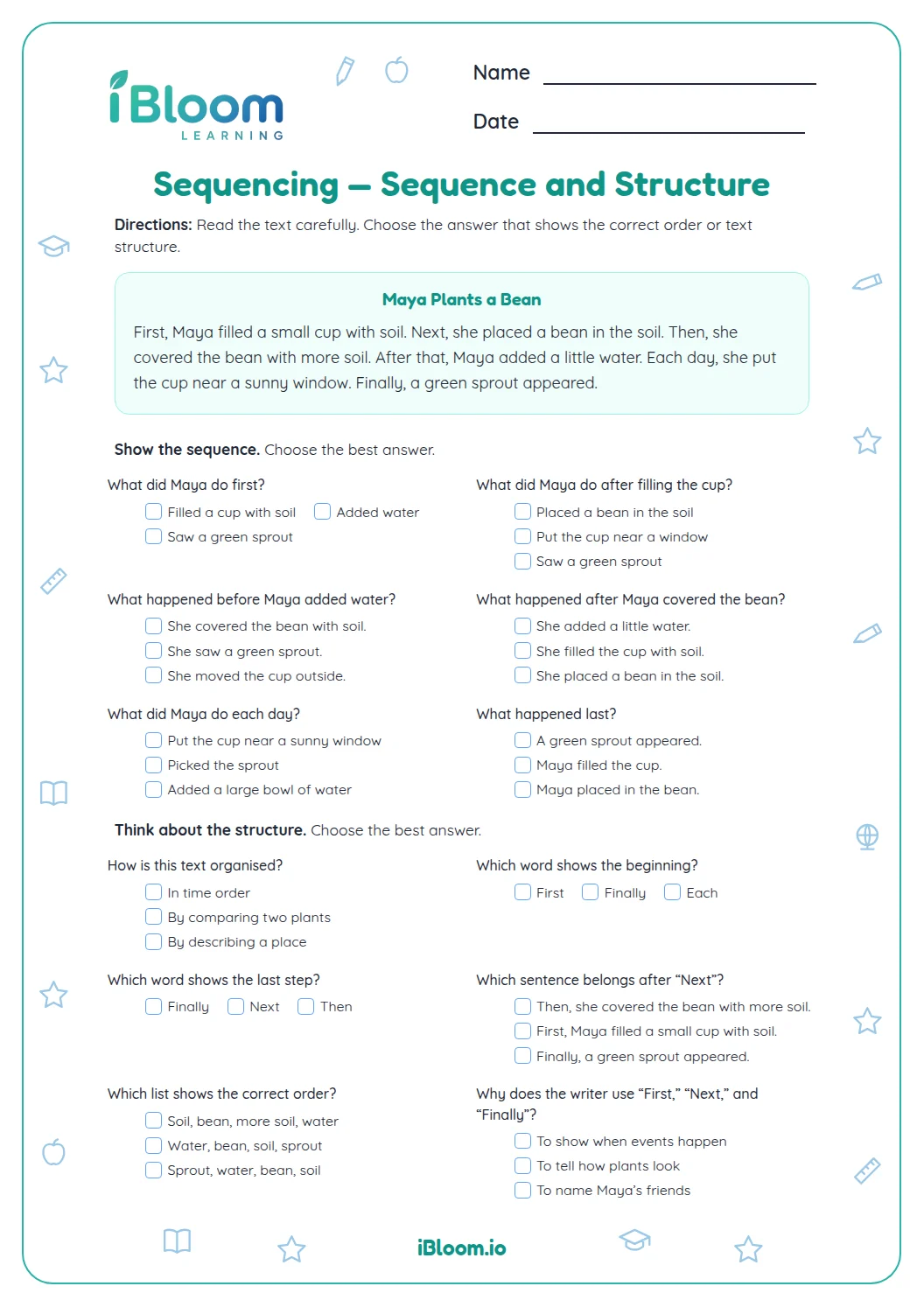
- 1Read the full passage once before starting the questions.
- 2Underline time words such as first, next and later.
- 3Check direct answers against a sentence in the passage.
- 4For an inference, name the clue and explain what it suggests.
- 5Use the answer key to discuss evidence, not just the final choice.
Mistakes to watch for
The mistake
Putting events in the order they were mentioned in a question.
The fix
Return to the passage and use its time words to check the order.
The mistake
Treating an inference as a guess.
The fix
Point to a passage clue and explain how it supports the idea.
The mistake
Giving a lesson without connecting it to the story.
The fix
Name one event that shows the lesson in action.
Common Core alignment
These standards describe the reading, writing or math skills practiced on this page.
Answer questions with details from the text.
On this sheet: The questions ask readers to cite passage details as evidence.
Show the official wordingHide the official wording
Ask and answer questions to demonstrate understanding of a text, referring explicitly to the text as the basis for the answers.
Recount events and explain how details support the central message.
On this sheet: Readers sequence the story events and infer a message using story details.
Show the official wordingHide the official wording
Recount stories, including fables, folktales, and myths from diverse cultures; determine the central message, lesson, or moral and explain how it is conveyed through key details in the text.
What to practice next
Make more practice
Further reading
Questions parents and teachers ask
What is an inference?
An inference is an idea supported by story clues and what a reader knows. Nia checks the soil before breakfast for several days and waits while the seeds grow; these details support an inference that she is patient and careful. Students can point to a line that supports their thinking.
How many questions follow the story?
There are 14 questions after the passage: 13 multiple-choice items and one written response. They ask about details, event order, an inference, the story lesson and evidence. Students can reread the passage and find the sentence that supports each choice.
How does the worksheet practice sequencing?
Questions ask what Nia and Grandpa do before planting, what Nia does while Grandpa loosens the soil, and what happens after they notice the tipped label. Other items ask for a full event order. Time words and rereading help check the sequence.
What counts as evidence for an inference?
Evidence is a detail stated in the passage that supports an idea. Nia checks the soil before breakfast for several days, which supports the idea that she is patient. The last question asks students to write one detail and the key gives a sample response.
What lesson does the story suggest?
The story suggests that patience helps when waiting for growth and that labels keep plans clear. Nia waits for seedlings and uses the label to locate the row. Both ideas come from what happens in the passage, and the question asks readers to choose the lesson that fits.
Can students answer in their own words?
Yes. Most items have choices, while the final response asks students to write one detail that supports an idea about Nia. The key gives a sample, and another clear detail from the story can also work if it supports patience.