Free printable practice
Moon Phases Practice Activities
Printable Grade 1 science activities for identifying, drawing, matching, and sequencing the Moon’s changing visible shapes.
Free printable worksheet PDFs
Preview every available page, then download the free worksheet PDF for home, homeschool, tutoring, or classroom practice.
Preview the exact activity before downloading it.
 Moon Phases — Sort and ClassifyPrintable Grade 1 science activities for identifying, drawing, matching, and sequencing the Moon’s changing visible shapes. This sort and classify worksheet provides a distinct, age-appropriate way to practise the same lesson.Grade 1Free PDF preview6 pages
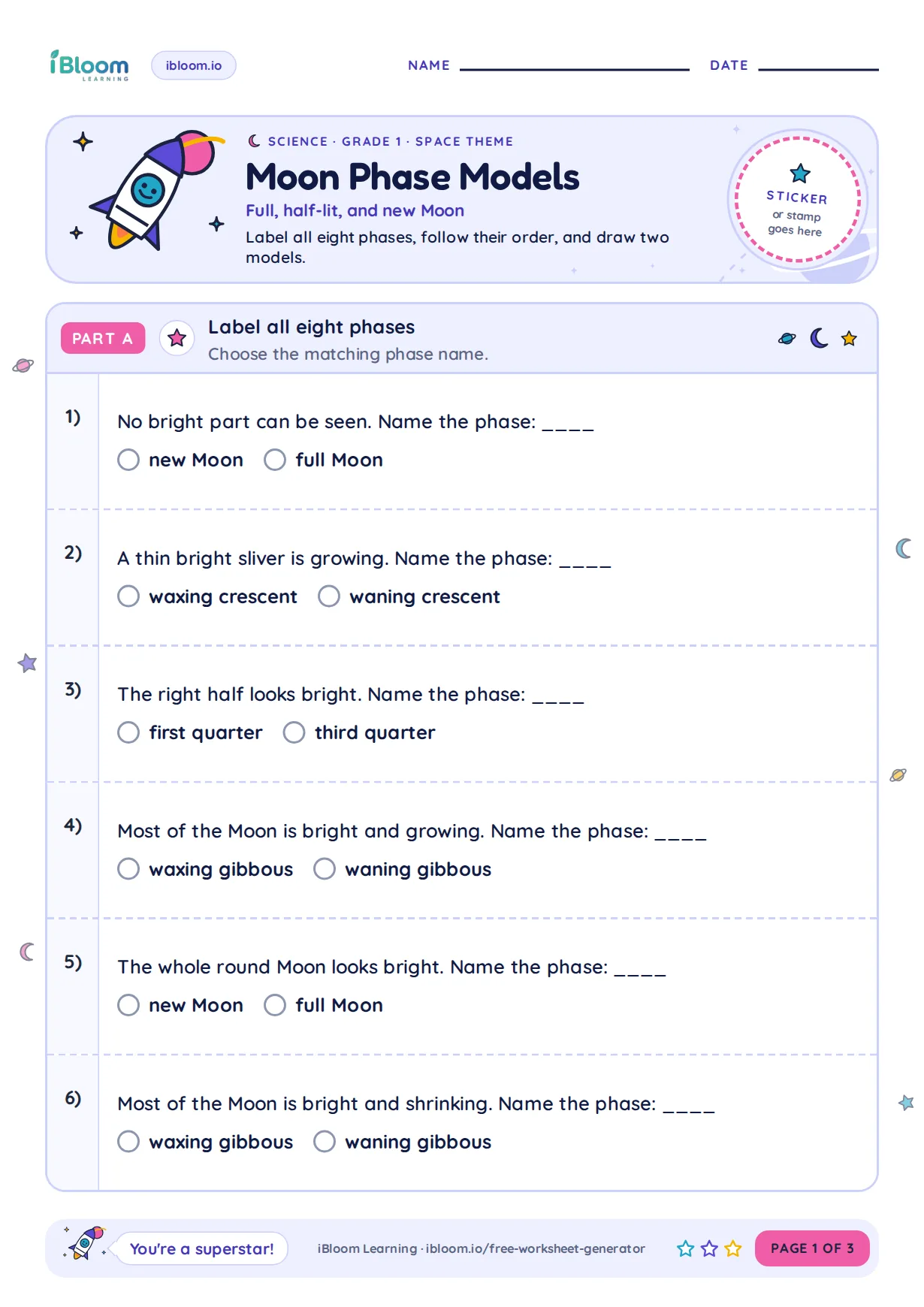 Moon Phases — Label and ModelPrintable Grade 1 science activities for identifying, drawing, matching, and sequencing the Moon’s changing visible shapes. This label and model worksheet provides a distinct, age-appropriate way to practise the same lesson.Grade 1Free PDF preview
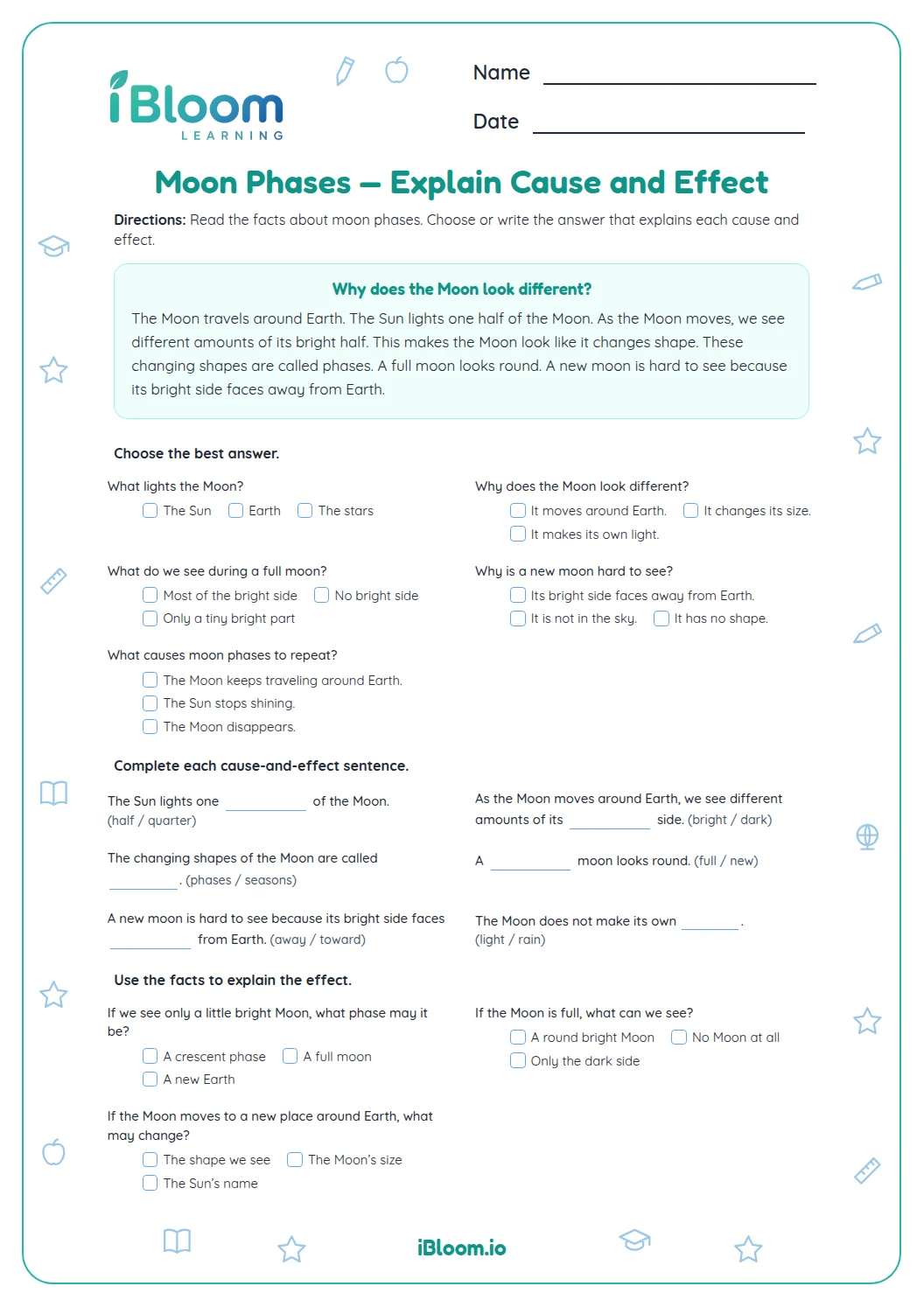 Moon Phases — Explain Cause and EffectPrintable Grade 1 science activities for identifying, drawing, matching, and sequencing the Moon’s changing visible shapes. This explain cause and effect worksheet provides a distinct, age-appropriate way to practise the same lesson.Grade 1Free PDF preview
 Moon Phases — Apply Science IdeasPrintable Grade 1 science activities for identifying, drawing, matching, and sequencing the Moon’s changing visible shapes. This apply science ideas worksheet provides a distinct, age-appropriate way to practise the same lesson.Grade 1Free PDF preview
 Moon Phases — Science Reasoning ReviewPrintable Grade 1 science activities for identifying, drawing, matching, and sequencing the Moon’s changing visible shapes. This science reasoning review worksheet provides a distinct, age-appropriate way to practise the same lesson.Grade 1Free PDF preview
Practice that builds confidence
What children learn about Moon phases
These Grade 1 science worksheets help children notice that the Moon appears to change shape in the night sky. Students practise identifying and describing visible Moon shapes such as new moon, crescent, quarter, gibbous, and full moon, using simple picture clues and everyday language.
The printable activities include labelling, matching, sequencing, drawing, and observation-style prompts. They connect the Earth-Sun-Moon topic to what children can see from home or school, building careful looking, science vocabulary, and early pattern awareness.
Children first learn that the Moon is not changing its real shape. It looks different because we see different amounts of its sunlit side from Earth. At this level, the goal is simple: observe, compare, name, and order the visible shapes. Worksheets may show a dark moon, a thin crescent, a half-looking moon, a mostly lit gibbous moon, and a fully lit moon.

Building from pictures to sequence
The activities move from recognizing one picture at a time to comparing several Moon images. Children match a phase name to a picture, shade the lit part, choose the next likely shape, or place phase cards in order. This progression helps them see the Moon phase cycle as a repeating pattern rather than as separate pictures to memorize.
A practical parent routine
Pick two or three evenings in a week to look for the Moon together, or use a picture if the sky is cloudy. Ask, “How much of the Moon looks bright?” and “Is it thin, half-looking, mostly bright, or full?” Have your child sketch the shape in a notebook, then compare it with a worksheet image. Keep the language relaxed and observational.

Classroom uses for Grade 1 science
Teachers can use these printables for a whole-class Earth, Sun, and Moon lesson, science centers, partner matching games, morning work after a Moon observation, or a quick check for understanding. Drawing prompts work well in science notebooks because children must show the lit part, not just circle an answer.

Common errors to watch for
Some children think clouds or Earth’s shadow make the Moon phases. An eclipse does involve shadow, but regular phases happen because of the Moon’s position as it moves around Earth. Children may also say the Moon makes its own light. Gently repeat: the Sun lights the Moon, and we see the bright part.
Free printable PDF download
Use this grade 1 moon phases worksheet page to preview the activity, print it, or download it as a PDF for quick practice. It works well for homework, homeschool lessons, tutoring, morning work, revision, and classroom centers.
Answers and answer key support
After the child completes the worksheet independently, parents and teachers can use the answer support or answer key information to check the work, review mistakes, and choose the next practice step.
Why iBloom worksheets help
The pages give young learners clear visuals, repeated vocabulary, and small tasks that match Grade 1 attention and reading levels. A child-friendly strategy is: look at the bright part, name the shape, trace or shade it, then say one sentence such as, “This Moon is a crescent because only a small part looks bright.”
Helpful answers
Frequently asked questions
Which Moon phases should a Grade 1 child recognize?
Most Grade 1 learners can start with broad visual groups: new moon, crescent, quarter or half-looking moon, gibbous, and full moon. Exact advanced terms can be introduced gradually.
Do these worksheets require children to observe the real Moon?
No. The worksheets can be completed with the printed pictures, but a simple sky observation at home or school makes the ideas more meaningful.
How can I explain Moon phases simply?
Tell children that the Sun lights the Moon, and from Earth we see different amounts of the bright part. The Moon itself stays round; only its visible bright part appears to change.
What is the most common misconception in this topic?
Many children think regular Moon phases are caused by Earth’s shadow. Clarify that shadows are part of eclipses, while phases are the usual changing views of the Moon’s sunlit side.
Can these printables be used in a science center?
Yes. Matching cards, phase-order tasks, and draw-and-label pages work well as independent or partner activities in Grade 1 science centers.
Is this grade 1 moon phases worksheet free?
Yes. You can preview it for free and use the printable worksheet for home or classroom practice.
Can I download this grade 1 moon phases worksheet as a PDF?
Yes. Use the worksheet download option to save a printable PDF, or print the worksheet directly from the page.
Does this grade 1 moon phases worksheet include answers or an answer key?
When the activity has fixed answers, iBloom includes answer support so parents and teachers can check the completed worksheet.