








About this worksheet
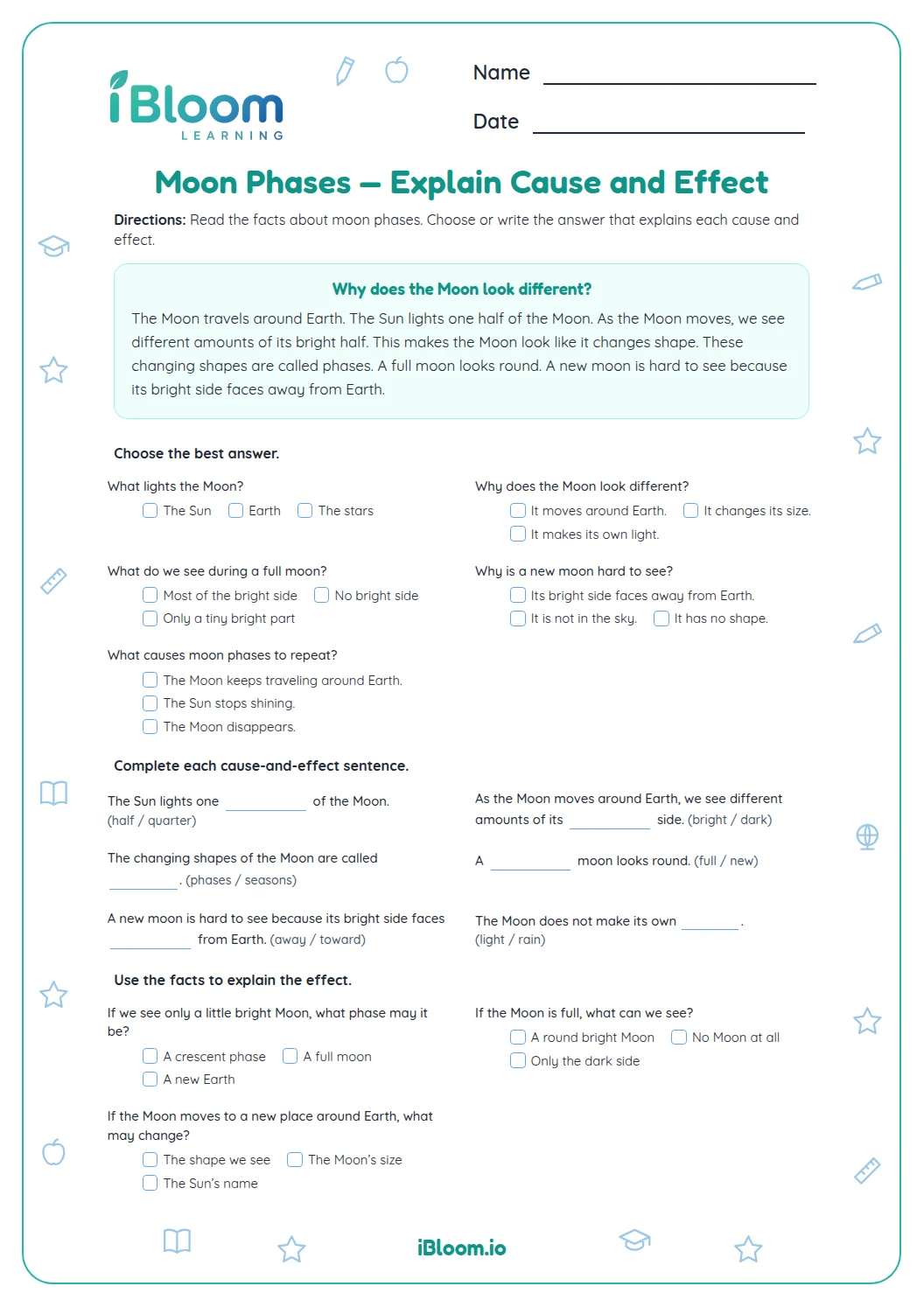
This free printable Grade 1 worksheet practices the eight familiar Moon phases by name, appearance, and order. Part A pairs each phase name with a short description, from new Moon through waning crescent. Part B asks children to write the next phase in the repeating cycle. Part C checks new Moon and first quarter. Part D provides two drawing boxes for full Moon and waxing crescent models. The 16 tasks connect phase vocabulary to simple observations; an adult can read descriptions aloud.
How can I match a description to a phase name?
Read the appearance clue and focus on two details: how much of the disk looks bright and whether the bright part is growing or shrinking. Part A uses choices to label all eight phases in cycle order.
A thin bright sliver that is growing is a waxing crescent. A thin sliver that is shrinking is a waning crescent. The words waxing and waning describe the change from night to night.
- 1A thin bright sliver is growing.
- 2A growing sliver is waxing.
- 3Write “waxing crescent.”
What comes next in the Moon phase cycle?
The phase names follow a repeating order: new Moon, waxing crescent, first quarter, waxing gibbous, full Moon, waning gibbous, third quarter, and waning crescent. After waning crescent, the cycle returns to new Moon.
For each Part B item, find the named phase in that sequence and write the one immediately after it.
What belongs in the two phase drawings?
Draw a full bright disk for the full Moon. For the waxing crescent, show a thin bright crescent on the right and shade most of the disk. Accept a clear circle with the correct bright area and a phase label.
How to use this worksheet
- 1Read the phase names aloud once in cycle order.
- 2For Part A, focus on how much of the disk looks bright.
- 3Use growing or shrinking to choose between waxing and waning names.
- 4For each Part B blank, write the phase that comes next in the cycle.
- 5Draw and label the full Moon and waxing crescent, then check the bright portions.
Mistakes to notice and fix
The mistake
Mixing up waxing and waning crescent.
The fix
Waxing means the bright part is growing; waning means it is shrinking.
The mistake
Calling first quarter the left half bright.
The fix
In this model, first quarter has the right half bright; third quarter has the left half bright.
The mistake
Putting full Moon after waning crescent.
The fix
Waning crescent returns to new Moon; waxing phases then lead toward full Moon.
What to practice next
Make more practice
Questions parents and teachers ask
Which Moon phases does the worksheet include?
It includes all eight phases: new Moon, waxing crescent, first quarter, waxing gibbous, full Moon, waning gibbous, third quarter, and waning crescent. Part A matches each name to an appearance clue, and Part B practices what comes next in the cycle.
How do waxing and waning differ?
Waxing means the visible bright part is growing from night to night; waning means it is shrinking. The crescent clues on this sheet use those changes to distinguish waxing crescent from waning crescent. Read the word and the description together before choosing a label.
Which side is bright at first quarter?
The sheet describes first quarter with the right half bright and third quarter with the left half bright. These conventional Northern Hemisphere drawings help children match the names with the pictured sky pattern. The phase name and stated bright side should agree in the model.
What should the waxing crescent drawing show?
Draw a circle with most of the disk dark and a thin bright crescent on the right. Label it waxing crescent. The key describes the important features, so a child’s circle need not be perfectly round as long as the bright sliver and label are clear.
What happens after waning crescent?
The cycle returns to new Moon after waning crescent. From there it moves through waxing crescent, first quarter, and waxing gibbous before full Moon. Part B includes this return so children can see that the sequence repeats rather than ending at the last named phase.