







About this worksheet
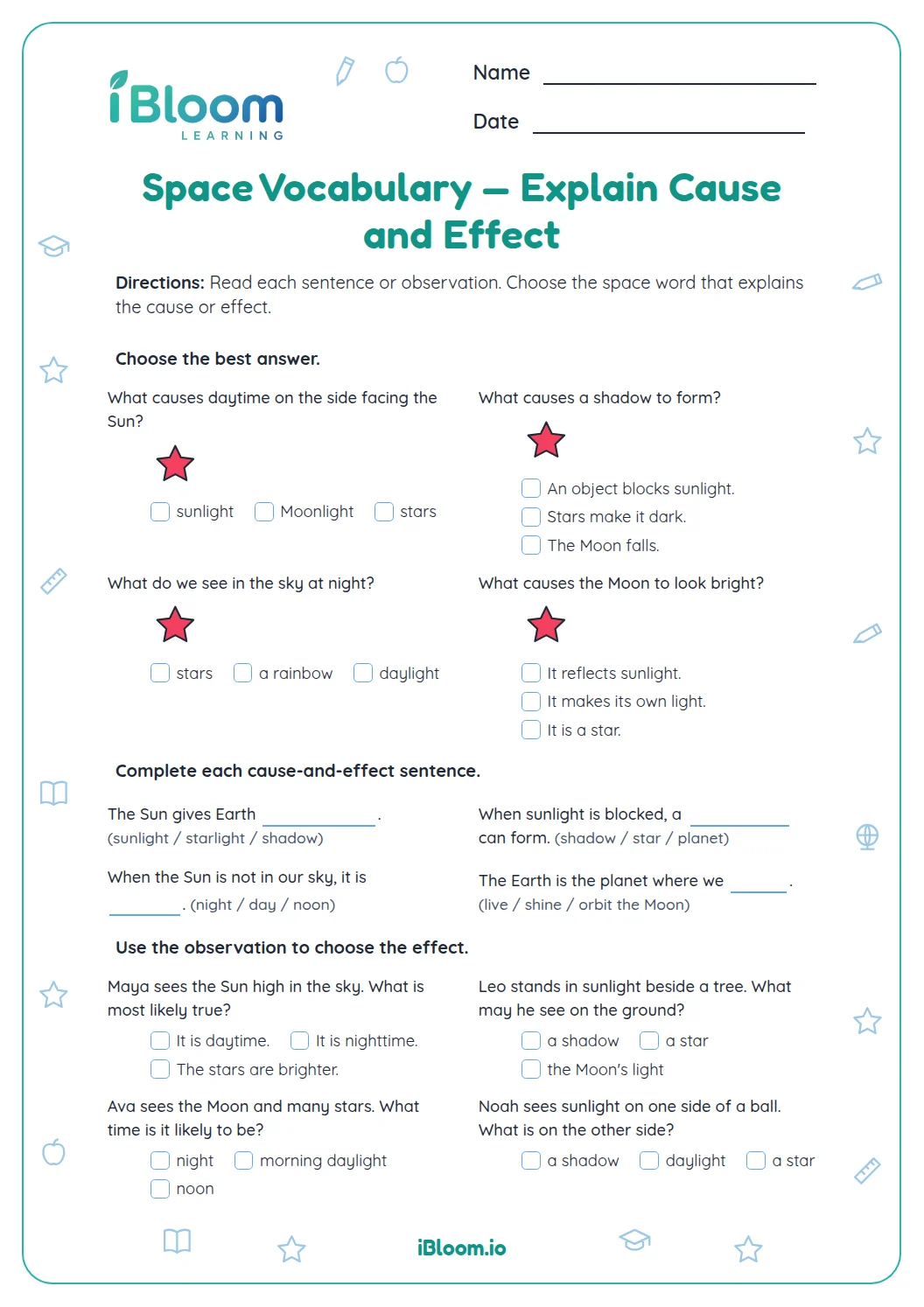
This Grade 1 science worksheet helps children use observations to describe patterns in the sky. Across 14 questions, students consider where the Sun appears at different times, connect its changing position with shadow changes, and use repeated observations to make predictions. The questions support NGSS 1-ESS1-1, which asks students to use observations of the Sun, Moon, and stars to describe predictable patterns. A separate key lists the correct choices for review.
Aligned to 1-ESS1-1
What changes as the Sun appears to move?
The worksheet begins with observations at different times of day. Students use words such as east, west, higher, and lower to describe the Sun’s apparent path.
How can a sky pattern help explain a shadow?
A changing Sun position can change a shadow’s length and direction. Students connect the observation with a reasonable effect, then use repeated observations to make a prediction.
- 1If a shadow is short at noon and long later, the Sun’s position has changed and the shadow has grown longer.
What makes an observation useful for prediction?
Recording the sky at the same times on different days helps children notice a repeating pattern. The pattern supports a prediction about what they may observe next.
How to use this worksheet
- 1Read each observation and identify its time or direction clue.
- 2Describe the Sun’s apparent position using everyday direction words.
- 3Connect a change in the Sun’s position with the shadow observation.
- 4Use repeated observations to explain what might happen next.
- 5Check the key and discuss which observation supports each answer.
Mistakes to watch for
The mistake
Saying the Sun stays in one place because it rises again the next day.
The fix
Track where it appears at morning, midday, and evening.
The mistake
Treating one cloudy or unusual observation as a repeating pattern.
The fix
Compare observations from several days at the same times.
The mistake
Assuming the Moon can only be seen at night.
The fix
Remember that the Moon is sometimes visible in daylight too.
Next Generation Science Standards alignment
Observe sky patterns to describe what can be predicted.
On this sheet: Students use observations of the Sun, Moon, and stars to describe and predict patterns.
Show the official wordingHide the official wording
Use observations of the sun, moon, and stars to describe patterns that can be predicted.
What to practice next
Make more practice
Further reading
Questions parents and teachers ask
What sky pattern does this worksheet focus on?
Students observe how the Sun appears in different parts of the sky during the day. They also connect its position with shadow changes and consider when other stars are visible. The questions focus on repeated observations children can use to describe a pattern.
Does the worksheet say the Sun actually travels around Earth each day?
The items describe what an observer sees: the Sun appears to move across the sky. This language keeps the activity focused on observable patterns and does not ask children to explain the full cause of day and night. The question wording keeps attention on what an observer can notice from Earth.
Why are shadows included?
Shadows offer a visible effect that can change as the Sun appears in a different part of the sky. Students connect a time-of-day observation with a change in shadow length or direction. Students can point to an observation before explaining the change they infer.
Can the Moon be seen during the day?
Yes. The Moon is sometimes visible during daylight. One question asks students to recognize that a daytime Moon sighting is possible while keeping most of the practice on the Sun’s daily pattern. This item checks a familiar sky observation rather than a memorized definition.
What does the answer key include?
The key lists the correct choice for each observation and pattern question. Review a response by asking which clue points to it. The illustrations support the sky observations, while the options keep the activity focused on patterns children can notice and describe.
How can we extend the activity outside?
At a safe location, look for the Sun at scheduled times without staring at it. Record the direction or position from a shaded spot, then compare notes and discuss what may happen at the next observation. A dated observation log gives children evidence to discuss and compare.