







About this worksheet
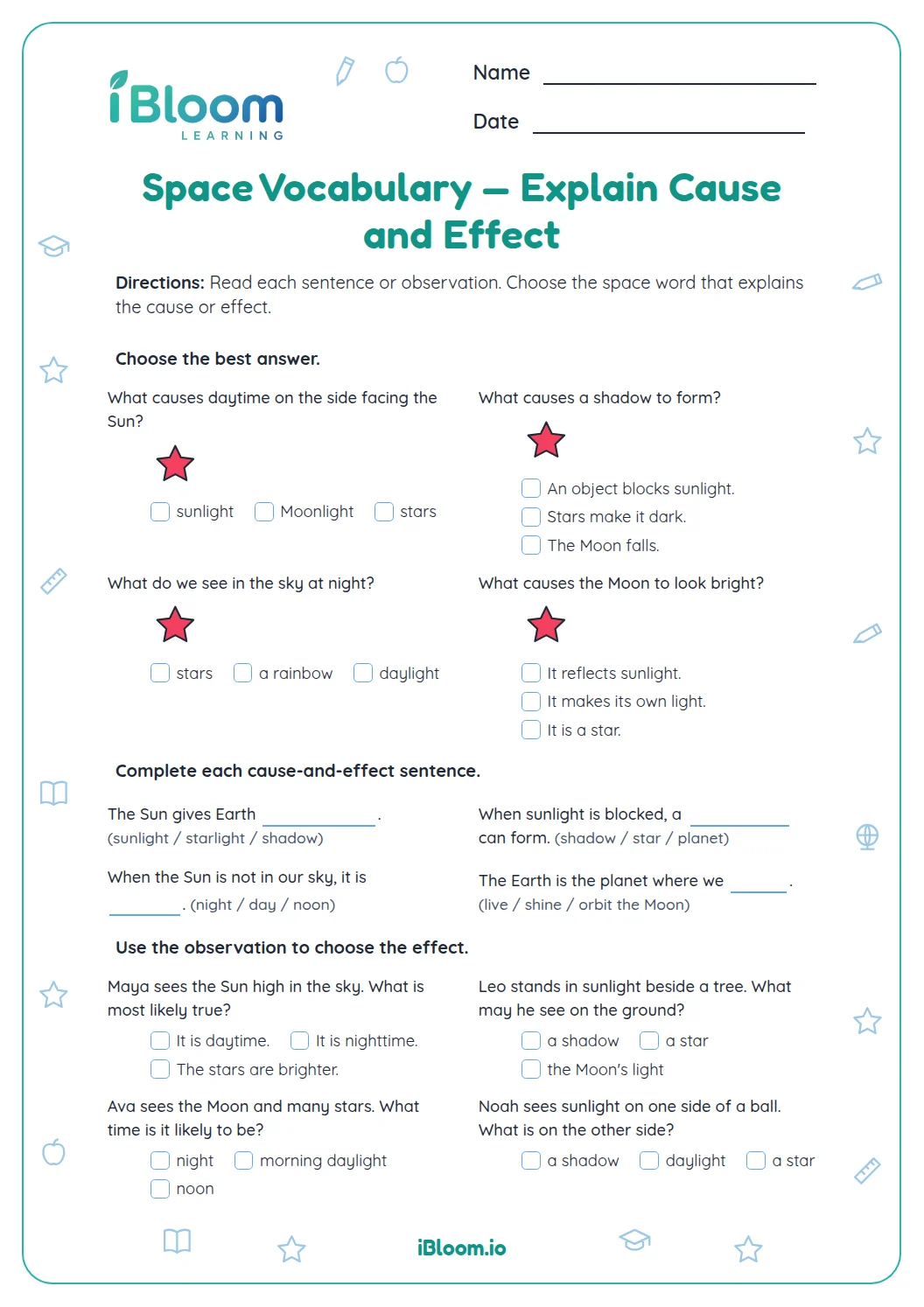
This Grade 1 science worksheet asks students to apply familiar observations of the Sun, Moon, and stars. Across 14 questions, children identify repeated sky patterns and choose what those observations help them predict. The page aligns with NGSS 1-ESS1-1: using observations of the Sun, Moon, and stars to describe patterns that can be predicted. The answer key lists the best choice for each question.
Aligned to 1-ESS1-1
What patterns do students reason about?
The 14 questions address the apparent daily path of the Sun, the Moon’s changing position in the sky, and the visibility of stars at night. Students choose observations and predictions that fit these repeated patterns.
Each item describes a familiar time or observation, then asks what it suggests. The focus is on evidence gathered by looking at the sky over time.
- 1When the Sun appears low in the west, nighttime usually follows.
- 2A repeated observation supports a simple prediction.
How do observations help predict what comes next?
A pattern is something people notice happening again in a similar way. After seeing the Sun appear in the morning on many days, a student can predict that it will appear again the next morning.
A prediction should fit observations. It is not a guess about something unrelated to the evidence.
How can children observe the sky safely?
Never look straight at the Sun. An adult can help children use a safe shadow observation, a photo, or a description of the time and place where the Sun appears.
Children can also notice stars at night with an adult and compare what is visible at different times.
How to use this worksheet
- 1Read each sky situation carefully.
- 2Think about what is repeatedly observed at that time of day.
- 3Choose the answer that follows from the observation.
- 4Explain the pattern aloud using “I noticed…” or “I predict…”.
- 5Review answers with the key and discuss the evidence.
Common mistakes and fixes
The mistake
Treating a prediction as a random guess.
The fix
Use a repeated observation as evidence for what may happen next.
The mistake
Thinking stars appear only because it is nighttime.
The fix
Explain that stars are present, but daylight makes them hard to see.
The mistake
Looking directly at the Sun to observe it.
The fix
Use a safe shadow, a photograph, or an adult-guided observation instead.
Curriculum alignment
This page gives children focused practice with the named skill.
Use sky observations to describe patterns that can be predicted.
On this sheet: Children apply repeated observations about where the Sun and Moon appear and when stars are visible.
Show the official wordingHide the official wording
Use observations of the sun, moon, and stars to describe patterns that can be predicted.
What to practice next
Further reading
Questions parents and teachers ask
What sky patterns does this worksheet cover?
The page focuses on patterns children can observe: the Sun appears to rise, move across the sky, and set; the Moon also appears in different parts of the sky; and stars are visible at night but not during the day. Students use these patterns to make simple predictions.
How many questions are included?
There are 14 multiple-choice questions in two parts. Part A asks students to notice recurring sky patterns; Part B asks them to apply observations as evidence for a prediction or explanation. The answer key marks the best choice for each question.
Does the worksheet say the Sun really moves around Earth?
The questions describe how the Sun appears to move across the sky from an observer’s view on Earth. Students use that observation to describe a repeated pattern, such as the Sun appearing in the east in the morning and low in the west near sunset.
Why do students learn about patterns in the sky?
Repeated observations help children notice what happens regularly and make a reasonable prediction. For example, seeing the Sun low in the western sky can help a child expect nighttime to follow. Students can describe which observation supports their prediction.
Can children observe the Sun directly?
Children should never look directly at the Sun. They can notice the sky with an adult’s guidance, using safe indirect observations such as shadows, time of day, or an adult-provided photograph. These methods let students compare observations without looking at the Sun.
What should a child do after answering the page?
Invite the child to describe the sky at different times using a drawing, a photograph, or an adult-guided observation. Ask what changed and what stayed predictable. Never look directly at the Sun; use shadows, safe photos, and adult guidance.