








About this worksheet
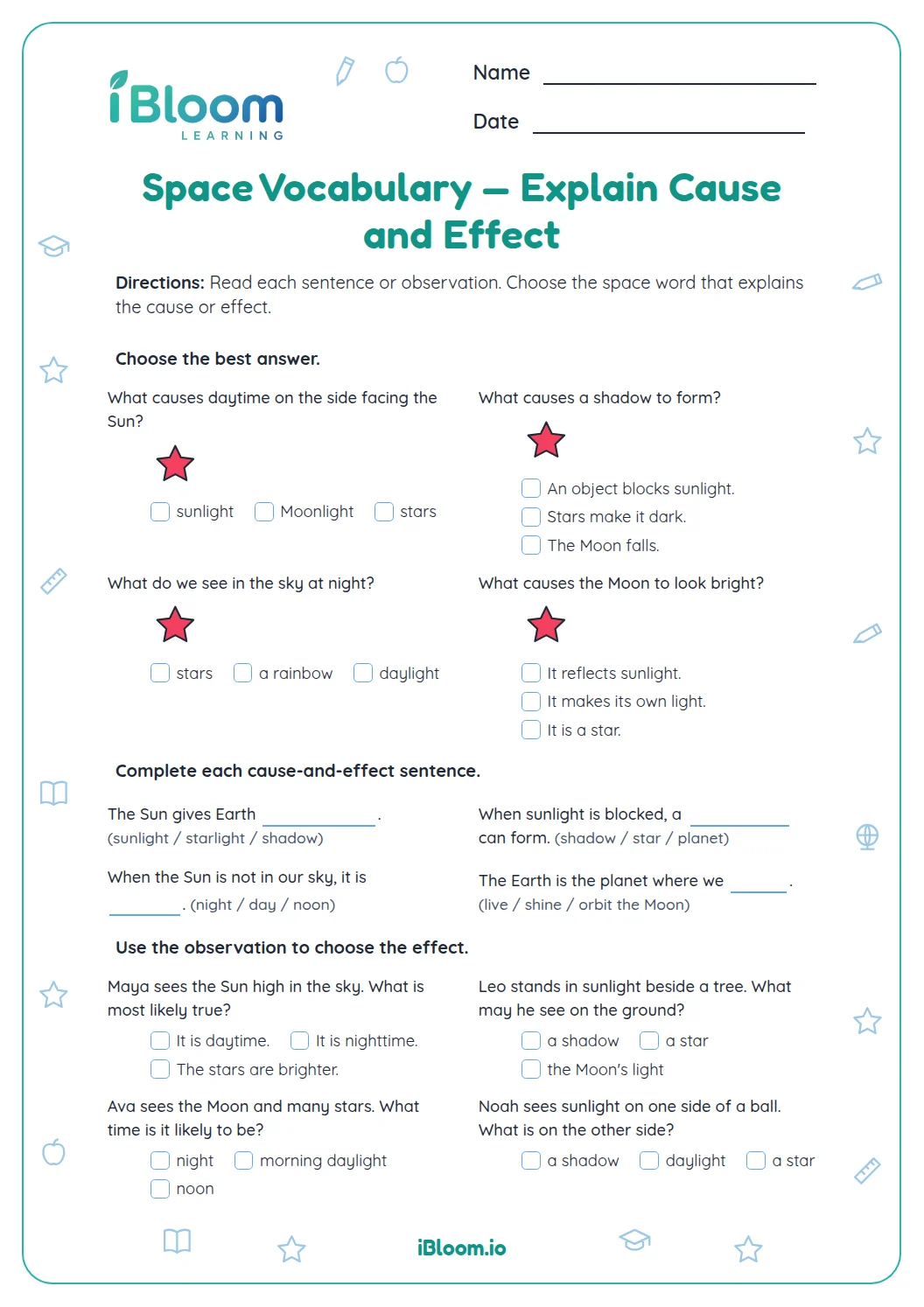
This Grade 1 printable practices noticing the Sun’s daily pattern and how sunlight and shadows change. Learners answer 14 questions: they choose observations, complete science sentences, and use evidence about a stick’s shadow at different times. The answer key supports checking the pattern and explaining what an observation shows. It connects to NGSS 1-ESS1-1 by using observations to describe patterns in the natural world.
Aligned to 1-ESS1-1
What Sun patterns does the sheet practice?
Part A asks learners to recognize when the Sun is visible and how it appears to move. Part B adds shadow evidence: a stick’s shadow is longer in the morning, shorter near noon, then may grow longer as the Sun appears lower.
The questions keep the wording observational: the Sun appears to move across the sky. Learners should never look directly at it.
- 14 questions practice the skill in steps
- The answer key follows the worksheet questions
- Open responses include sample answers
How can a learner tell a pattern from a guess?
Question 9 compares a stick’s morning shadow with its noon shadow. The answer is “longer”: as the Sun appears higher, the shadow is shorter.
How can the answer key support practice?
Check the selected response first, then compare each completed sentence with the key. For the shadow items, ask what changed between the two observations and what that suggests about the Sun’s apparent position.
- Point to one clue that supports the answer
- Return to the passage or situation when needed
A simple practice routine
- 1Read each observation carefully.
- 2Choose what the observation supports.
- 3Complete the Sun and shadow sentences.
- 4Use the time of day to compare shadow lengths.
- 5Check the key and explain one pattern aloud.
Common mistakes and quick fixes
The mistake
Saying the Sun sets in the morning.
The fix
Recall the daily order: it appears to rise in the morning and set in the evening.
The mistake
Looking directly at the Sun to observe its path.
The fix
Observe the sky without looking at the Sun itself.
The mistake
Calling a single sighting a repeating pattern.
The fix
Compare observations made at different times or on more than one day.
Curriculum alignment
The questions connect observations and evidence to the science idea named in this NGSS performance expectation.
Use repeated sky observations to describe the Sun’s apparent daily movement.
On this sheet: Patterns of the sun, moon and stars
Show the official wordingHide the official wording
Use observations (firsthand or from media) to describe patterns in the natural world in order to answer scientific questions.
What to practice next
Make more practice
Further reading
Questions parents and teachers ask
What does the Sun patterns worksheet cover?
It covers the Sun’s apparent daily movement and the way shadows change as the Sun appears higher or lower. Learners answer eight selected-response items and six fill-ins, then use the answer key to check Sun and shadow observations. Invite the learner to explain one choice and point to its evidence before checking.
How should children observe the Sun safely?
Children should never look directly at the Sun. They can observe the surrounding sky from a safe place or compare a shadow made by an object at different times. The worksheet reinforces safe observation while asking what repeated observations can show.
Why is a morning shadow longer than a noon shadow?
When the Sun appears low in the morning, an object’s shadow is often longer. Near noon, the Sun appears higher and the shadow is often shorter. The worksheet uses this pattern to help children connect observations with time of day.
How many questions and pages are included?
There are 14 questions across two worksheet pages, followed by a two-page answer key. The first part uses multiple choice; the second part completes short sentences about shadow lengths, blocked sunlight, and daily patterns. Invite the learner to explain one choice and point to its evidence before checking.
Can children use different words from the key?
The selected-response answers should match a listed choice. For fill-ins, accept a different word only if it expresses the same science idea and fits the sentence. In particular, keep the wording observational: the Sun appears to move across the sky.