


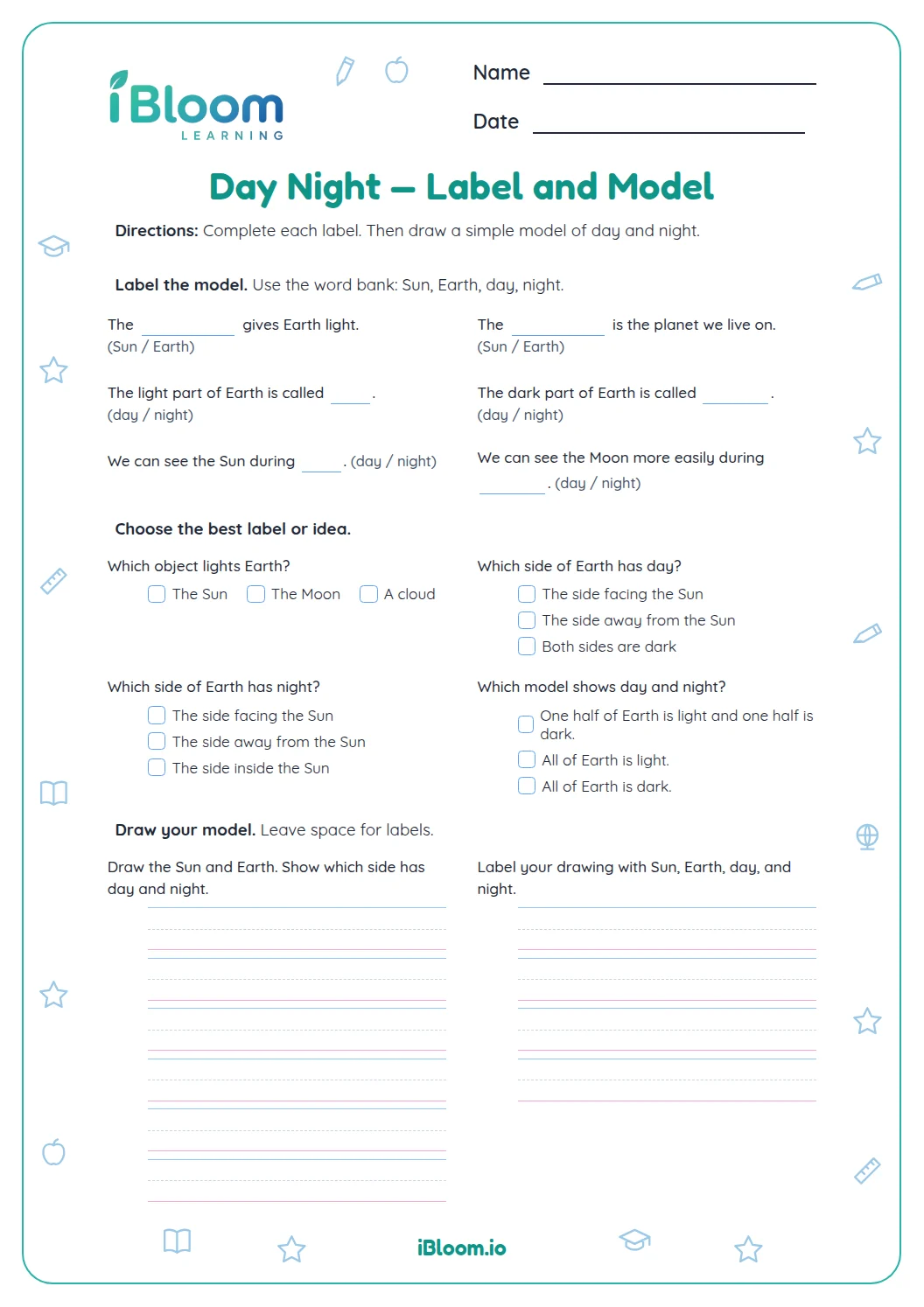
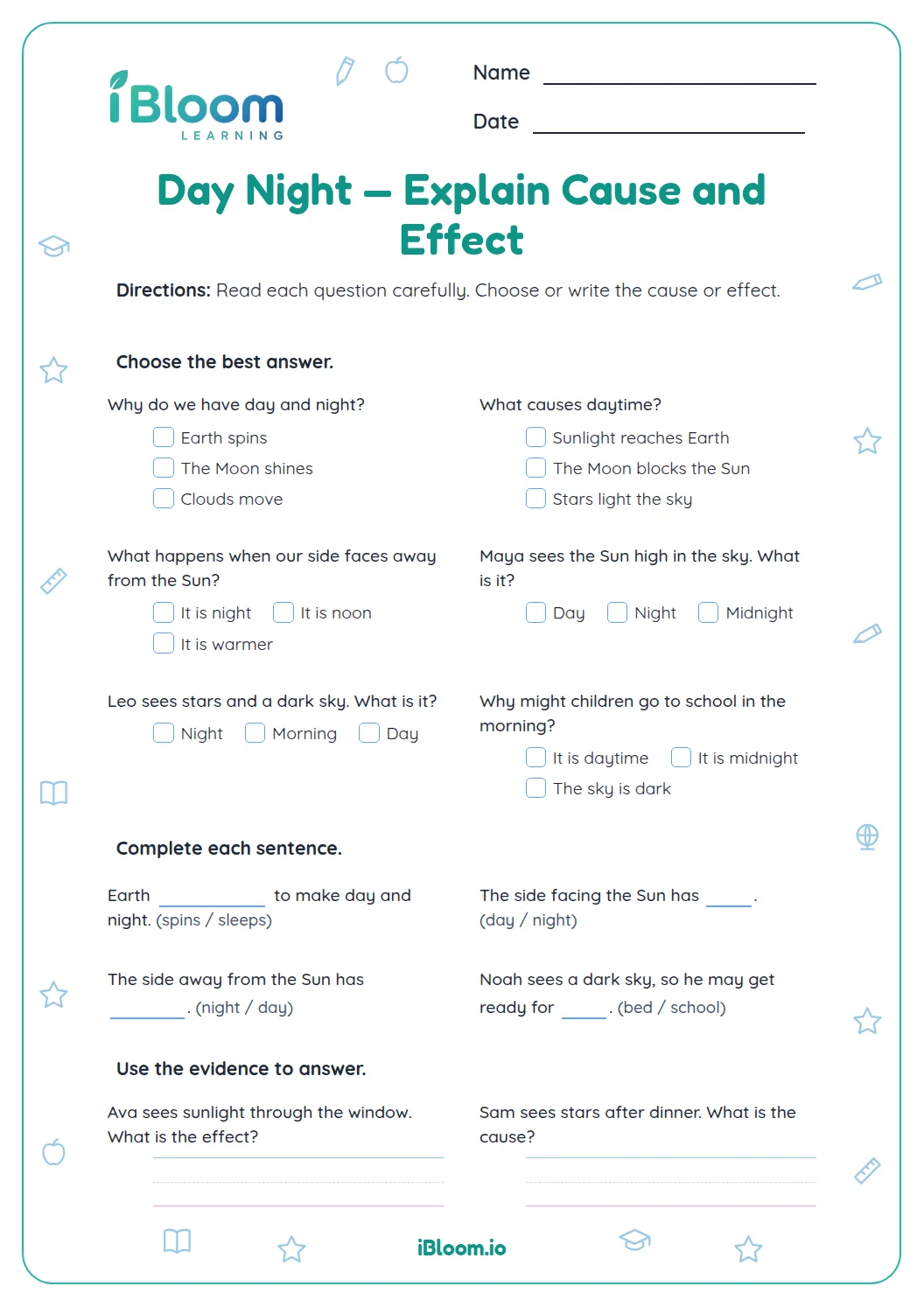


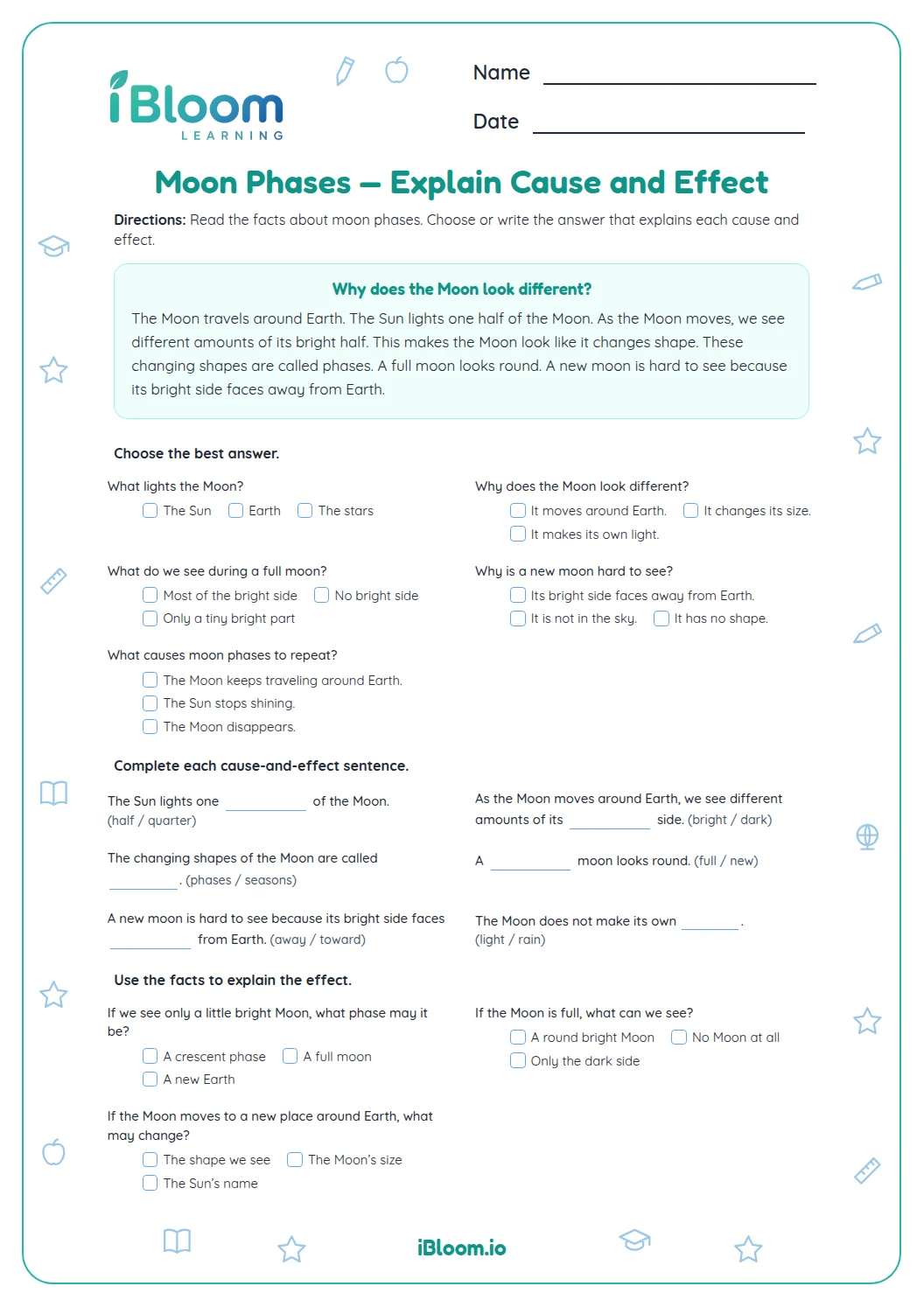


About this worksheet
This Grade 1 science worksheet uses observations of the sky to describe a pattern students can predict. Its 14 questions cover where the Sun appears at sunrise and sunset, how its apparent position changes through the day, when stars are usually visible, and what observations can be repeated and recorded. A separate answer key follows the same numbering. The practice connects to NGSS 1-ESS1-1 by using observations of the Sun and stars to describe predictable patterns.
Aligned to 1-ESS1-1
What daily pattern does the Sun appear to follow?
Repeated observations show the Sun appearing low in the east around sunrise, higher later in the day, and low in the west around sunset. Question 6 summarizes that apparent path.
- 1The observed order is east, across the sky, then west.
- 2This describes the Sun’s apparent daily pattern.
How can an observation support a prediction?
If a student repeatedly sees the Sun low in the east in the morning, that pattern supports a prediction that it may appear in the east the next morning. A prediction uses repeated evidence and remains a possibility to check.
What should students record?
Recording both the time and the Sun’s position makes observations easier to compare. The worksheet also asks students to distinguish daytime observations from the usual nighttime view of other stars.
How to use this worksheet
- 1Read the time clue in each question before choosing a sky observation.
- 2Keep sunrise in the east and sunset in the west in mind.
- 3For a prediction, connect the new situation to a repeated observation.
- 4When asked what to record, include both time and sky position.
- 5Check answers with the key and explain which observation supports each one.
Common mistakes and quick fixes
The mistake
Switching sunrise and sunset directions.
The fix
Pair sunrise with east and sunset with west before tracing the order across the sky.
The mistake
Treating the Sun’s apparent movement as a one-time event.
The fix
Compare observations made at the same times on different days.
The mistake
Recording only the Sun’s position.
The fix
Add the observation time so positions can be compared meaningfully.
Curriculum alignment
This worksheet practices 1-ESS1-1 through its question set.
Use repeated observations of the Sun and stars to describe patterns and make predictions.
On this sheet: The questions directly practice the named skill through identification, application, and explanation.
Show the official wordingHide the official wording
Use observations of the sun, moon, and stars to describe patterns that can be predicted.
What to practice next
Make more practice
Further reading
Questions parents and teachers ask
What does the worksheet ask about sunrise and sunset?
Students identify that the Sun appears in the east at sunrise and in the west at sunset. They use those observations to describe its apparent movement across the sky during the day. Have students point to the clue in the question or passage and explain how it supports the choice they made.
Does the worksheet include predictions?
Yes. Students use a repeated observation, such as the Sun appearing low in the east each morning, to predict what they may observe the next morning. The questions emphasize a pattern rather than a one-time guess. Have students point to the clue in the question or passage and explain how it supports the choice they made.
What do students record to compare observations?
Question 14 asks students to record the time and the Sun’s position in the sky. Repeating those observations gives them information to compare across the day. Have students point to the clue in the question or passage and explain how it supports the choice they made.
Why are stars included in a Sun-pattern worksheet?
Students compare daytime and nighttime observations as part of describing sky patterns. They identify that stars other than the Sun are usually visible at night. Have students point to the clue in the question or passage and explain how it supports the choice they made.
How many questions and parts are included?
There are 14 questions in four parts, including multiple-choice items and short responses. The parts move from noticing the daily pattern to making a prediction and describing useful observations. Have students point to the clue in the question or passage and explain how it supports the choice they made.