Free printable practice
Light Dark Practice Activities
Grade 1 science worksheets that help children compare light and dark, notice light sources, and describe how visibility changes.
Free printable worksheet PDFs
Preview every available page, then download the free worksheet PDF for home, homeschool, tutoring, or classroom practice.
Preview the exact activity before downloading it.
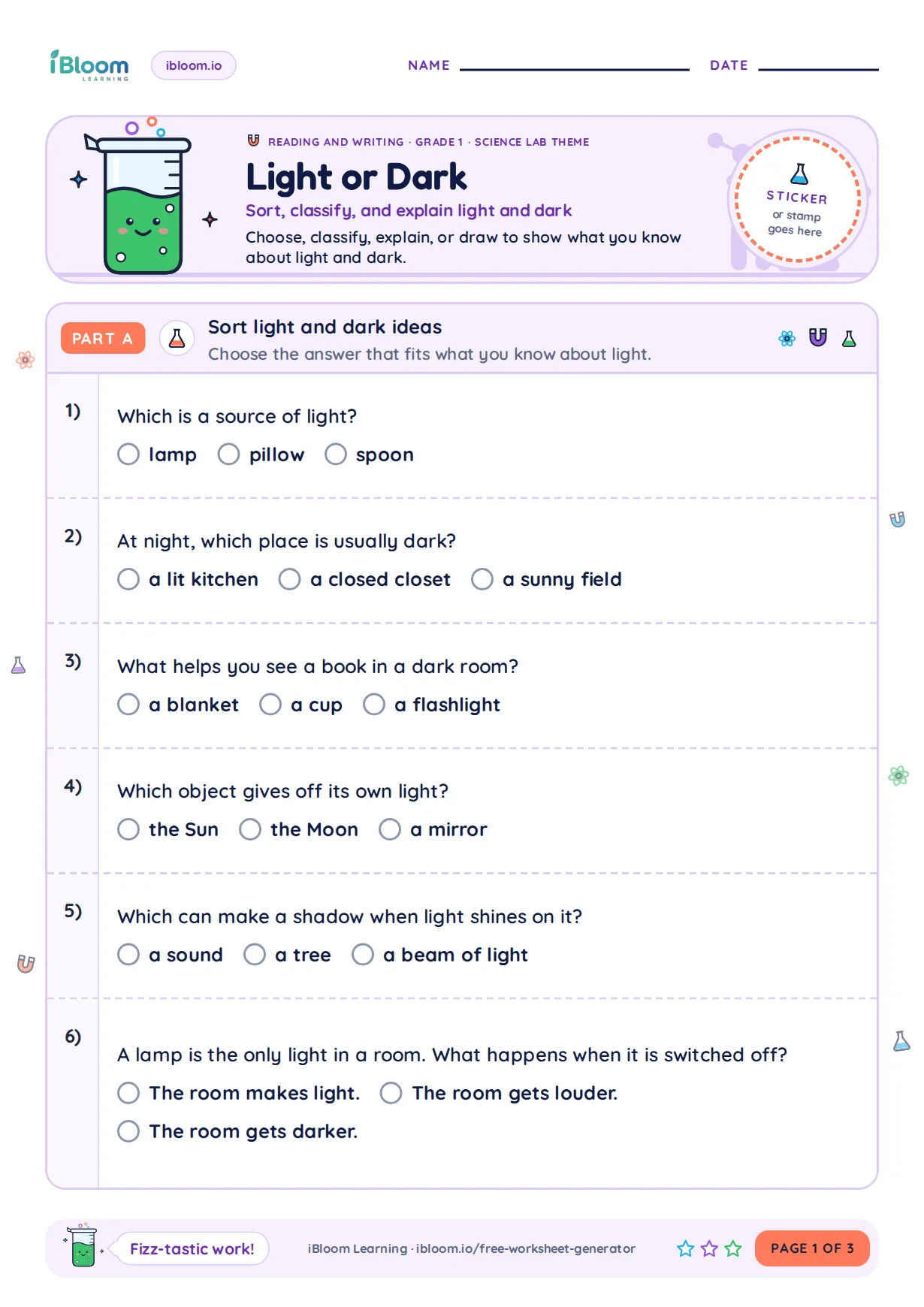 Light Dark — Sort and ClassifyGrade 1 science worksheets that help children compare light and dark, notice light sources, and describe how visibility changes. This sort and classify worksheet provides a distinct, age-appropriate way to practise the same lesson.Grade 1Free PDF preview4 pages
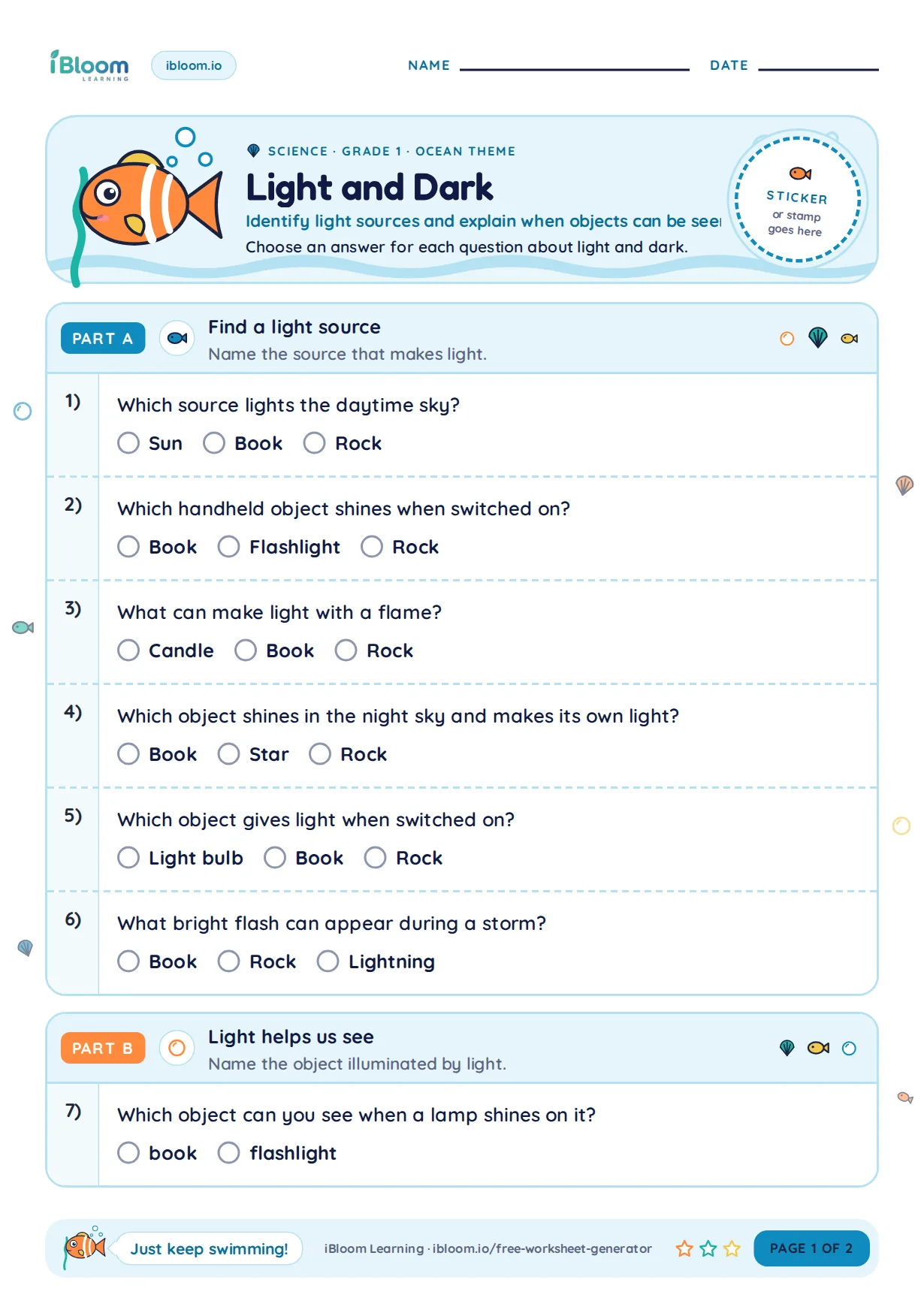 Light Dark — Label and ModelGrade 1 science worksheets that help children compare light and dark, notice light sources, and describe how visibility changes. This label and model worksheet provides a distinct, age-appropriate way to practise the same lesson.Grade 1Free PDF preview
 Light Dark — Explain Cause and EffectGrade 1 science worksheets that help children compare light and dark, notice light sources, and describe how visibility changes. This explain cause and effect worksheet provides a distinct, age-appropriate way to practise the same lesson.Grade 1Free PDF preview
 Light Dark — Apply Science IdeasGrade 1 science worksheets that help children compare light and dark, notice light sources, and describe how visibility changes. This apply science ideas worksheet provides a distinct, age-appropriate way to practise the same lesson.Grade 1Free PDF preview
 Light Dark — Science Reasoning ReviewGrade 1 science worksheets that help children compare light and dark, notice light sources, and describe how visibility changes. This science reasoning review worksheet provides a distinct, age-appropriate way to practise the same lesson.Grade 1Free PDF preview
Practice that builds confidence
What children learn
These Grade 1 science worksheets help children explore the everyday difference between light and dark. Students practise identifying when objects are easier or harder to see, connecting light to visibility, and using simple science words such as light, dark, shadow, bright, and dim.
The printable activities include picture-based questions, sorting tasks, observation prompts, and short response items. Children look at familiar scenes such as rooms, outdoor spaces, lamps, the Sun, and night-time settings to build a clear understanding of how light helps us see.
Light and dark are introduced as observable conditions, not abstract definitions. Children notice that light can come from sources such as the Sun, lamps, flashlights, and screens, while dark places have little or no light. The worksheets guide students to compare bright and dim scenes and explain simple changes, such as turning on a lamp in a dark room.

Building science vocabulary
Grade 1 learners practise using precise words: light, dark, bright, dim, source, see, shadow, day, and night. Picture prompts help them connect each word to something they can observe. For example, a child may describe a sunny playground as bright or a cupboard with the door closed as dark.
A simple parent routine
At home, choose one room and ask your child to observe it with the light off and then on. Talk about what becomes easier to see, which objects are still visible, and where the light is coming from. After the discussion, use one worksheet page and encourage your child to point to evidence in the picture before answering.

Classroom uses for teachers
Teachers can use these pages during an energy, sound, and light unit, as science centers, morning work, or a follow-up to a flashlight demonstration. The worksheets also support oral language: students can explain their choices to a partner before coloring, circling, matching, or writing a short answer.

Common errors to watch for
Some children may think dark is an object rather than the absence or low amount of light. Others may label every night picture as completely dark even when the Moon, streetlights, or indoor lights are shown. Encourage students to look carefully for light sources and to compare how much can be seen.
Free printable PDF download
Use this grade 1 light and dark worksheet page to preview the activity, print it, or download it as a PDF for quick practice. It works well for homework, homeschool lessons, tutoring, morning work, revision, and classroom centers.
Answers and answer key support
After the child completes the worksheet independently, parents and teachers can use the answer support or answer key information to check the work, review mistakes, and choose the next practice step.
Why iBloom worksheets help
The activities move from easy visual recognition to simple reasoning. Children first identify light and dark scenes, then connect light sources to visibility, and finally explain what changes when light is added or removed. A child-friendly strategy is: “Find the light source, look at what you can see, then choose your answer.”
Helpful answers
Frequently asked questions
What should Grade 1 students understand about light and dark?
They should understand that light helps us see objects and that dark places have little or no light. They should also begin identifying common light sources such as the Sun, lamps, and flashlights.
Do these worksheets teach shadows too?
They may introduce shadow-related vocabulary when it supports the idea of light, but the main focus is comparing light and dark conditions and noticing how light affects visibility.
How can I explain dark to a first grader?
Use a familiar example, such as a room with the light off. Explain that dark means there is not enough light to see clearly, then turn on a light and ask what changed.
Are the activities mostly reading-based?
No. The worksheets are designed for Grade 1 learners with picture support, sorting, circling, matching, coloring, and short responses so children can show understanding without heavy reading.
How can teachers use these pages in a science lesson?
Teachers can pair them with a flashlight or classroom light demonstration, use them in centers, or ask students to discuss which pictures are bright, dim, or dark and explain their evidence.
Is this grade 1 light and dark worksheet free?
Yes. You can preview it for free and use the printable worksheet for home or classroom practice.
Can I download this grade 1 light and dark worksheet as a PDF?
Yes. Use the worksheet download option to save a printable PDF, or print the worksheet directly from the page.
Does this grade 1 light and dark worksheet include answers or an answer key?
When the activity has fixed answers, iBloom includes answer support so parents and teachers can check the completed worksheet.