






About this worksheet
This Grade 1 science worksheet applies ideas about light rays, beams, and materials in line with NGSS 1-PS4-3. Fourteen questions ask students to follow light from a flashlight, predict what happens when an object blocks it, compare how clear plastic, wax paper, and cardboard affect a beam, and explain a fair test. A separate answer key lists the words and model explanation.
Aligned to 1-PS4-3
What happens as light travels from a source?
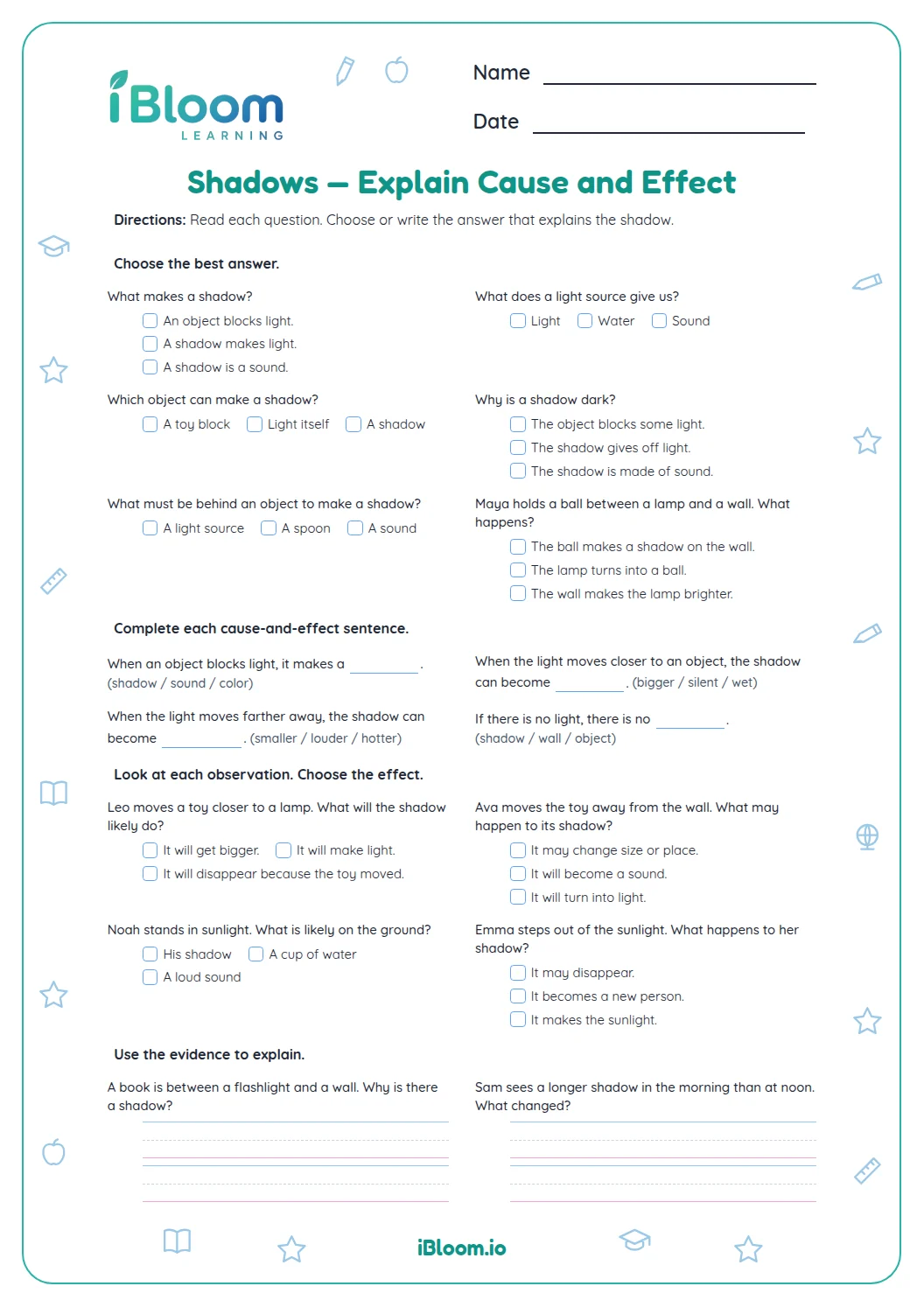
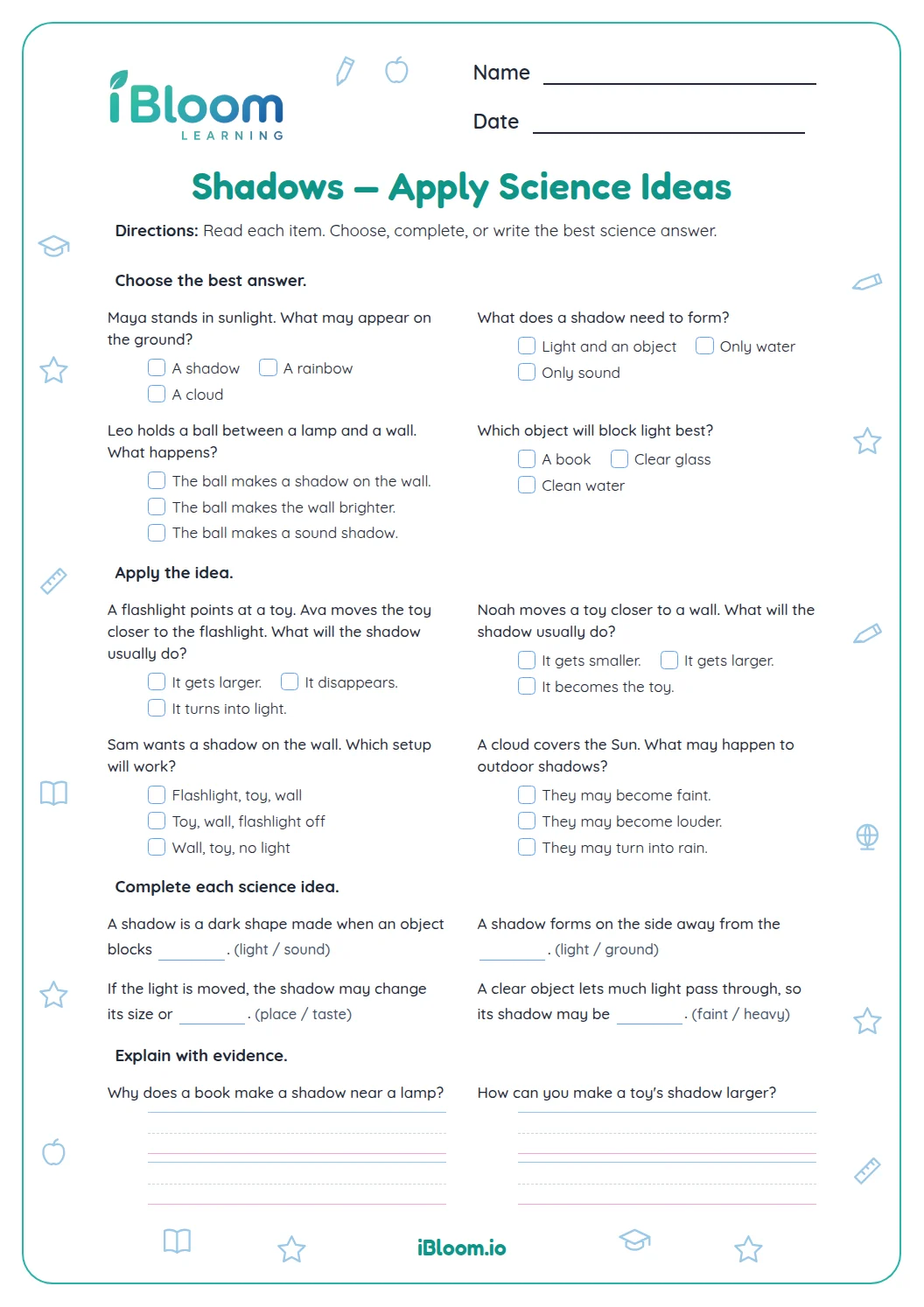
Part A follows light from a source toward an object and wall. Light travels in a straight path, and an object that blocks the beam can make a shadow beyond it.
Light from an illuminated ball reaches the eyes, which lets a person see the ball.
How do materials affect the light beam?
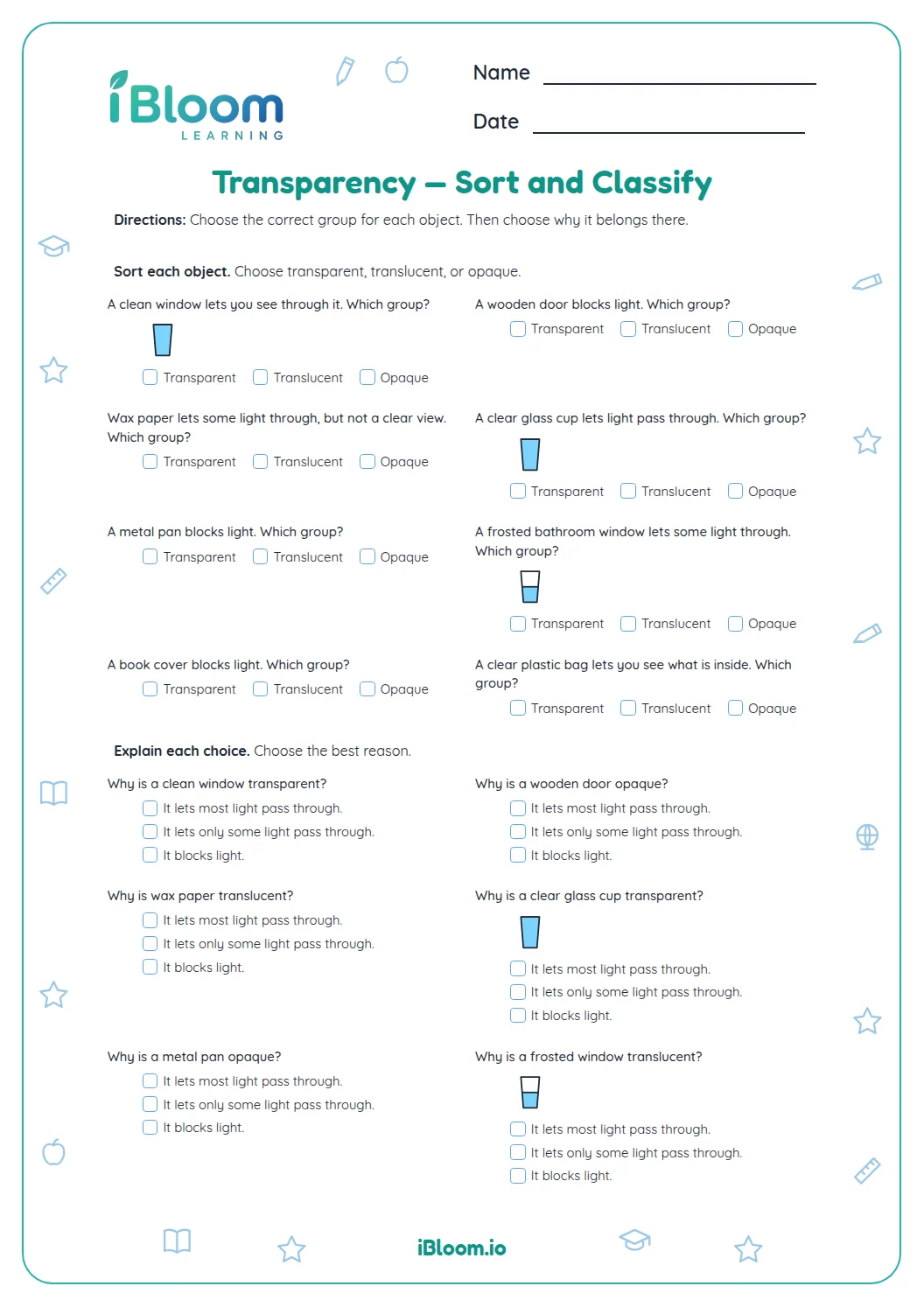
Part B compares materials by how much light passes through: clear plastic lets most through, wax paper lets some through, and cardboard blocks the beam in these examples.
Question 13 asks which material would make the darkest shadow. Cardboard blocks the beam, so it is the best choice.
How can you compare materials fairly?
Part C uses observations to compare materials: a dimmer wall behind wax paper means some light passes through, while cardboard makes the darkest shadow.
Part D asks why the flashlight should stay the same distance from each material. Keeping it steady makes the material the change being tested.
How to use this worksheet
- 1Read the situation and identify the light source or material.
- 2Decide whether the beam travels, passes through, is blocked, or changes direction.
- 3Use transparent, translucent, or opaque to describe the material.
- 4For fair-test questions, change the material and keep the light source and distance the same.
- 5Use the answer key to check each science word.
Mistakes to watch for
The mistake
Calling wax paper transparent because some light passes.
The fix
Transparent means most light passes; translucent means only some passes.
The mistake
Saying cardboard redirects light like a mirror.
The fix
Cardboard blocks light; a mirror reflects and redirects a beam.
The mistake
Changing both the material and flashlight distance in a test.
The fix
Keep the light source and distance the same so the material is the only changed factor.
Curriculum alignment
The questions give children a chance to use this idea in short, concrete examples.
Compare how different materials affect a beam of light and describe the observed effect.
On this sheet: Students compare material observations, predict a shadow from blocked light, and identify how to test materials fairly.
Show the official wordingHide the official wording
Plan and conduct investigations to determine the effect of placing objects made with different materials in the path of a beam of light.
What to practice next
Make more practice
Further reading
Questions parents and teachers ask
What does this worksheet cover?
It reviews light moving from a source, straight beam paths, shadows, and what happens when light meets different materials. Students identify transparent, translucent, and opaque examples, predict which material makes the darkest shadow, and explain how to keep a material test fair.
What does transparent mean?
A transparent material lets most light pass through it. Clear plastic is a familiar example. Wax paper lets only some light through, while cardboard blocks the beam and can make a dark shadow beyond it. These words describe how much light passes through.
How many questions are included?
There are 14 questions in four parts. Children complete light-ray and material statements, choose what observations show, and explain how to keep a material test fair. A separate answer key gives the matching word, correct choice, or a model explanation.
What makes a material test fair?
Keep the light source and distance the same while changing only the material. Then observe the wall beyond it and note whether it is bright, dim, or dark. This helps connect the result to the tested material. Keep the same wall when recording the result.
Why does a mirror appear in the worksheet?
A mirror shows that a beam can be redirected. That is different from a transparent material that lets most light pass, a translucent one that lets some through, or an opaque object that blocks the beam. A mirror changes the beam’s direction rather than blocking it.