





About this worksheet
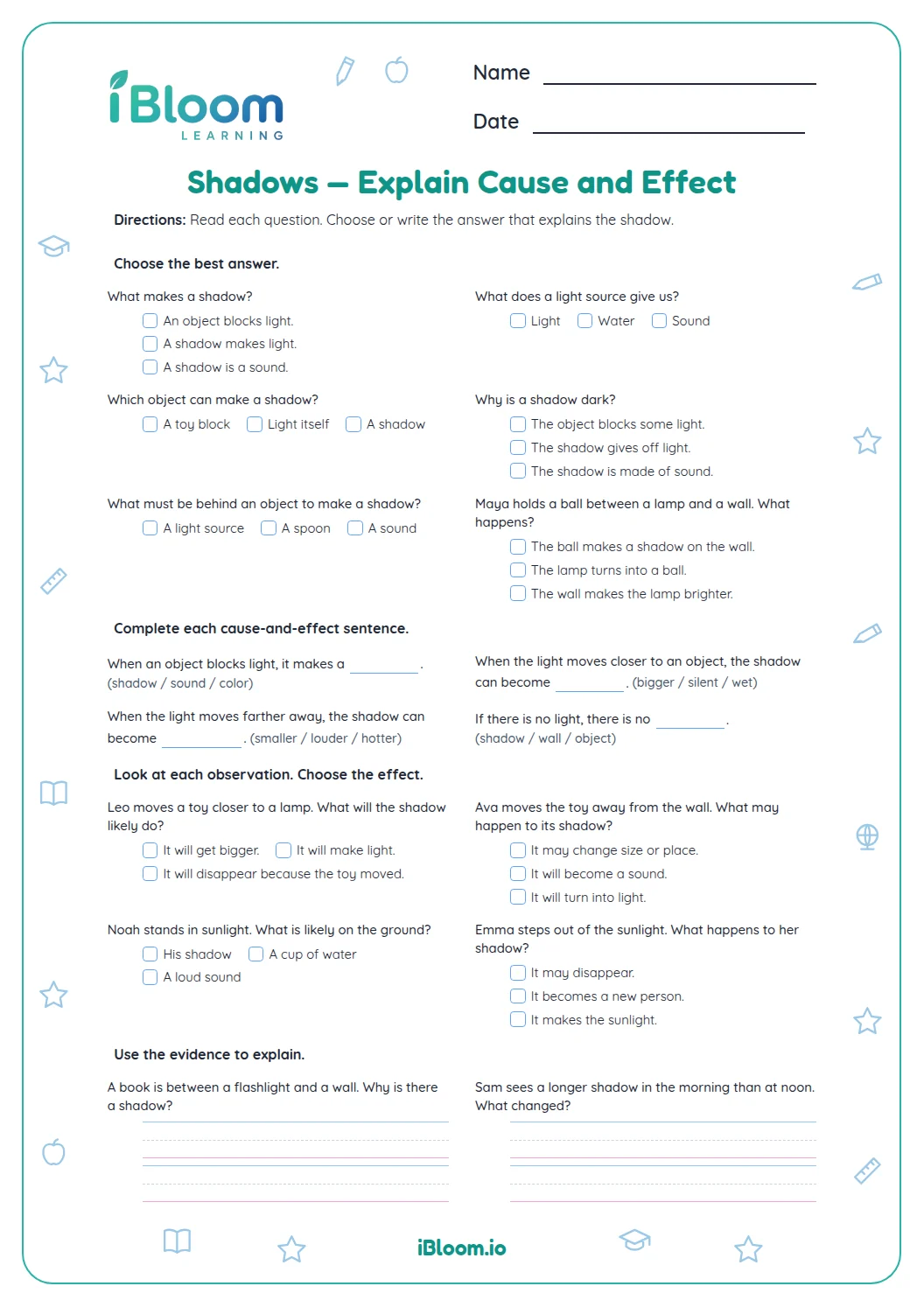
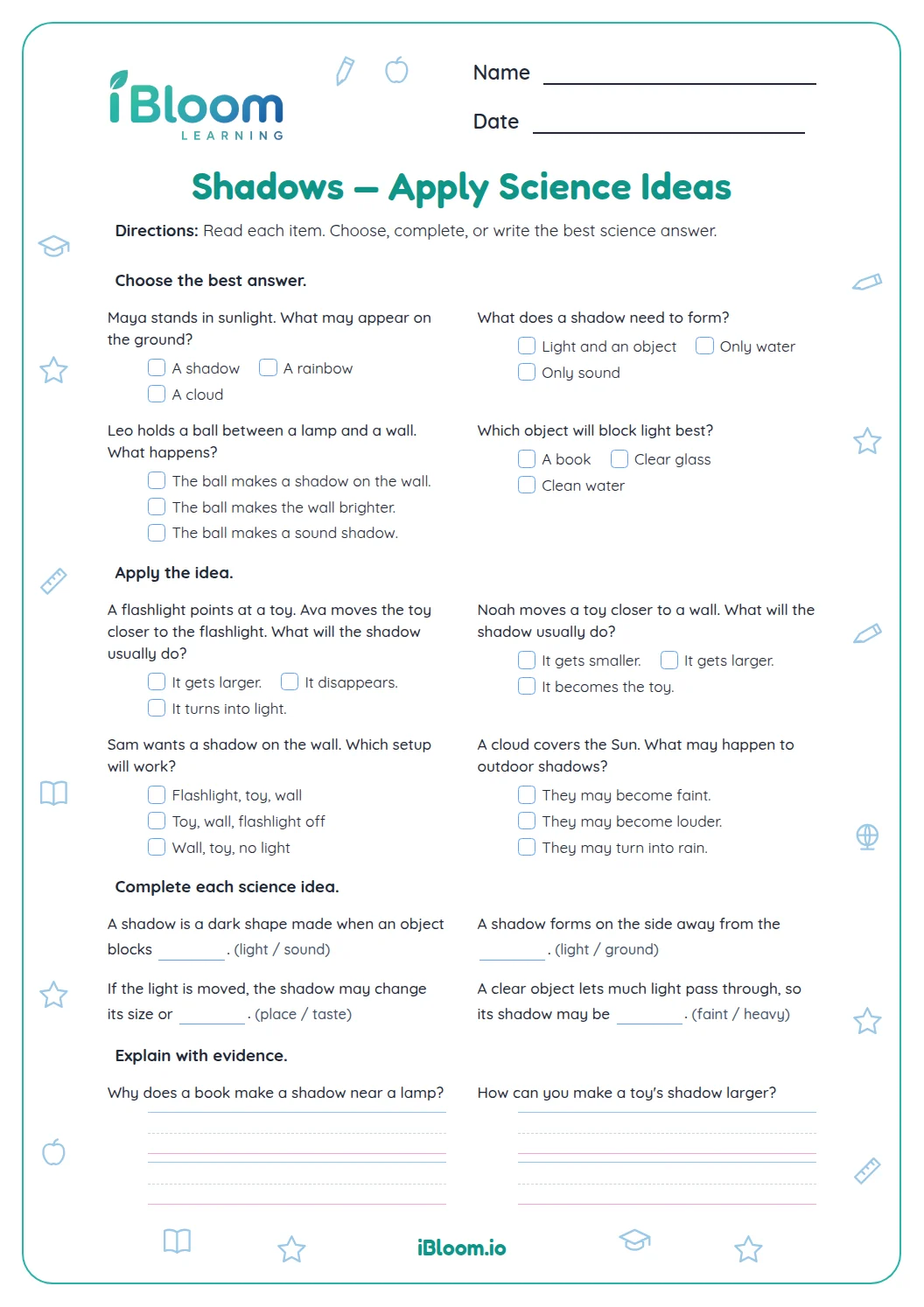
This free printable Grade 1 science worksheet teaches that light travels in straight paths, called rays, and that what happens next depends on what the light meets. Part A asks children to find the cause behind four everyday light events, such as a flashlight lighting a wall. Part B gives four causes and asks what happens next, such as a cloud covering the Sun. Part C has three fill-in sentences, and Part D has one sentence for children to write about shadows. It practices NGSS 1-PS4-3, what happens when objects are placed in a beam of light, and 1-PS4-2, seeing objects only when light shines on them. The answer key has its own pages.
Aligned to 1-PS4-3 and 1-PS4-2
What are light rays, and what should first graders know?
A light ray is the straight path that light takes from where it starts, such as a flashlight, a lamp or the Sun. At this age the goal is noticing, not physics: light goes straight, a bright spot or a lit page means light has reached it, and we see a book or a wall because light bounces off it and into our eyes.
This sheet turns those ideas into cause-and-effect questions. A cause is why something happens, and an effect is what happens because of it.
- 1Cause: A ball is held in a flashlight beam.
- 2The ball is in the way, so it blocks the light.
- 3Light cannot go through the ball.
- 4Effect: a dark shape, a shadow, forms behind the ball.
- 5Answer: A shadow
What happens when light meets something in its way?
It depends on the object. A thick box or a wall blocks the light, so little or none gets through (questions 4 and 11). A mirror bounces the light off in a new direction (question 6). A clear window lets most light pass, which is why a room is bright when the curtains are open (question 8).
A shadow is the dark place behind an object that blocks light. Mia's shadow in question 12 is there because her body is in the way of the sunlight, not because the ground makes the dark.
How do you help children explain cause and effect in science?
Teach a sentence frame: "This happened because ___." Parts A and B use both directions. In Part A children know the effect, like a shadow or a bright spot, and choose the cause. In Part B they know the cause, like a cloud covering the Sun, and choose the effect.
Part C asks children to finish short sentences with because and so thinking, and Part D asks for one explanation in their own words.
What is on this worksheet?
Twelve questions on two pages. The questions use a flashlight, a lamp, a mirror, a cloud, a wall and the Sun, so everything is easy to try at home or at school.
- Part A, Find the cause: 4 multiple-choice questions
- Part B, Find the effect: 4 multiple-choice questions
- Part C, Finish the sentence: 3 fill-in sentences, each with two words to pick from
- Part D, Explain it: 1 sentence to write about a shadow
- Answer key on separate pages
How to use this worksheet at home or in class
- 1Do a quick experiment: darken the room, shine a flashlight at the wall, and hold a hand in the beam. Ask what happened to the light.
- 2Say the words cause and effect. The cause is why, and the effect is what happens.
- 3Read question 1 aloud and let your child choose the cause, then do Part A on their own.
- 4For Part B, ask your child to say the sentence "If ___, then ___" before choosing the effect.
- 5Try a mirror and a flashlight to show question 6 for real, if you have one.
- 6Check with the answer key. Ask your child to say each answer as a because sentence.
Common mistakes and quick fixes
The mistake
Thinking an object makes its own light, such as a book or a wall.
The fix
Turn out the lights and ask whether the book still glows. We see it only when light from a lamp or the Sun bounces off it.
The mistake
Thinking a shadow is a thing that comes out of the object.
The fix
Show that a shadow is the place where light is blocked. Move the flashlight and watch the shadow move or change.
The mistake
Thinking light disappears when it hits a mirror.
The fix
Point a flashlight at a mirror and look for the bright spot it makes on another wall. The light bounced off.
Science standards alignment
Many US states use the Next Generation Science Standards or a state version built on them. This sheet practices the two Grade 1 light standards below.
Find out what happens when a ball, box, mirror, wall or window is in the path of light.
On this sheet: Questions 3 to 8 and 11 ask what happens when an object blocks, bounces or lets through a beam of light.
Show the official wordingHide the official wording
Plan and conduct investigations to determine the effect of placing objects made with different materials in the path of a beam of light.
Objects can be seen only when light shines on them.
On this sheet: Question 2 explains that we see a book because light bounces off it, and question 10 that a room with the lamp off is dark.
Show the official wordingHide the official wording
Make observations to construct an evidence-based account that objects in darkness can be seen only when illuminated.
What to practice next
Make more practice
Further reading
Questions parents and teachers ask
What are light rays for first graders?
Light rays are the straight paths light takes from a source such as a flashlight or the Sun. Grade 1 children learn that light goes straight until it meets something. This worksheet asks what happens next: a shadow forms, a mirror bounces the light, or a clear window lets it pass.
What does cause and effect mean in science?
A cause is why something happens, and an effect is what happens because of it. For example, a ball in a flashlight beam blocks the light, so a shadow appears behind it. Parts A and B of this sheet practice both directions, finding the cause and finding the effect.
Why does a mirror change where the light goes?
A mirror has a smooth, shiny surface that bounces light back instead of letting it pass or soaking it up. Question 6 asks what happens when a flashlight beam hits a mirror, and the answer is that the light bounces off. Children can try it at home with a small mirror.
What are the answers to Part A?
The answers are: light goes to the wall; light bounces off the book; an object blocks light; and the box blocks the light. Together they show that light travels from a source, bounces off things so we can see them, and is stopped by objects in its way. The answer key shows all twelve answers.
What should my child write for question 12?
Any answer that says the body blocks the sunlight is correct. The key shows one sample: her body blocks the sunlight. Children may say something like "the sun cannot go through me" or "I am in the way of the light." Ask your child to include the word light.
Is there an answer key, and how long does the sheet take?
Yes, the answer key is a separate set of pages with every answer shown, including a sample sentence for question 12. Most first graders finish in about 15 minutes. A quick flashlight demonstration beforehand lets children see a shadow and a mirror bounce for themselves before they answer questions 5 and 6.