




About this worksheet
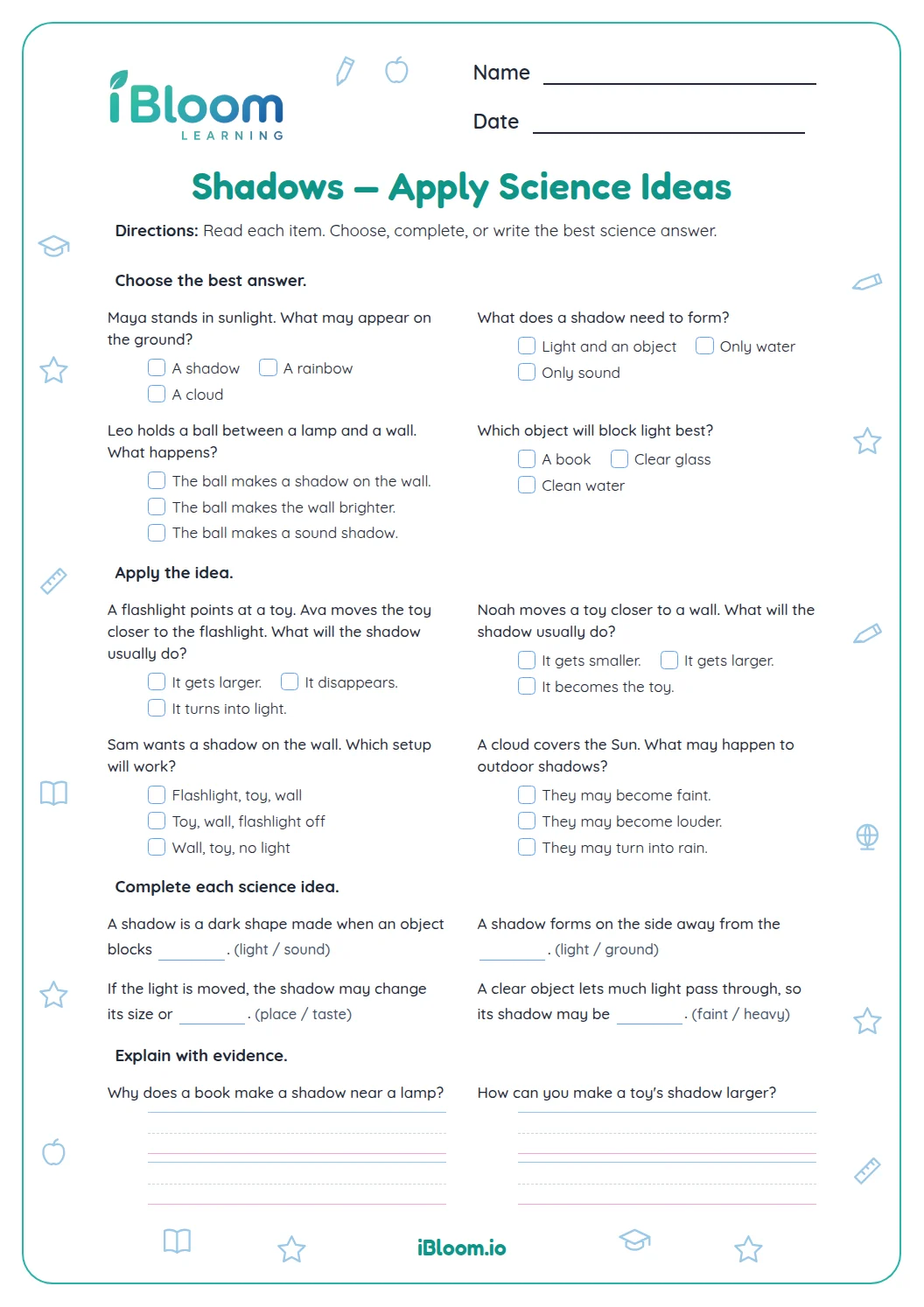
This free Grade 1 science worksheet asks children to use ideas about sunlight and shade in everyday situations. They choose helpful places and objects, predict what happens when sunlight is blocked, and think about a fair comparison of sunny and shady spots. Short answers ask children to connect an object with the shade it makes. A final drawing lets students show a place where someone can find shade.
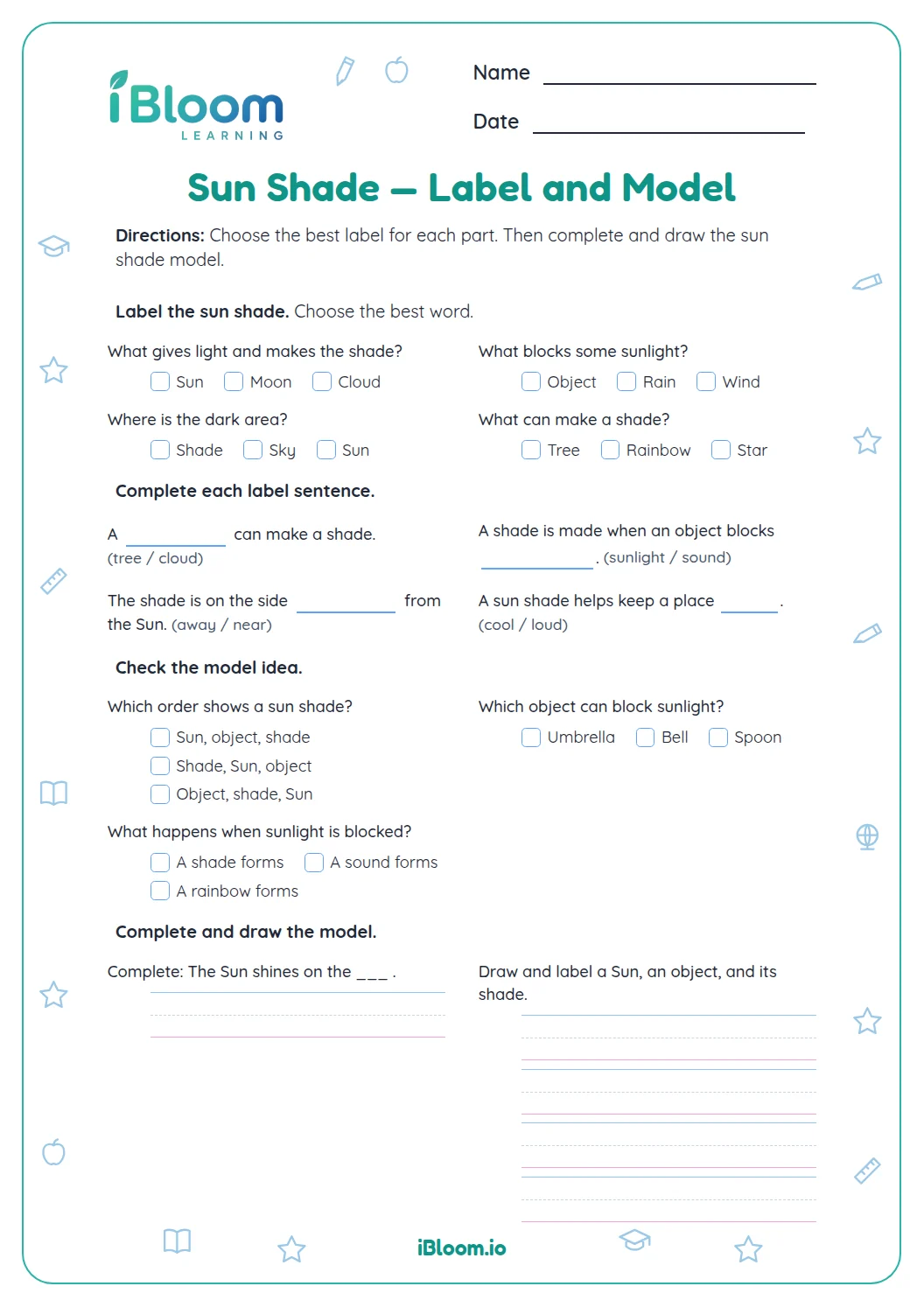
What can create shade on a sunny day?
A tree, umbrella, or building can block some sunlight from reaching a place. Question 3 asks which object can make shade; the umbrella is the best answer. A shaded spot still receives light from other directions.
- 1Question 3: Which object can block sunlight and make a shady spot?
- 2An umbrella can block some sunlight and create shade.
How can students compare a sunny and shady spot?
Look at both places and use the same way to observe them. Keeping the tool and time of observation the same makes the comparison clearer. Questions 7 and 12 ask children to choose or name a fair observation.
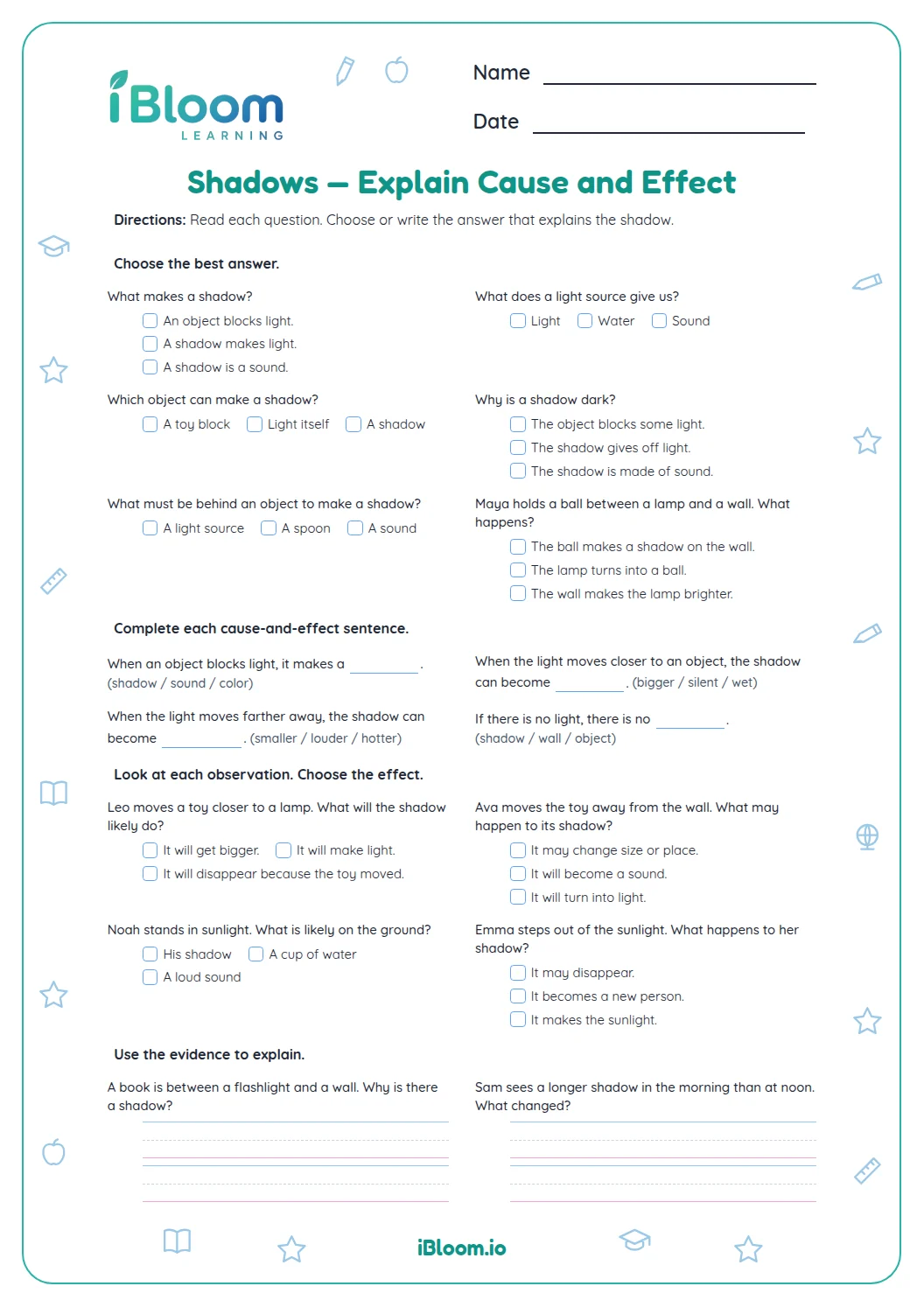
How does an object make a shadow?
A shadow forms when an object blocks light. A person can use a tree or umbrella for shade, and a plant still needs light to grow. The drawing gives children a chance to show one safe place to find shade.
How to use this worksheet at home or in class
- 1Read each situation before choosing or completing an answer.
- 2For the sunny and shady spot comparison, notice what students observe and keep the same.
- 3Complete each sentence with the science word or phrase that fits.
- 4Use the key to compare explanations and discuss other reasonable examples.
Common mistakes and quick fixes
The mistake
Saying a shade tree blocks all light.
The fix
Explain that the tree blocks some direct sunlight, while the place may still be bright.
The mistake
Assuming a shaded place receives no light at all.
The fix
Look for light from the open sky or nearby surfaces.
The mistake
Changing several things in a comparison.
The fix
Observe both spots at the same time and use the same tool or method.
What to practice next
Make more practice
Questions parents and teachers ask
What is shade?
Shade is a place where an object blocks some direct sunlight. A tree, umbrella, or building can make a shaded area. It may still be bright there because light can reach the place from the open sky and nearby surfaces.
How does an umbrella make shade?
An umbrella blocks some sunlight from reaching the person or ground beneath it. Question 3 asks children to identify an object that can make a shady spot, and a later prompt asks them to explain how the object affects sunlight.
Why might a shaded spot feel cooler?
On the same sunny day, a shaded surface receives less direct sunlight than a nearby sunny surface, so it may feel cooler. The worksheet asks children to compare familiar places and connect the shade to the light an object blocks.
What does a plant need from sunlight?
A plant needs light to grow. The worksheet asks children to choose a helpful change for a plant in a dark closet and to name a place where a seedling can get light while receiving a break from harsh afternoon sun.
How can students make a fair comparison?
Students can observe the sunny and shady places at the same time and use the same tool or method in both. Keeping those conditions steady makes it easier to tell whether the sunlight differs between the two places. The worksheet asks about the method rather than expecting a specific instrument.
How does the final question check the shadow idea?
It asks children to complete a sentence about what an object blocks to form a shadow. The answer key gives the missing word, and an adult can connect the sentence to a familiar example such as a tree blocking sunlight.