






About this worksheet
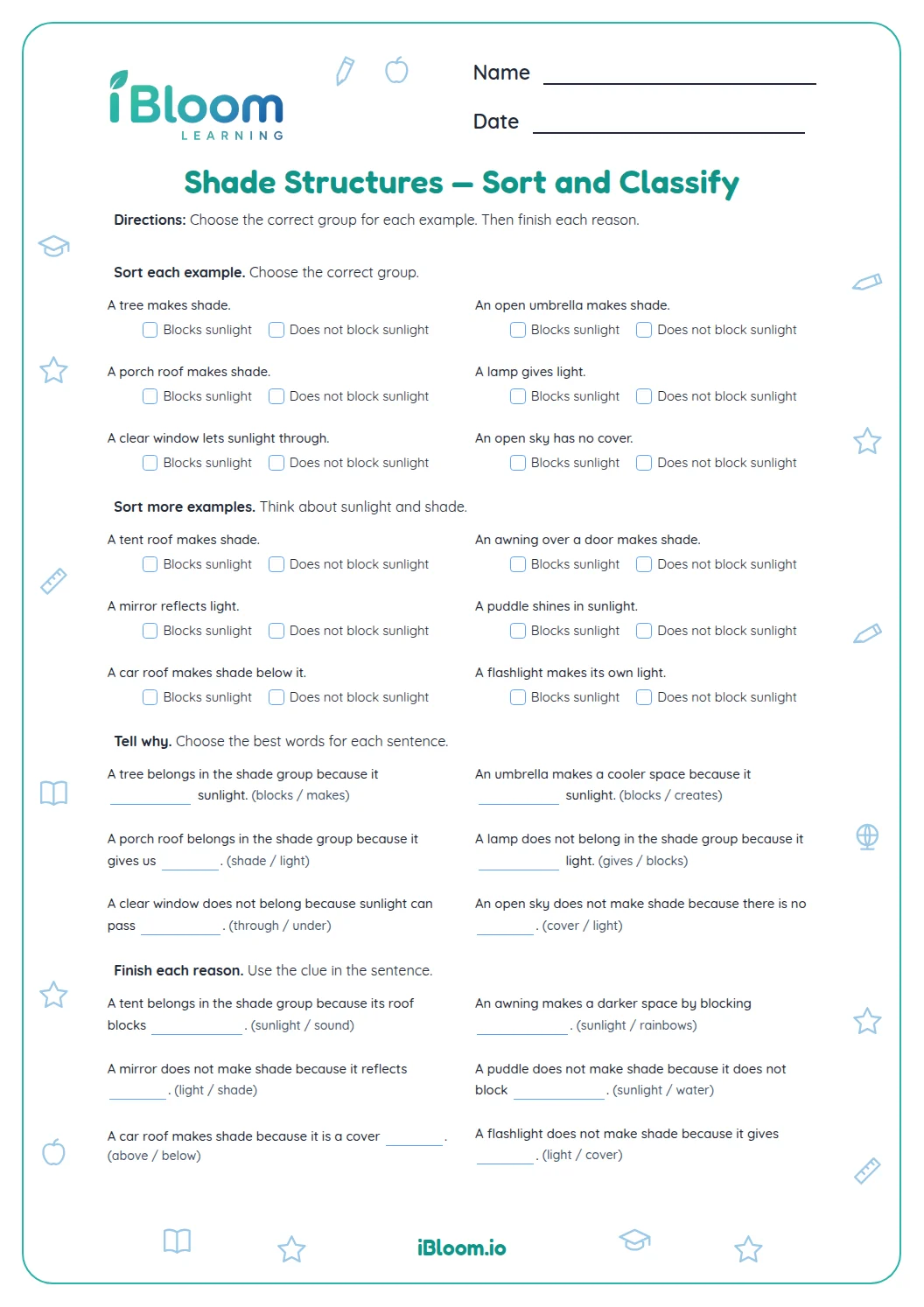
This Grade 1 science worksheet follows the original sun-and-shade task: children classify familiar objects by whether sunlight is blocked or passes through, then choose a reason for each result. Six picture-supported classification questions lead into eight cause-and-effect choices about trees, windows, umbrellas, walls, and hats. It practices observing how different materials affect a beam of light, aligned with NGSS 1-PS4-3.
Aligned to 1-PS4-3
How do you sort objects by sunlight?
Ask whether sunlight can pass through the object. A tree trunk, umbrella, or brick wall blocks sunlight and makes shade. Clear window glass lets much of the sunlight pass through.
- 1A clear window lets sunlight pass through.
- 2Choose “Lets sunlight through.”
- 3A brick wall blocks sunlight and makes shade.
What makes an object create shade?
An object makes shade when it blocks some sunlight from reaching the space behind or below it. A tree canopy and a hat brim can both block sunlight, even though they are different objects.
What will children classify on the page?
The first six questions sort familiar objects into two groups. Eight more ask children to choose why an object makes shade or lets sunlight pass through.
How to use this worksheet
- 1Look at the pictured object and read its sunlight clue.
- 2Decide whether sunlight passes through or is blocked.
- 3Choose the matching group in the first section.
- 4In the next section, select the reason that explains the result.
- 5Check each choice against the answer key.
Common mistakes and quick fixes
The mistake
Calling every bright-looking object transparent.
The fix
Ask whether sunlight actually passes through the object.
The mistake
Saying a tree makes shade by making the Sun dimmer.
The fix
Remember that the leaves block some sunlight.
The mistake
Thinking an umbrella lets sunlight through because it is above you.
The fix
Check what the umbrella canopy blocks.
NGSS alignment
Children compare how familiar materials affect sunlight.
Compare how different materials affect a beam of light.
On this sheet: Children sort clear and opaque objects by whether sunlight passes through or is blocked.
Show the official wordingHide the official wording
Plan and conduct investigations to determine the effect of placing objects made with different materials in the path of a beam of light.
What to practice next
Further reading
Questions parents and teachers ask
What does “makes shade” mean?
An object makes shade when it blocks some sunlight from reaching the space behind or below it. The worksheet uses familiar examples such as a tree, umbrella, brick wall, and hat brim to help children connect the object with the blocked light.
Which objects let sunlight through on this page?
The clear window and clear plastic let much of the sunlight pass through. Children compare them with objects such as an umbrella or brick wall, which block sunlight and make shade. Ask the child to point to the clue that supports the choice.
Why does a tree make shade?
Leaves and branches block some sunlight from reaching the ground below. Children choose this cause in the second section, then compare the tree with a clear window that lets much of the light pass. Ask the child to point to the clue that supports the choice.
How many questions are on the worksheet?
There are 14 questions across two parts. Children first classify six pictured objects, then choose reasons for eight statements about sunlight and shade. Ask the child to point to the clue that supports the choice. Ask the child to point to the clue that supports the choice.
Is an answer key included?
Yes. A separate answer key marks the correct group or reason for all 14 questions. Adults can ask children to explain which part of the object blocks sunlight or lets it pass. Ask the child to point to the clue that supports the choice.