





About this worksheet
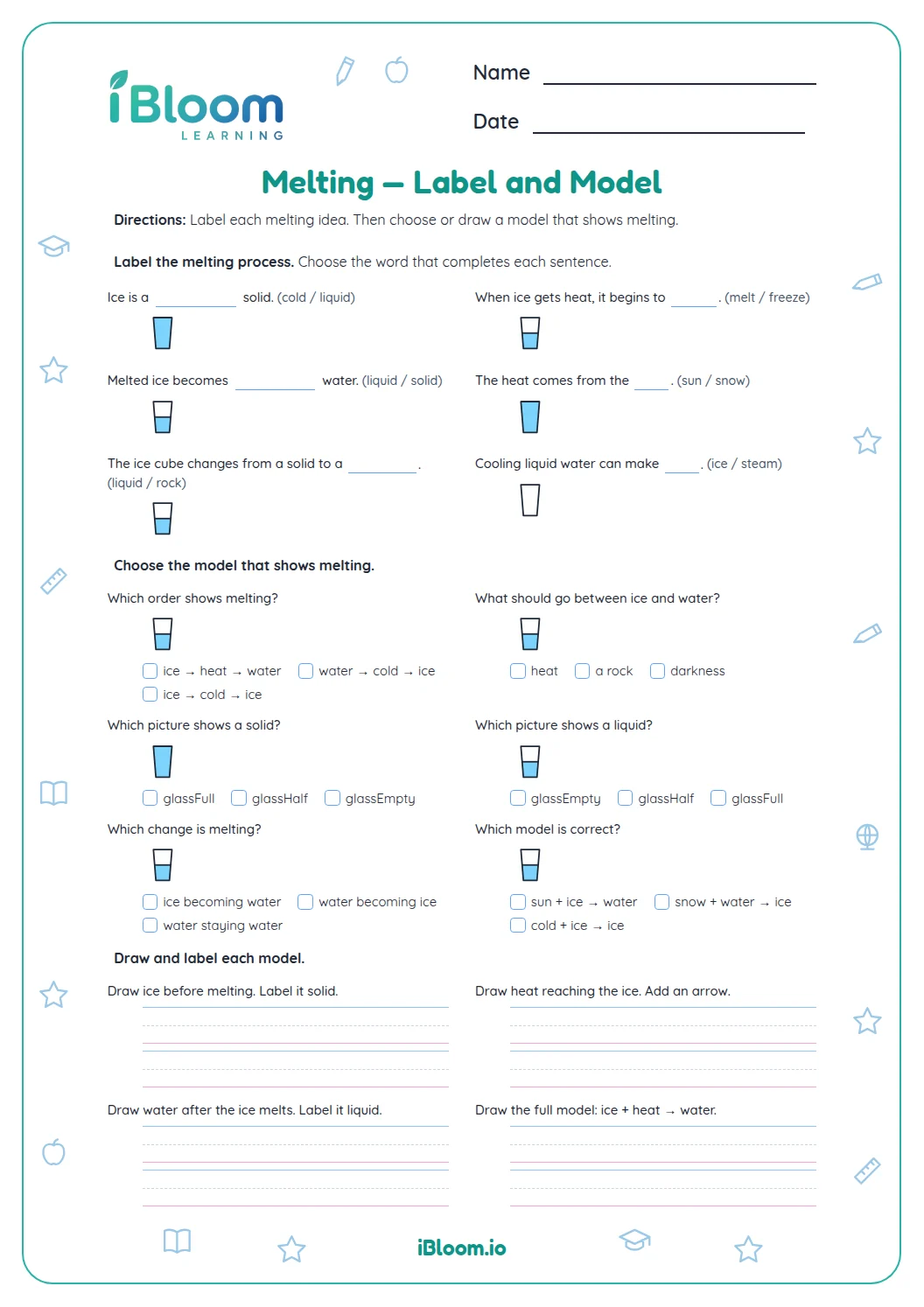
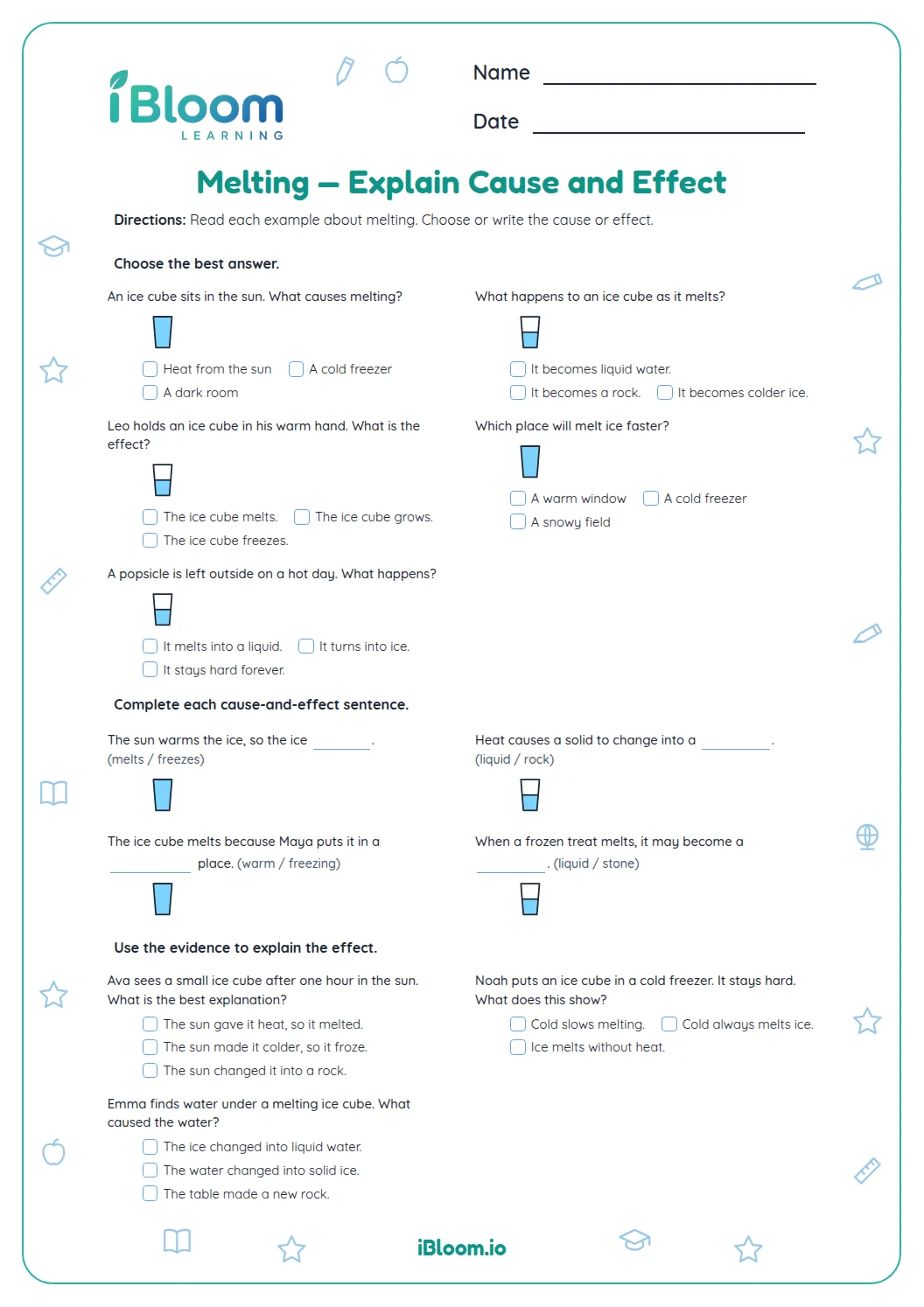
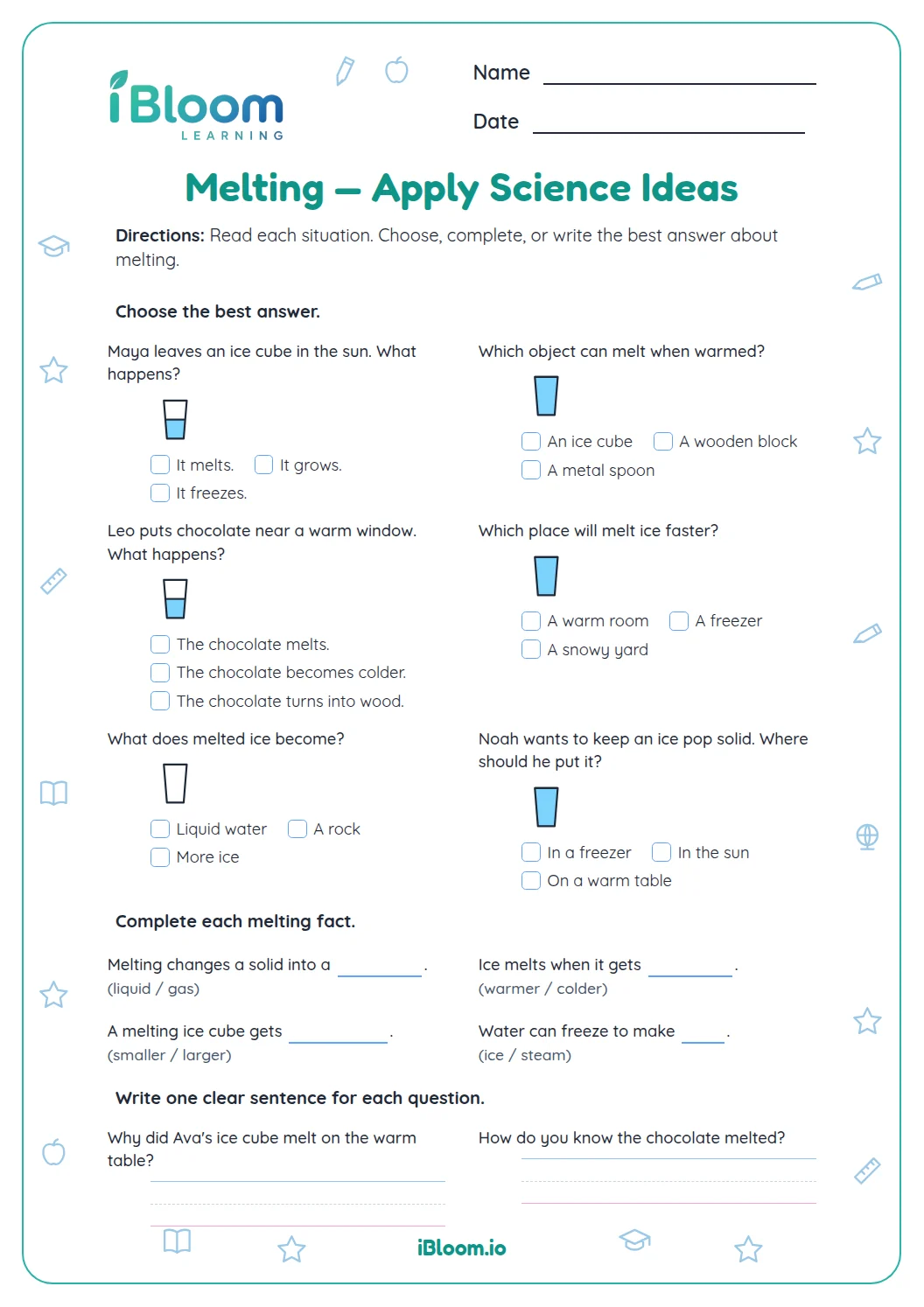
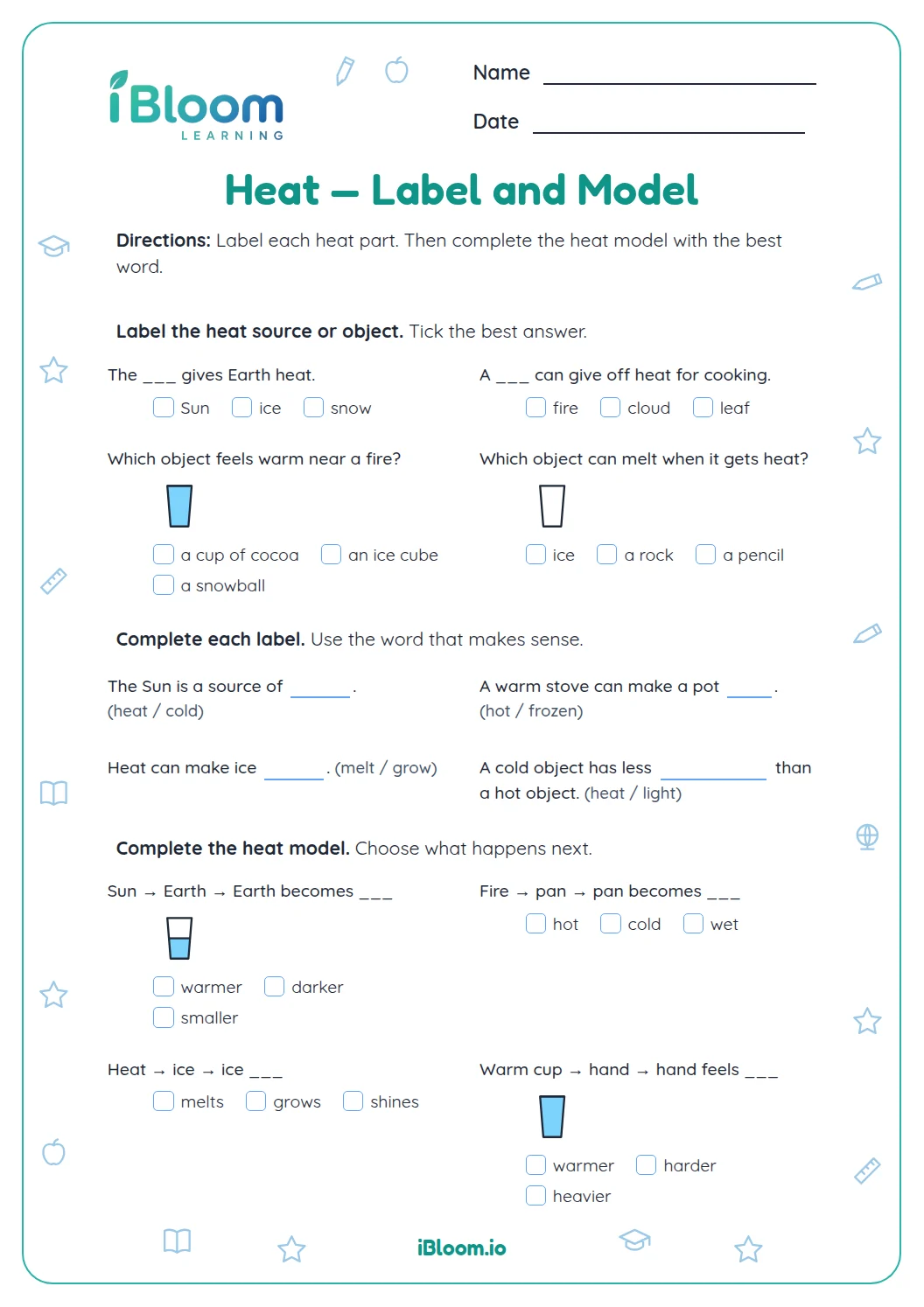
This Grade 1 melting worksheet helps students connect warmth and cooling to observable changes in materials. Students answer 12 choice and fill-in questions, then explain two simple situations using evidence such as liquid water left by an ice cube. The printable includes four parts and a separate answer key with sample responses. It focuses on familiar materials—ice, water, butter, and chocolate—so children can reason from everyday observations.
Aligned to 2-PS1-4
What happens when a solid melts?
Melting is a change from solid to liquid. An ice cube may become a puddle of liquid water when it gains warmth. Students first identify this change in familiar examples such as ice pops, butter, and chocolate.
Can a melted material become solid again?
Water can freeze when it cools enough. Ice melting into water and water freezing back into ice show a reversible change. Cooking an egg with heat is different: cooling does not turn it back into a raw egg.
- 1Ice warms and becomes ___.
- 2Answer: liquid. The material changes from a solid to a liquid.
How can students use evidence to explain melting?
An explanation should name what changed and connect it to warmth or cooling. A shrinking ice cube and a puddle left behind are observable evidence. In the final part, students use these clues to explain cause and effect or plan a simple comparison.
How to use this worksheet
- 1{'step': 'Name the material before the change.', 'detail': 'For example, the starting material may be solid ice.'}
- 2{'step': 'Notice whether it gets warmer or colder.', 'detail': 'Use the situation as a clue.'}
- 3{'step': 'Describe what you can observe.', 'detail': 'A puddle is evidence that ice became liquid water.'}
- 4{'step': 'Connect the change to its cause.', 'detail': 'Explain how warmth or cooling led to the observation.'}
Common mistakes and quick fixes
The mistake
Saying melting makes a solid colder.
The fix
Melting happens when a material gains warmth.
The mistake
Calling freezing and melting the same change.
The fix
Melting changes solid to liquid; freezing changes liquid to solid.
The mistake
Giving a cause without evidence.
The fix
Name an observation, such as a puddle where ice was.
Students compare changes caused by warming and cooling and support explanations with observations.
Students explain how heating or cooling can cause a change that can be reversed.
On this sheet:
Show the official wordingHide the official wording
Construct an argument with evidence that some changes caused by heating or cooling can be reversed and some cannot.
What to practice next
Questions parents and teachers ask
What is melting?
Melting is a change in which a solid becomes a liquid. An ice cube becoming liquid water is a familiar example. The worksheet asks students to recognize this change and connect it to warmth in several everyday situations.
Can water freeze back into ice?
Yes. When liquid water cools enough, it can freeze into solid ice. That is why melting ice can be reversed by cooling the water. The worksheet asks students to name this change and explain how it could happen.
How many questions are included?
There are 14 questions in four parts: six multiple-choice questions, four fill-in questions, two comparison questions, and two written explanations. The answer key gives the correct choices and blanks, plus sample evidence-based responses for the written items for a quick review.
What should count as evidence that ice melted?
Liquid water where the ice cube was is evidence of melting. A smaller ice cube can also show that some of its solid material became liquid. Students should connect the observation to warmth rather than simply say “it changed.”
Is this a hands-on experiment?
The worksheet is printable reasoning practice, and one question asks how to compare ice cubes in sunny and shady places. An adult can support a safe observation with small ice cubes, but students can answer from the scenario as written.