





About this worksheet
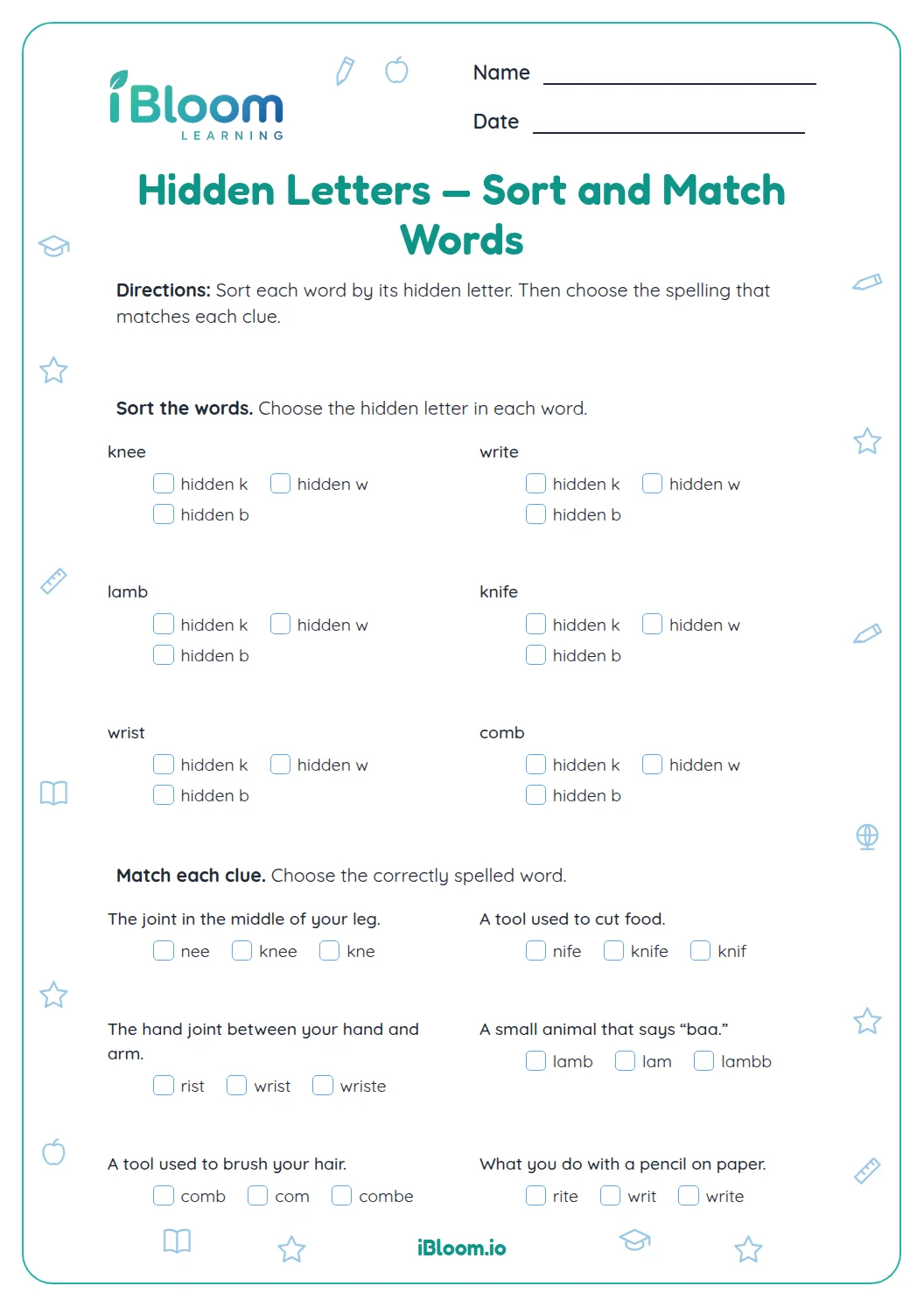
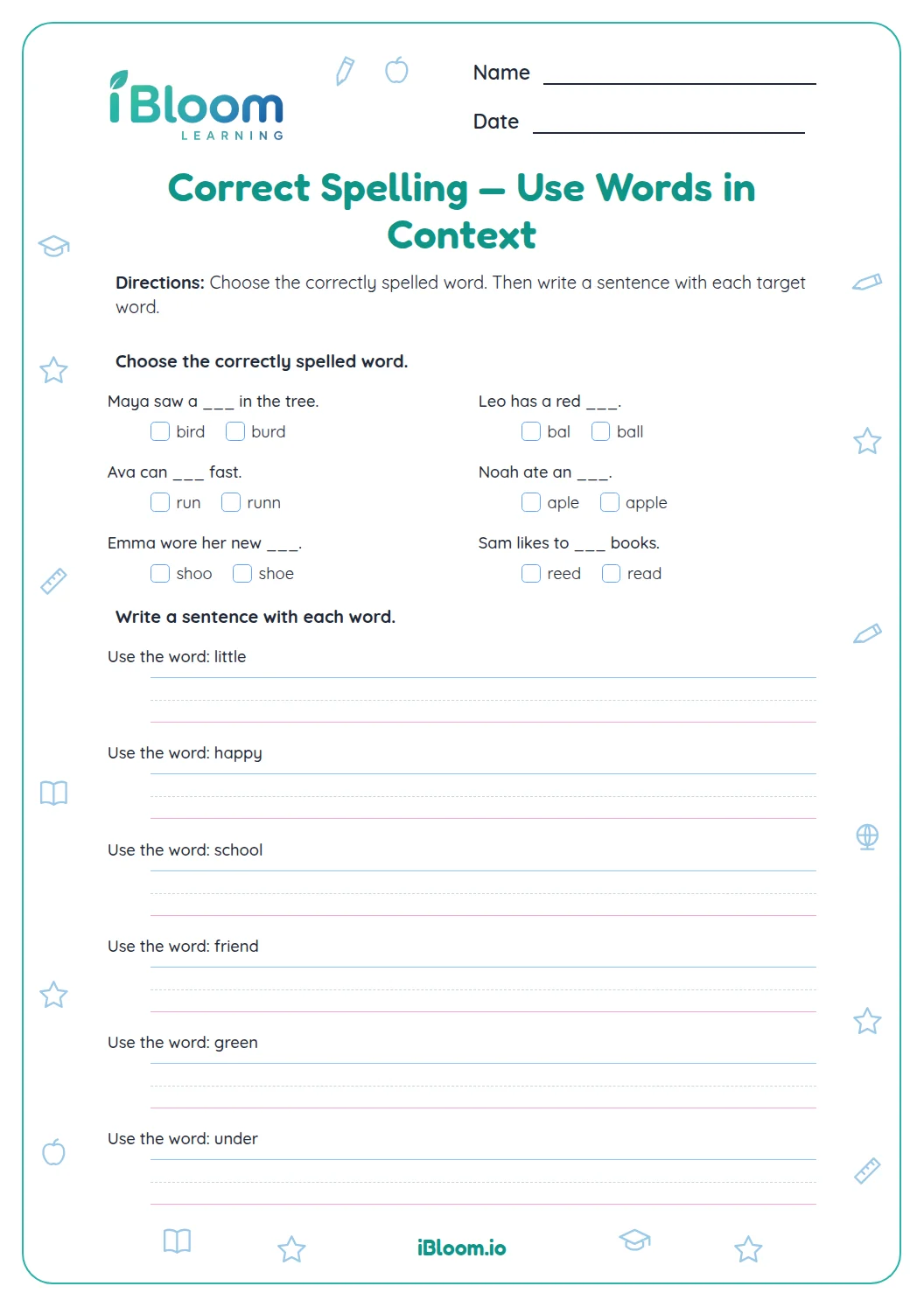
This printable Grade 1 spelling page practices words with letters that are written but not heard, such as know, knock, wrist, and write. In Part A, learners use a short sentence to choose the correctly spelled word. In Part B, they complete four short sentences with target words. The practice supports conventional spelling under CCSS L.1.2d. A separate answer key provides sample sentences.
Aligned to L.1.2d
How do sentence clues help with spelling?
Some words have letters that are written but not heard, such as k in know and w in write. The sentence helps identify the word, while comparing spellings helps a learner notice its silent letter. In question 1, “I ___ the answer” needs know, not no.
- 1I ___ the answer. (know / no)
- 2The sentence means that I have the answer.
- 3Choose know; its k is silent.
How can children check the missing letter?
Part A contrasts familiar spellings in context, including kn, wr, and mb words. Part B asks learners to complete sentences with target words, so they retrieve the spelling and use its meaning.
What does this page practice?
The target words include letters that are part of standard spelling even when they are quiet in speech. Encourage the learner to say the word, look at its spelling, then read the whole sentence again.
How to use this worksheet
- 1Read the entire sentence before choosing.
- 2Say each option and notice which word meaning fits.
- 3Look carefully at the silent-letter spelling in the correct word.
- 4In Part B, complete the sentence with the target word and reread it.
- 5Use the key to check spelling and compare sentence meaning.
Common mistakes and quick fixes
The mistake
Choosing a shorter spelling because the silent letter cannot be heard.
The fix
Remember the standard spelling, such as know and wrist, even when a letter is quiet.
The mistake
Choosing a sound-alike word that does not fit the sentence, such as no instead of know.
The fix
Read the whole sentence and check what it means.
The mistake
Writing a sentence that uses the target word in the wrong sense.
The fix
Make the sentence show the word’s meaning, then check its spelling.
Common Core alignment
The word completions practice conventional spelling in a meaningful sentence.
Spell words with common spelling patterns and frequently used words.
On this sheet: Learners select and use conventional spellings for familiar words that include silent letters.
Show the official wordingHide the official wording
Use conventional spelling for words with common spelling patterns and for frequently occurring irregular words.
What to practice next
Make more practice
Questions parents and teachers ask
What is a silent letter?
A silent letter is written in a word but is not pronounced. Examples on this worksheet include k in know and knock, w in wrist and write, and b in thumb and lamb. Learners still need to include that letter when they spell the word.
Why does the worksheet show two spellings?
The choices help learners compare the conventional spelling with a tempting spelling that leaves out a silent letter. The sentence gives a meaning clue so the child can select the word that fits. Only one choice is the standard spelling used in books and classroom writing.
How many words are practiced?
Part A has 10 sentence-based spelling choices. Part B has four short sentence completions that practice the same silent-letter patterns without naming the missing word in the prompt. The key lists the conventional spelling for each item. Read each completed sentence aloud to check its meaning.
Can I help by reading the prompts aloud?
Yes. Reading each sentence aloud keeps attention on the word’s meaning and spelling. The learner can choose the correct word, then explain which letter is written but not heard. Invite the learner to point out the quiet letter after choosing the word.
Which silent-letter patterns appear?
The word choices include silent letters at the beginnings of words, as in know, knock, wrist, write, knife, wrong, climb, and knee. The word thumb has a quiet b at the end, and lamb has a quiet b as well. Read each word aloud and notice which written letter is not heard.