



About this worksheet
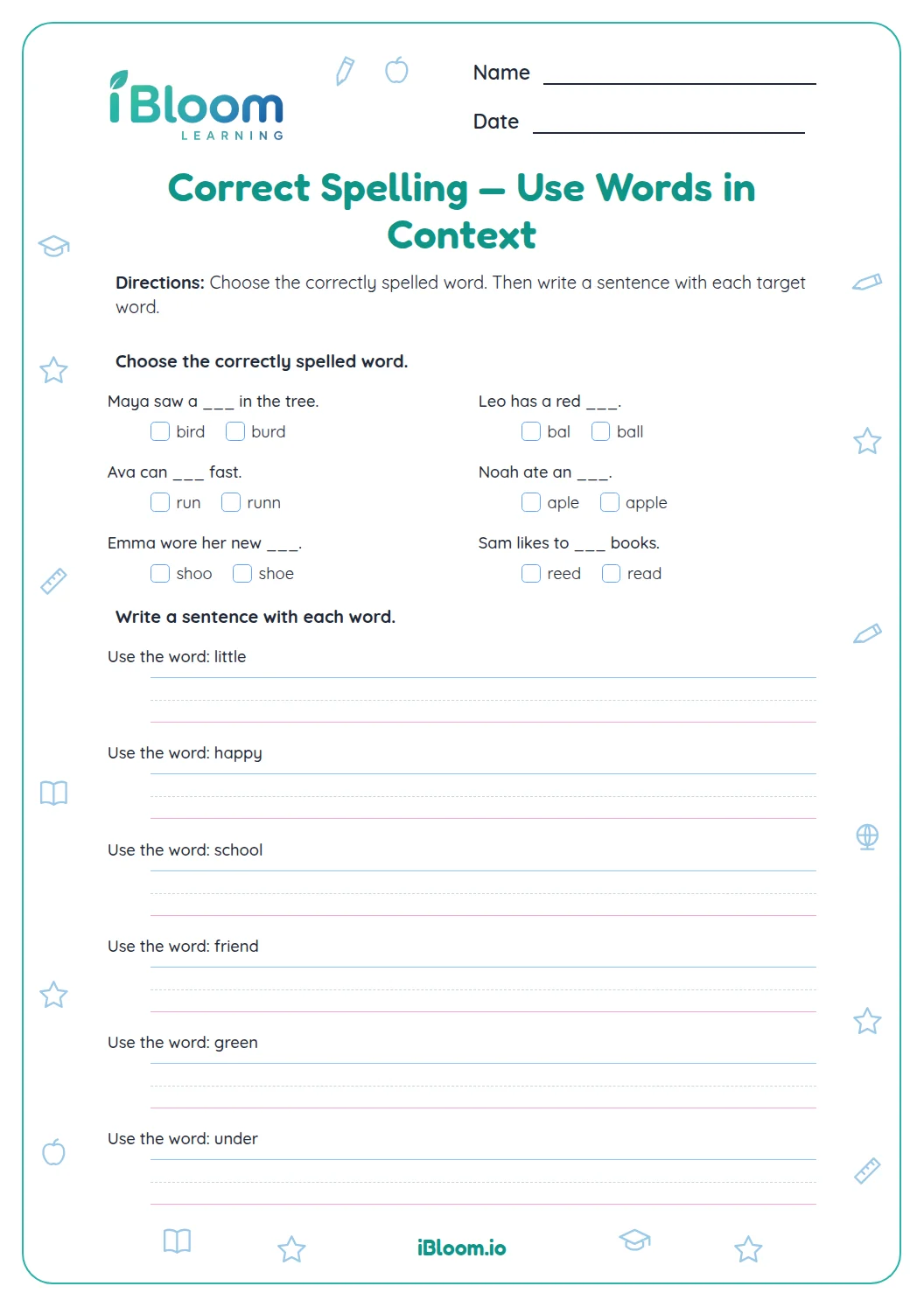
This free Grade 1 spelling worksheet connects word recognition with using words in context. Part A has eight sentence choices using backpack, pencil, happy, jump, flower, read, basket and ball. Part B asks children to correct DOGG, HATT, FISSH and SHIPP. Part C asks for four original sentences using words from Part A. The 16 questions practice Common Core RF.1.4c through rereading for meaning and L.1.2d through conventional spelling. An adult can read the surrounding sentences aloud while the child checks the choices. A separate key gives fixed answers and sample sentences.
Aligned to RF.1.4c and L.1.2d
How do spelling and sentence clues work together?
Read the letters before deciding which word fits. Pencil and pensil sound alike when read aloud, so the child must recognize the usual spelling, pencil. Other choices also require meaning: read and reed are both words, but only read fits “We ___ books at bedtime.”
After choosing, reread the completed sentence. If the child needs help with a longer word such as backpack, say it together and identify the two familiar parts, back and pack.
- 1We ___ books at bedtime.
- 2Choices: reed and read
- 3The sentence needs a word for what we do with books.
- 4Choose read: We read books at bedtime.
What should children write in the spelling corrections?
Part B asks for just the corrected word in lowercase. DOGG becomes dog, HATT becomes hat, FISSH becomes fish and SHIPP becomes ship. Each printed word has one extra letter.
Do not turn this into a rule that doubled letters are always wrong. Happy and ball in Part A need their doubled letters. Check the conventional spelling of each whole word.
How do the final four questions use words in context?
Children write one complete sentence each with backpack, pencil, happy and flower. The word is supplied in the prompt, so they can check its spelling while deciding what to say. A short sentence such as “My backpack is blue” is enough.
The key provides examples, not required sentences. Accept a different sentence when it expresses a complete thought, uses the given word meaningfully and spells it correctly. Help the child add a capital at the beginning and punctuation at the end.
Read, choose and check
- 1Read the first sentence and compare backpack with bakpak letter by letter.
- 2Let the child finish Part A, rereading every completed sentence.
- 3In Part B, say each intended word and write its conventional spelling.
- 4Before writing in Part C, ask the child to say a whole sentence with each target word.
- 5Check fixed answers with the key; check original sentences for meaning and accurate target-word spelling.
Word-reading and spelling slips
The mistake
Choosing reed in “We ___ books at bedtime” because it sounds like read.
The fix
Use the sentence to check meaning: read is the action we do with books; a reed is a plant.
The mistake
Removing a doubled letter from happy or ball after correcting DOGG.
The fix
Doubled letters belong in some words. Compare each word with its usual spelling instead of removing every repeated letter.
The mistake
Writing only “a flower” for the final sentence.
The fix
Ask what the flower is like or what it does. “A flower grows here” expresses a complete thought.
Common Core alignment
Reread sentences to confirm word recognition and meaning.
On this sheet: Part A asks children to choose a word that fits, then reread the completed sentence to check it.
Show the official wordingHide the official wording
Use context to confirm or self-correct word recognition and understanding, rereading as necessary.
Choose conventional spellings, correct four words and use words in original sentences.
On this sheet: Children choose and correct spellings, then write four target words in their own sentences.
Show the official wordingHide the official wording
Use conventional spelling for words with common spelling patterns and for frequently occurring irregular words.
What to practice next
Make more practice
Further reading
Questions parents and teachers ask
Which words do children practice?
Part A uses backpack, pencil, happy, jump, flower, read, basket and ball. Part B corrects dog, hat, fish and ship. The last four questions reuse backpack, pencil, happy and flower in original sentences, so children move from recognizing the spelling to using the word themselves.
May I read the sentences aloud?
Yes, an adult can read the surrounding sentences while the child studies the choices. Pause at each blank and let the child compare the letters. After the child chooses, reread the completed sentence together. For the writing questions, rehearse an original sentence aloud before putting it on paper.
Why are both read and reed offered?
Both are real words, so the bedtime sentence supplies the deciding clue. Read names what we do with books; reed names a plant. Ask the child to try each choice in “We ___ books at bedtime,” then reread the sentence with the word that makes sense.
Are doubled letters always spelling mistakes?
No. The four Part B words each have an extra letter, but happy and ball in Part A need their doubled letters. Compare DOGG with dog and HATT with hat, then revisit happy and ball. The aim is to learn each word’s spelling, not to remove every repeated letter.
Do the final sentences need to match the key?
No, the key gives one sample sentence for each target word. Accept any complete sentence that uses backpack, pencil, happy or flower appropriately and spells that word correctly. Encourage a capital at the start and ending punctuation, while keeping the main check on meaning and spelling.