









About this worksheet
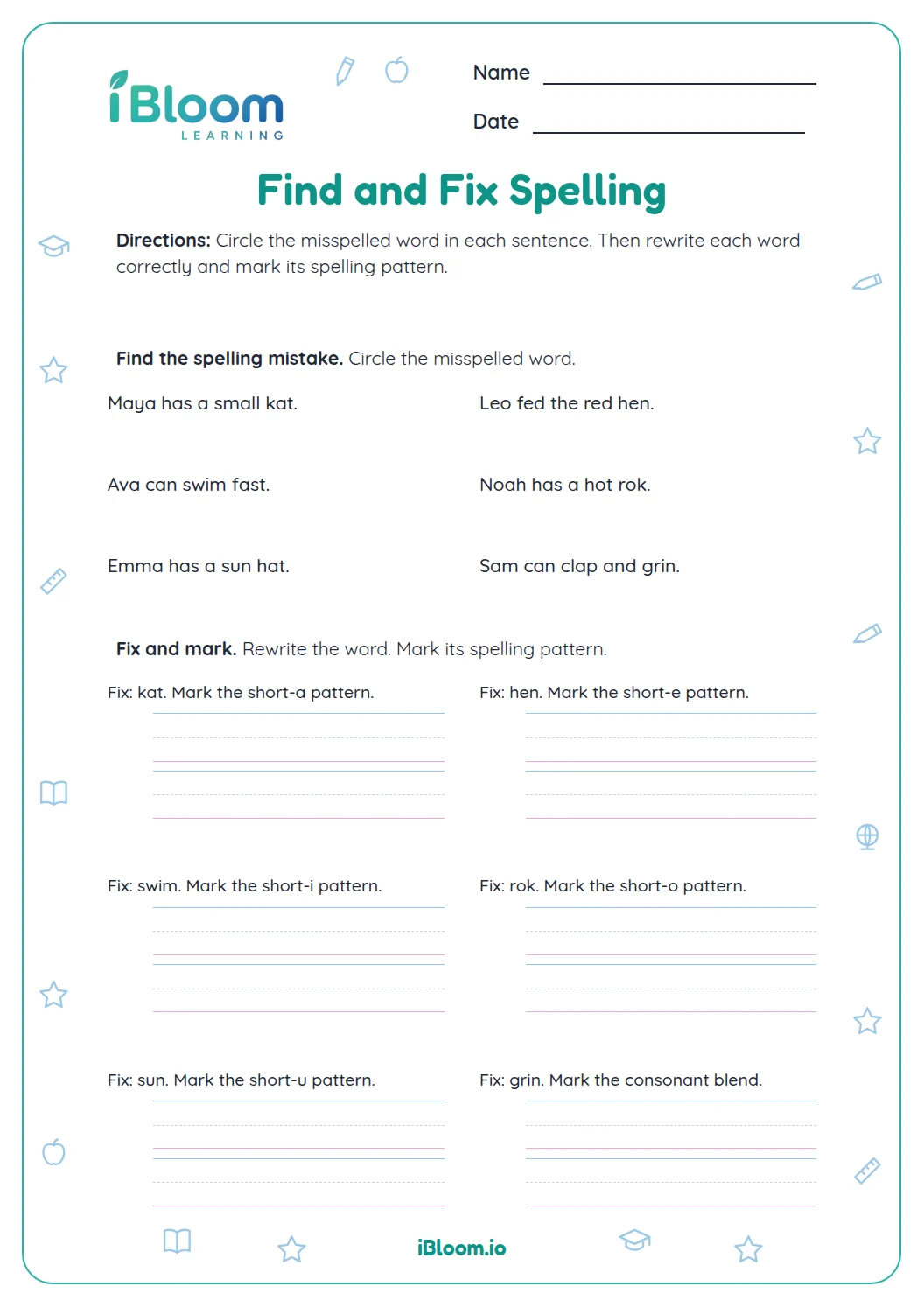
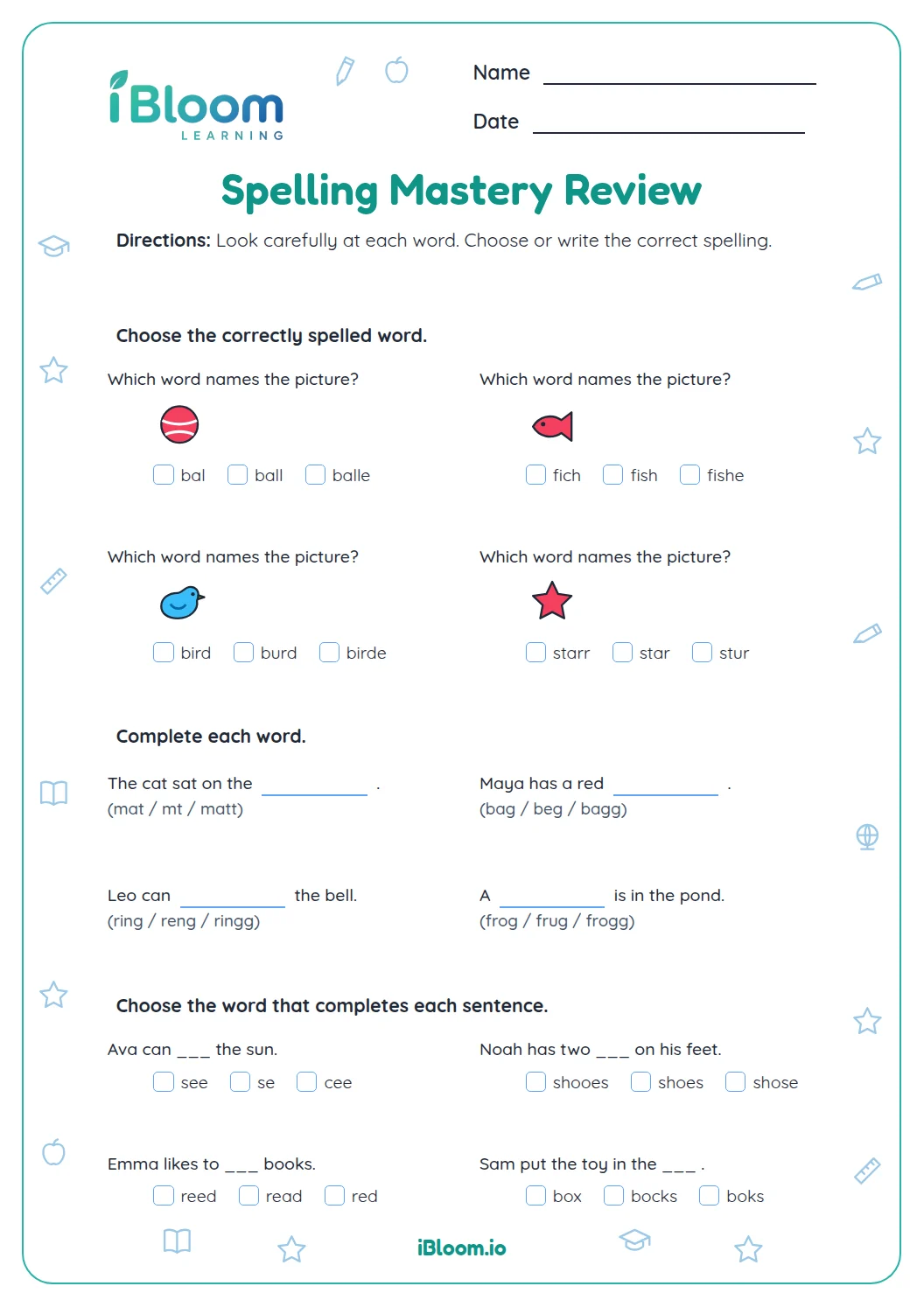
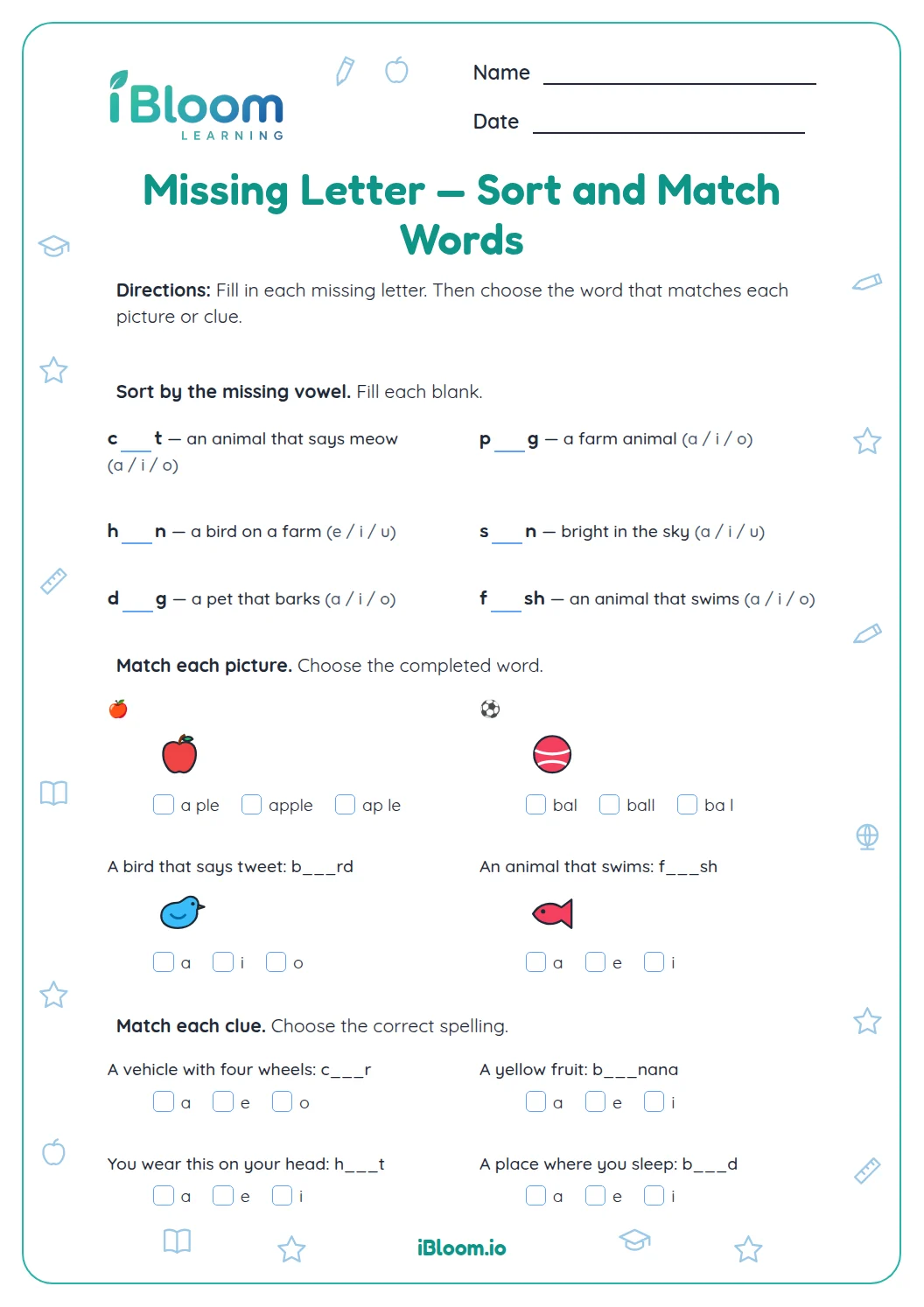
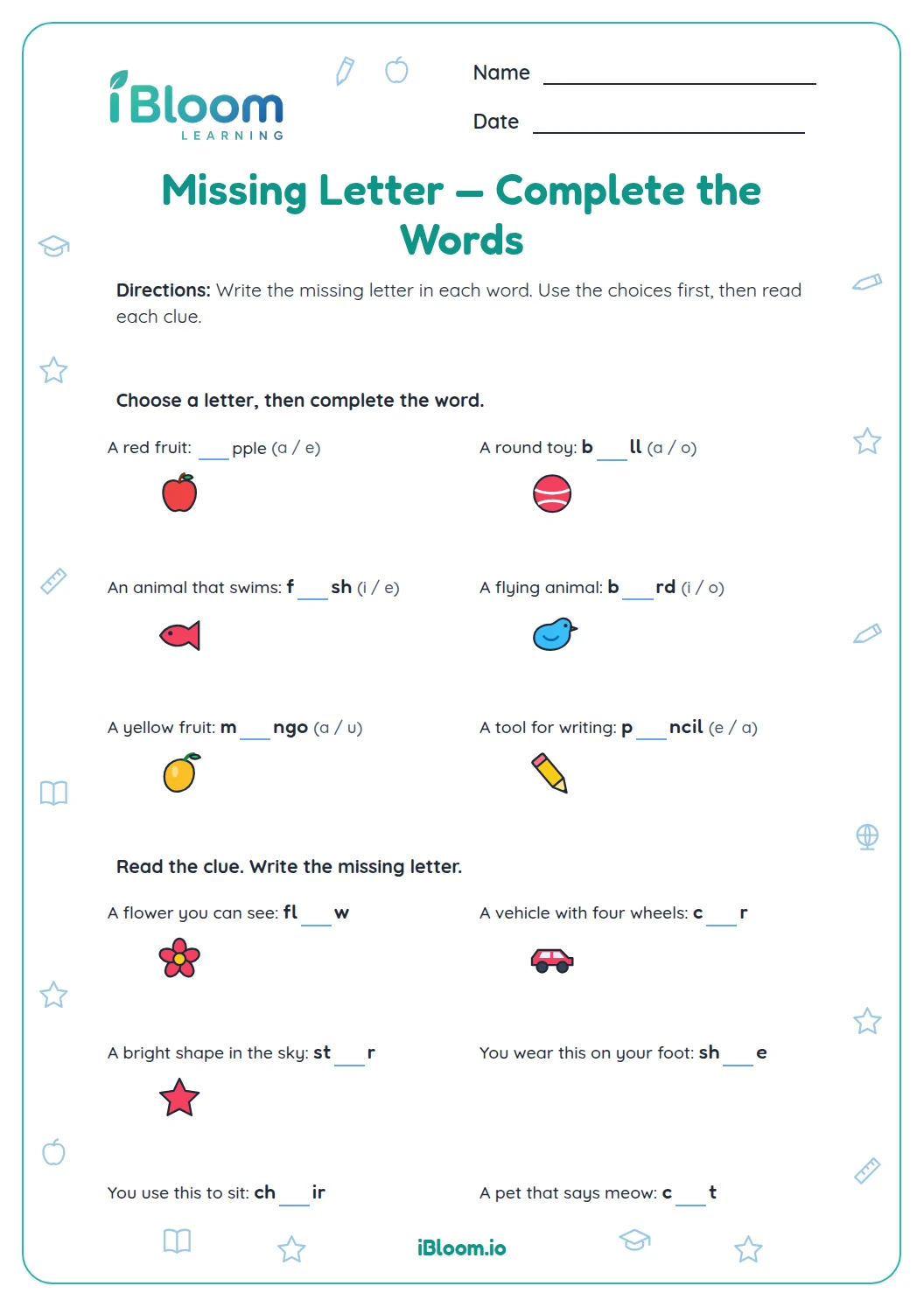
This free printable Grade 1 spelling worksheet helps children sort and match short words. In Part A they say words like jam, zip and rug and choose the short vowel they hear. In Part B they look at a picture of a pig, a fish or a duck and pick the correct spelling from three tries. In Part C they find the word that belongs to the same word family as hat, dig, run or hop. It practices Common Core L.1.2.d and RF.1.2.c. A two-page answer key is included.
Aligned to L.1.2.d and RF.1.2.c
What does it mean to sort words by their vowel sound?
Short words such as jam, net, zip, mop and rug each have one vowel, and each vowel makes a short sound: a as in jam, e as in net, i as in zip, o as in mop and u as in rug. Sorting words by that sound means saying the word and deciding which vowel sound sits in the middle.
Each question in Part A prints one word and three vowel choices. Saying the word aloud before choosing links the sound children hear to the letter that spells it, and reading the choices aloud (short a, short e) helps too.
How do students pick the right spelling for a picture?
In Part B each picture has three spellings. One is correct and the others are the kind of slip a first grader makes: the wrong vowel, the wrong digraph or an extra final letter. Students say the name slowly, tap each sound and choose the spelling that matches the sounds.
Fish shows the idea. It has three sounds, f, i and sh, and sh is spelled with two letters that work together.
- 1The picture shows a fish. Which is the correct spelling? fesh, fich or fish
- 2Say it slowly: f - i - sh. The middle sound is short i.
- 3fesh uses an e for the middle sound, so it does not match.
- 4fich ends with ch, but the ending sound is sh.
- 5Answer: fish
What is a word family, and how does it help spelling?
A word family is a group of words that end with the same sounds and letters: hat, cat and sat all end in -at. Once a student can spell one word in the family, changing the first letter gives a whole set.
Part C asks for the word that ends the same way as the model word: cat for hat, big for dig, sun for run and top for hop. Covering the first letter and reading what is left (-at, -ig, -un, -op) is a quick way to check.
What is on this worksheet?
Twelve multiple-choice questions in three parts, spread over two pages.
- Part A, Sort by vowel sound: five words (jam, net, zip, mop, rug), one for each short vowel (questions 1 to 5)
- Part B, Match the spelling: pig, fish and duck, each with three spellings to choose from (questions 6 to 8)
- Part C, Find the word family: the words that go with hat, dig, run and hop (questions 9 to 12)
- A matching two-page answer key
How to use this worksheet at home or in class
- 1Warm up by saying words slowly with a clap for each sound: j-a-m, p-i-g. Ask which sound is in the middle.
- 2Read question 1 together and say jam two or three times. Let your child say each vowel sound out loud and pick the one that matches.
- 3Finish Part A, then check that all five short vowels were used once. Each answer is a different vowel.
- 4In Part B, ask your child to say the picture's name slowly and tap the sounds on the table before choosing a spelling.
- 5In Part C, cover the first letter of each word with a finger. Say what is left and look for the match.
- 6Use the answer key and ask your child to read aloud the correct word for any miss, and then to spell it with a finger on the table.
Common mistakes and quick fixes
The mistake
Mixing up short i and short e, as in choosing short e for zip or writing fesh for fish.
The fix
Say pairs side by side, such as pig and peg or zip and zap, and listen for which vowel the word really has.
The mistake
Doubling the last letter, as in catt, pigg or dukk.
The fix
Count the sounds: c-a-t has three sounds and three letters, so there is no extra t. Duck is different: ck is two letters that spell one sound at the end.
The mistake
Choosing a word that starts the same instead of ends the same, such as hot or hit for hat.
The fix
Word families share the ending. Cover the first letter: hat becomes -at, and cat is also -at.
Common Core alignment
Most US states use the Common Core Language and Foundational Skills standards or a close state version. These two standards name the spelling and listening skills this worksheet practices.
Spell words with common patterns correctly, like fish, duck and the -at family.
On this sheet: Parts B and C: students choose the correct spelling of pig, fish and duck and match words that share an ending.
Show the official wordingHide the official wording
Use conventional spelling for words with common spelling patterns and for frequently occurring irregular words.
Hear and say the middle vowel sound in short words like jam, net, zip, mop and rug.
On this sheet: Part A: children say each word and name its middle short vowel; Part B asks them to tap each sound first.
Show the official wordingHide the official wording
Isolate and pronounce initial, medial vowel, and final sounds (phonemes) in spoken single-syllable words.
What to practice next
Make more practice
Further reading
Questions parents and teachers ask
What are short vowel sounds?
They are the quick vowel sounds in simple words: a in jam, e in net, i in zip, o in mop and u in rug. Each of the five vowels also has a long sound that says its own name. Part A gives one word for each short vowel, so students hear all five.
Why does the worksheet include wrong spellings like pik and dukk?
They are realistic slips: the wrong letter for a sound, as in pik, or a doubled last letter, as in dukk. Choosing the correct one means thinking about every sound and checking the pattern, which takes more care than copying a word. Talk through why each wrong spelling does not match the sounds.
What is a word family?
A word family is a set of words that end with the same sounds and letters, such as hat, cat and sat, which all end in -at. Part C uses four families: -at, -ig, -un and -op. Changing only the first letter makes new words in the set.
What are the answers to Part C?
Cat goes with hat, big with dig, sun with run and top with hop. Students find each by looking for the same ending, not the same beginning. The answer key lists all twelve answers in order, including the five vowel sounds and three spellings.
Does my child need to know how to read the words?
Yes, a little. The words are short one-syllable words such as jam, net and cat, so a child who reads simple words can read them. A grown-up can read any word aloud first. Saying the word out loud is part of the task in Part A.
How long does it take, and is there an answer key?
Most Grade 1 children need about 15 minutes. Yes, a two-page answer key follows the worksheet, so you can print the two worksheet pages alone and keep the key for checking afterward. Part A fills page 1, and Parts B and C are on page 2, so it splits easily into two short sittings.