






About this worksheet
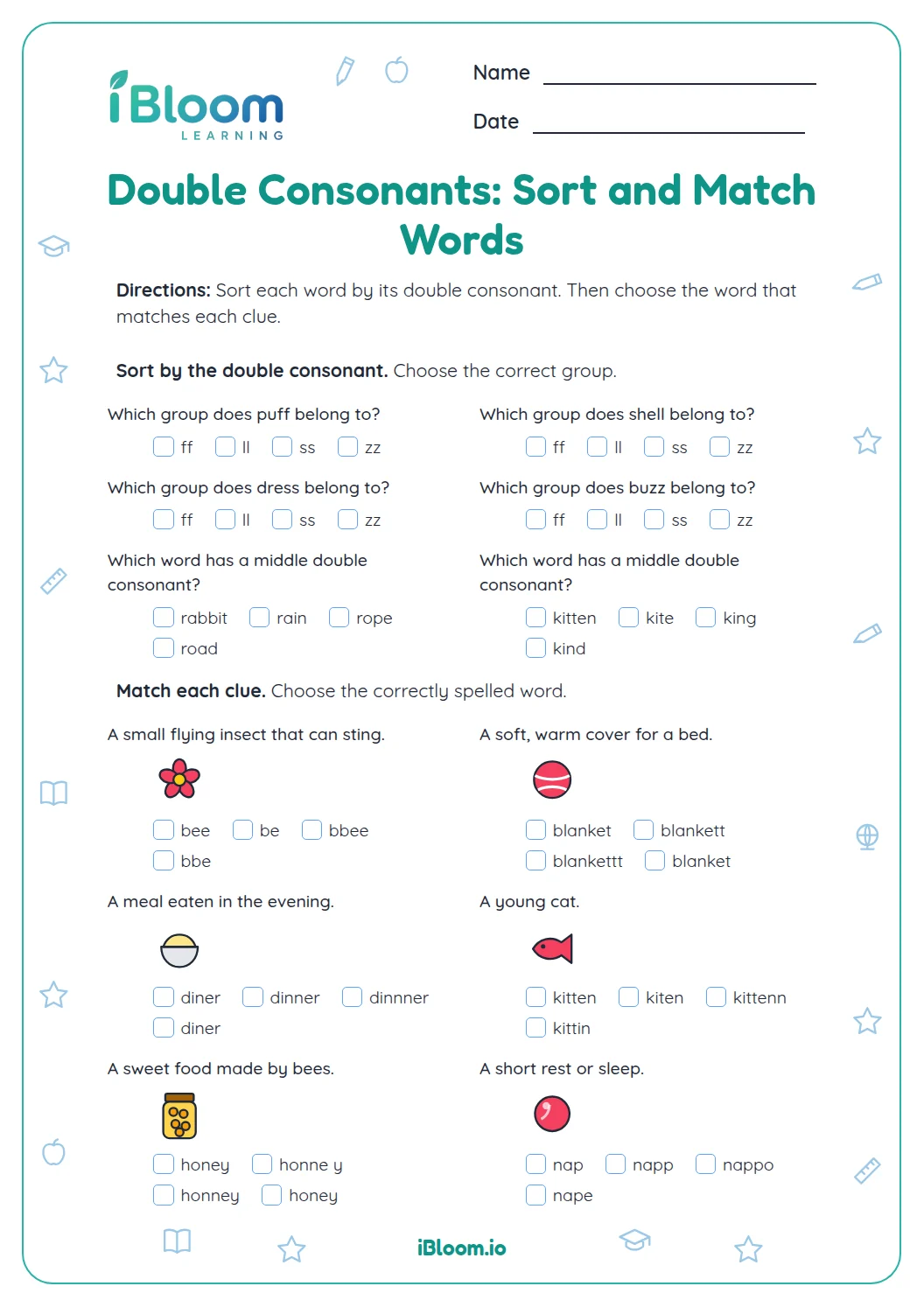
This free printable Grade 2 spelling review gives children eighteen questions about doubled consonant letters. Part A asks them to choose four correctly spelled words. Part B gives eight misspelled words to repair. Part C has four sentence blanks with word clues, and Part D asks for two original sentences. Children practice familiar patterns in words such as bell, rabbit, kitten and happy, then apply them when writing complete words. The sheet supports Common Core L.2.2d, using learned spelling patterns in writing. A separate answer key lists correct spellings and sample sentences.
Aligned to L.2.2d
Which double consonants appear on this sheet?
The review includes ll in bell and yellow, ss in dress, ff in puff, zz in buzz, tt in kitten and mitten, pp in happy and puppy, nn in dinner, bb in rabbit, mm in summer, and dd in middle. Each pair repeats the same consonant letter.
Read the whole word naturally, then point to its doubled letters. Children need to remember both letters in writing even when they do not hear two separate consonant sounds.
How do children fix a missing consonant?
Part B supplies a misspelled word and a meaning clue. Children identify the intended word and write its complete correct spelling. Ask them to check the letters on both sides of the doubled pair instead of writing just the missing letter.
- 1rabit: an animal with long ears
- 2The intended word is rabbit.
- 3Keep the two b letters together: ra + bb + it.
- 4Write the whole word: rabbit.
Why finish with sentence clues?
Part C connects spelling with meaning: a young cat is a kitten, happy means glad, a mitten has a space for the thumb, and dinner is an evening meal. Part D asks children to use yellow in one sentence and rabbit and happy together in another.
After checking, have children cover the printed word, write it from memory and compare the doubled letters. A sentence they say aloud can help confirm that they also know what the word means.
How to use this worksheet
- 1Read a familiar word such as bell and point to the repeated letter.
- 2Have the child choose the correct spellings in Part A.
- 3For Part B, read each clue and write the whole repaired word.
- 4Complete Part C from the clues, then write two original sentences in Part D.
- 5Check with the key, then cover and rewrite any missed words.
Mistakes to notice and fix
The mistake
Writing rabit because one b seems enough when saying the word.
The fix
Point to bb in rabbit, cover it, and rewrite the complete word from memory.
The mistake
Treating any two consonants as a doubled pair.
The fix
Compare dress with its dr blend and ss pair: doubled letters must be identical and next to each other.
The mistake
Writing only the missing consonant in Part B.
The fix
Read the direction again and write the complete word so its full spelling can be checked.
Curriculum alignment
Apply learned double consonant spellings when repairing words and completing sentences.
On this sheet: Children apply doubled-letter patterns in corrected words, sentence blanks and two original sentences.
Show the official wordingHide the official wording
Generalize learned spelling patterns when writing words (e.g., cage → badge; boy → boil).
What to practice next
Make more practice
Further reading
Questions parents and teachers ask
Which words should we study before starting?
Start with a few familiar examples such as bell, dress, happy and rabbit. Read each word aloud and point to the repeated letter. The worksheet then mixes recognition, correction and sentence use, so a short look at the pattern is enough to begin the review.
Is this a rule about doubling before adding a suffix?
This sheet focuses on doubled letters already present in familiar words such as kitten, dinner and rabbit. Children choose and write those complete spellings. While checking, ask them to name the repeated letter and use the word orally to connect its spelling with its meaning.
Should children say the doubled consonant twice?
Have children say each word naturally rather than forcing two separate consonant sounds. Then look closely at the spelling and name the repeated letters. In happy, the written pair is pp. The purpose of the review is to remember both letters when writing the word.
What should a child write for each repair question?
Write the entire correctly spelled word, not just the missing letter. For rabit, the answer is rabbit. The meaning clue identifies the intended word, and the full answer lets you check the doubled consonant as well as the letters before and after it.
How should I check the two original sentences?
Check that each sentence uses the requested word or words with correct doubled letters. Question 17 uses yellow; question 18 uses both rabbit and happy. The key gives examples, but children can write different sentences. Read each aloud to check that it makes sense.