





About this worksheet
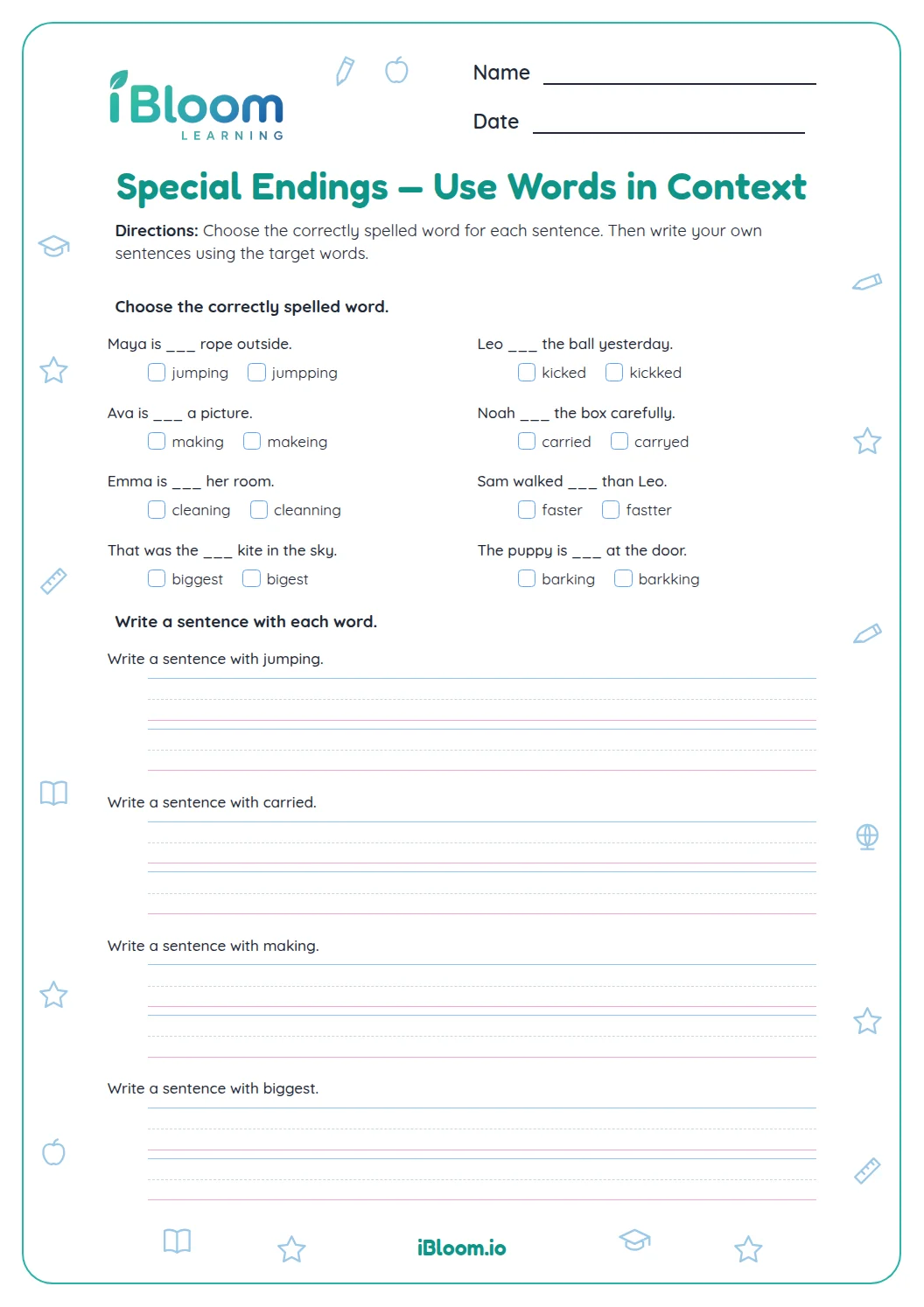
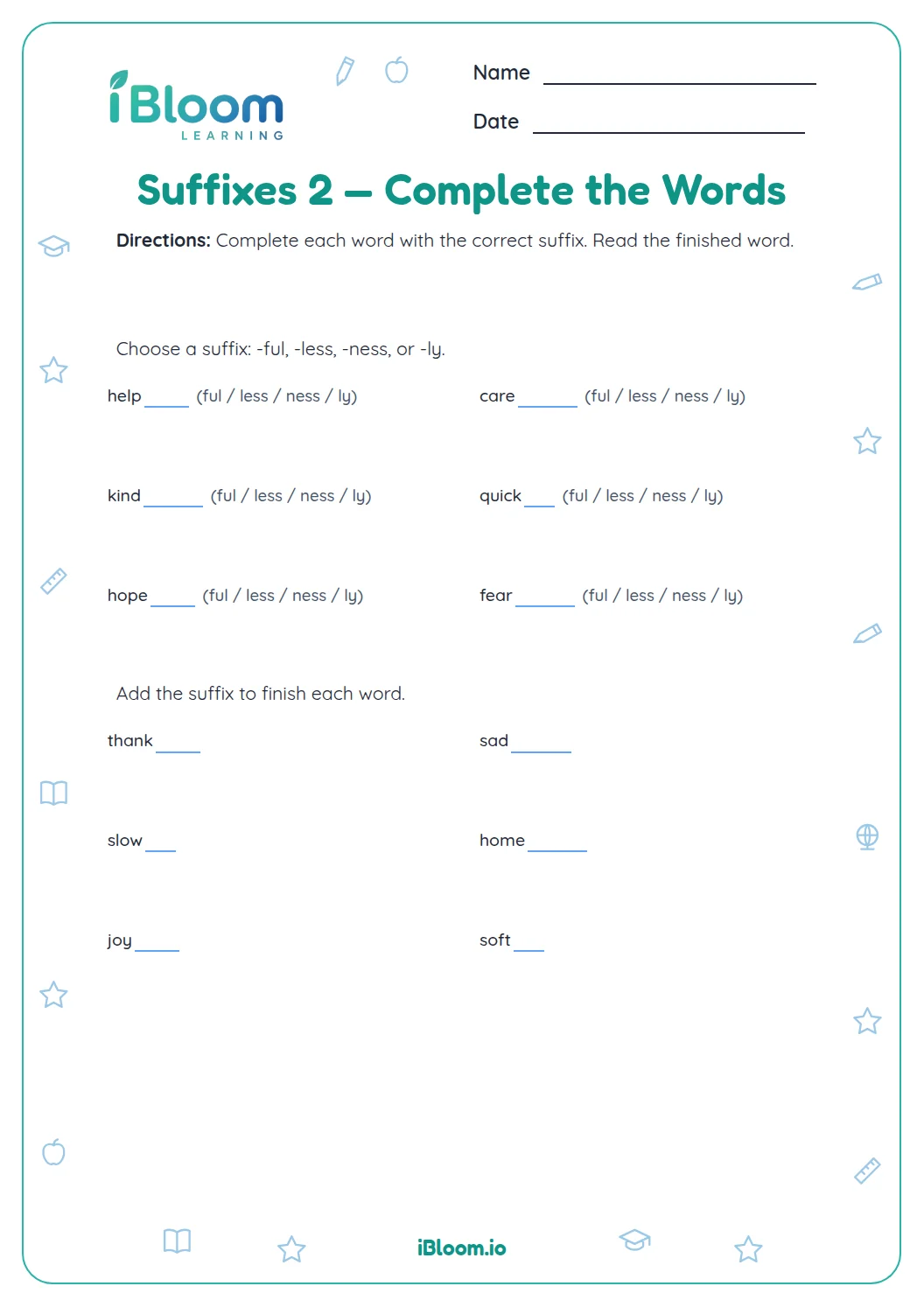
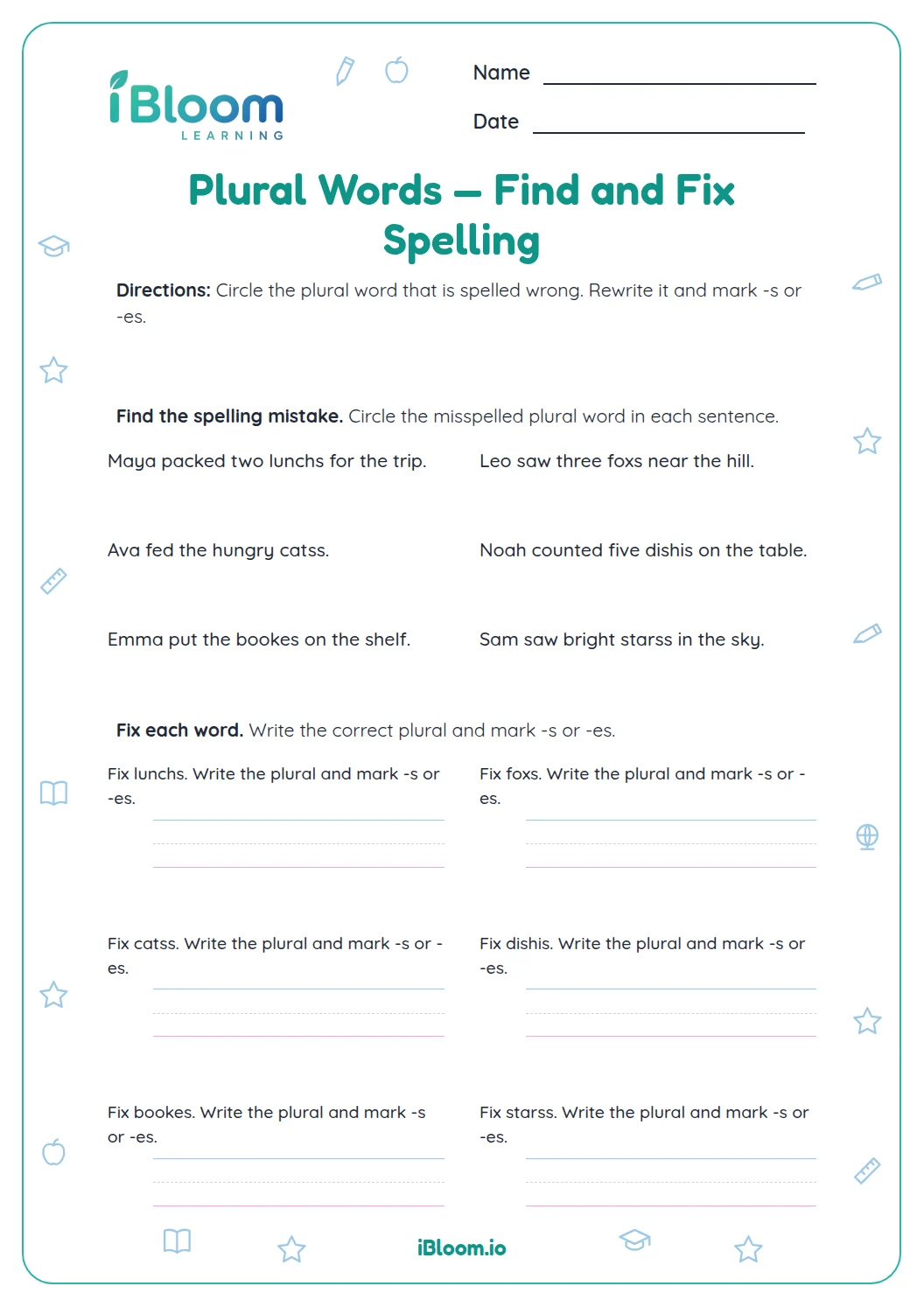
This Grade 2 spelling worksheet focuses on the endings -s, -ed, and -ing. Children sort six words by their ending, choose correctly spelled forms that fit meanings such as “more than one cat,” and complete four sentences using a base word. The two student pages and separate answer key support practice with common inflectional endings. The spelling work aligns with CCSS.ELA-Literacy.L.2.2.d.
Aligned to CCSS.ELA-Literacy.L.2.2.d
How can you sort words by suffix?
Look at the letters at the end of each word. Cats and dogs end in -s, jumped and painted end in -ed, and fishing and helping end in -ing. This first section builds attention to the suffix in a complete word.
- 1cats
- 2The ending is -s.
- 3Sort it under -s.
How does the ending change the meaning?
Use the clue in the prompt. “More than one cat” calls for cats; “a ball that was kicked” calls for kicked. The word must both fit the meaning and be spelled correctly.
How do the suffixes work in sentences?
Part C gives a base word in parentheses and a sentence clue. Yesterday points to jumped, right now to helping, and one dog, two ___ calls for dogs.
- Part A: sort six complete words by -s, -ed, or -ing
- Part B: match six meanings to a correctly spelled word
- Part C: complete four sentence blanks using the base word
How can a child check an ending?
Read the sentence with the completed word. Ask whether it tells about more than one, an action that happened, or an action happening now. Then check that the suffix is attached to the base word as the prompt expects.
How to use this worksheet
- 1Read the directions together and name the skill in your own words.
- 2Complete the first few items slowly, explaining each choice.
- 3Work through the remaining questions independently or in a small group.
- 4Use the answer key to check each response and discuss any mismatch.
- 5Return to missed items and solve them again with the key covered.
Common mistakes and quick fixes
The mistake
Choosing an ending from the meaning but misspelling the word.
The fix
Read the whole option, such as flying, and compare every letter with the base word.
The mistake
Using -ed for an action happening now.
The fix
Look for a clue like right now or are; those clues call for an -ing form here.
The mistake
Writing fishs for more than one fish.
The fix
Use fishes, the plural spelling offered in the matching choices.
Common Core alignment
This page connects the practice activities to the following Common Core standard.
Children apply familiar spelling patterns when adding -s, -ed and -ing.
On this sheet:
Show the official wordingHide the official wording
Generalize learned spelling patterns when writing words (e.g., cage → badge; boy → boil).
What to practice next
Make more practice
Further reading
Questions parents and teachers ask
Which suffixes does this page practice?
It practices -s, -ed, and -ing through sorting, meaning matches, and sentence completion. The examples include cats, jumped, and helping. The 16 questions appear on two worksheet pages, with a separate two-page answer key. The sentence clues also help children decide which form belongs in context.
What does the -s ending show in “cats”?
In this example, -s shows that there is more than one cat. Question 15 gives the clue “One dog, two ___,” so children complete it with dogs. The prompt supplies the base word to keep the focus on using the ending.
How does the worksheet distinguish -ed and -ing?
The sentence clue gives a time or action cue. Yesterday, Sam ___ points to jumped, while “Right now, we are ___ the garden” points to helping. Children read the whole sentence before selecting the form. The completed word should sound natural when the whole sentence is read aloud.
Why is the answer “fishes” for more than one fish?
The item asks children to choose among fishs, fishes, and fished. Fishes is the correctly spelled plural choice in this activity; fished describes a past action, and fishs is not the spelling used here. The answer key follows the choices printed on the worksheet.
Is an answer key included?
Yes. The answer key follows the two worksheet pages and lists the ending for each sorting word, the matching choices, and the completed sentence words. Have the learner try each part first, then compare answers and reread any sentence that needs a correction.