







About this worksheet
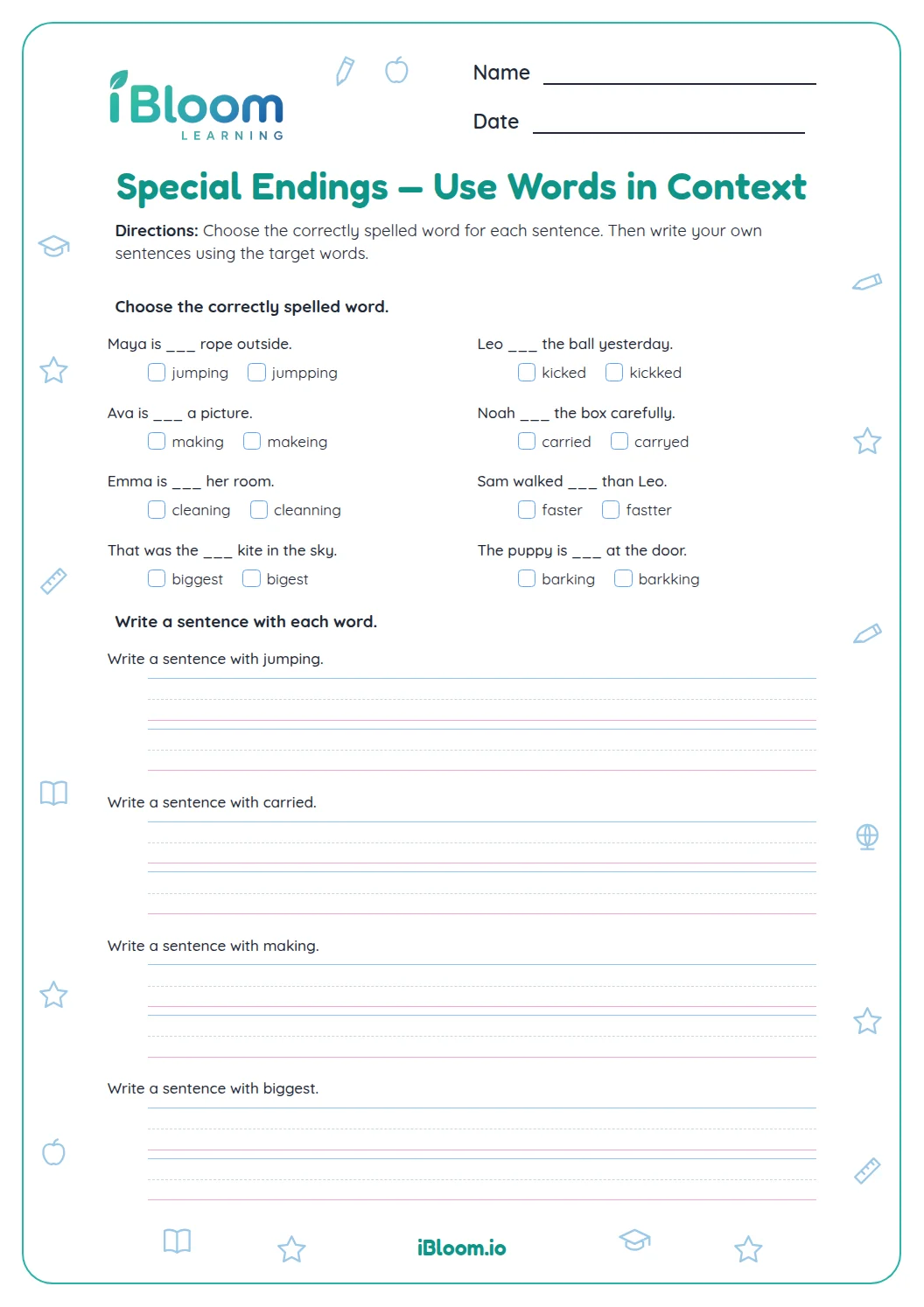
This free printable Grade 2 spelling worksheet practices common endings in complete sentences. Students choose forms such as plays, packed, picking and taller, write endings for supplied base words, and finish with plural, past-tense and comparison checks. The 16 questions build on the old sheet’s mix of sentence choices and spelling practice. The separate answer key shows the expected word forms. Use it to notice whether a child is mixing up -s and -es, leaving off -ed, or choosing -er instead of -est.
Aligned to L.2.2.d
How does the sentence help choose an ending?
A time clue or comparison word points to the ending. “Yesterday” calls for packed, while “is” before an action can fit picking. Read the whole sentence before choosing the word form.
The opening questions mirror the old sheet’s short sentence choices and pictured word prompts.
How do you add an ending to a base word?
Say the base word, then add the ending that fits the sentence. Some spellings change when an ending is added: tie becomes tying, while feed becomes feeds.
- 1Question 10: Leo ___ the door last night. (lock + ed / ing)
- 2“Last night” tells us the action is finished.
- 3Write locked.
How can you check plurals and comparisons?
For words ending in ch, add -es to make dishes. Use -er to compare two things and -est for the greatest degree: taller, brightest. Read each finished sentence to check that its meaning fits.
How to use this worksheet
- 1Read the entire sentence and spot time or comparison clues.
- 2Choose the word form that makes the sentence sound right.
- 3For base-word prompts, say the base and ending before writing.
- 4Check spelling changes such as tie to tying and dish to dishes.
- 5Use the answer key to review each ending and repair missed forms.
Mistakes to discuss and fix
The mistake
Writing dishs for a word ending in ch.
The fix
Add -es after ch: dish becomes dishes.
The mistake
Using packed when the sentence says the action is happening now.
The fix
Match the ending to the time clue: is packing describes an action in progress.
The mistake
Choosing taller when the sentence asks for the most.
The fix
Use -est for the greatest degree: tallest or brightest.
Common Core alignment
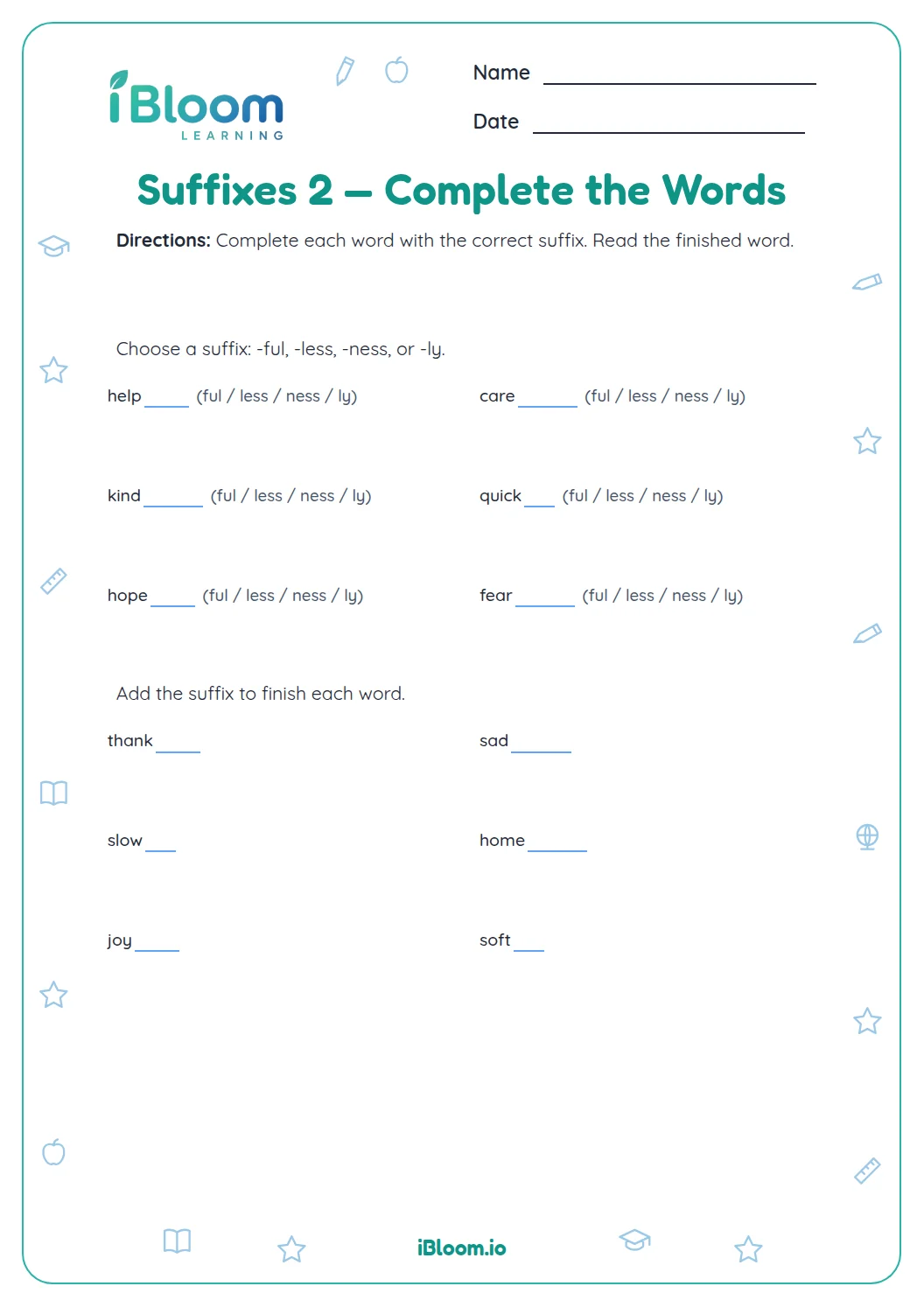
Apply spelling patterns to write words ending in -ful, -less and -ly.
On this sheet: Children build, complete and correct words by preserving the base and spelling each suffix accurately.
Show the official wordingHide the official wording
Generalize learned spelling patterns when writing words (e.g., cage → badge; boy → boil ).
What to practice next
Make more practice
Further reading
Questions parents and teachers ask
Which endings are practiced?
Students work with -s, -es, -ed, -ing, -er and -est. The sentences include actions in the present, past and in progress, along with comparisons. The last questions check plural spelling and the difference between comparing two things and describing the greatest degree.
How can I help a child choose the right form?
Ask the child to read the complete sentence and look for a time or comparison clue. “Yesterday” points to a past-tense form, and “than” often signals a comparison. Then have the child read the chosen word back in the sentence to see whether it fits.
Does a base word ever change when an ending is added?
Yes. The sheet includes tie becoming tying, where the final e is dropped before -ing. Children should compare the supplied base with the finished form and notice that spelling patterns can change when a suffix is attached. They can underline the changed letters before writing the complete word.
When should a word take -es instead of -s?
A word ending in ch often adds -es to make a plural. The worksheet asks students to choose dishes, rather than dishs. Reading the base ending aloud can help children remember to include the extra e before the s.
What does the answer key show?
The separate answer key gives the expected word for each question. For written word completions, check both the ending and any spelling change, such as tie to tying. If an answer is missed, return to the sentence clue and try the word form again.