




About this worksheet
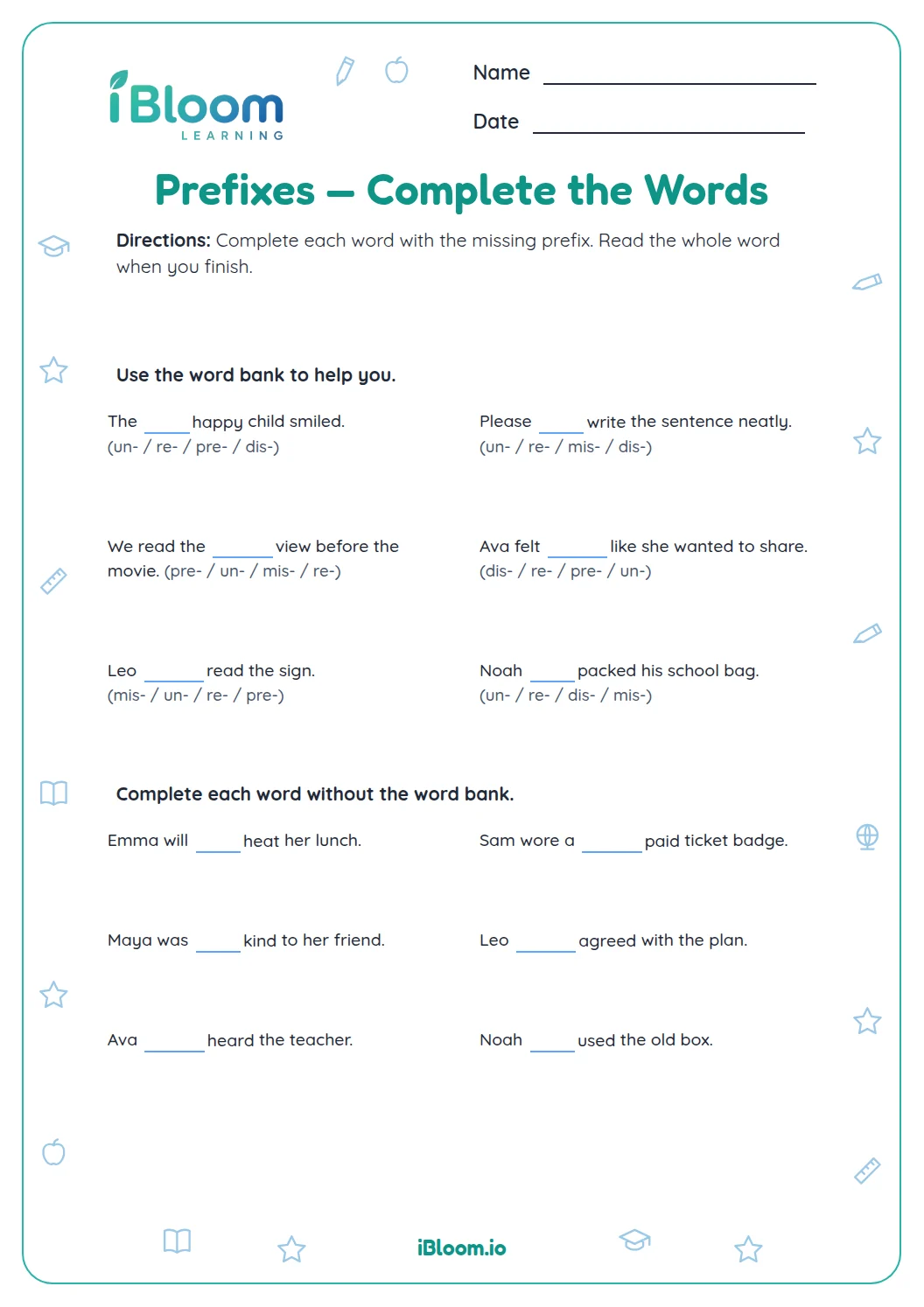
This Grade 2 spelling worksheet focuses on finding and fixing errors in words with un-, re-, mis-, and dis-. Children choose correctly spelled words, correct misspellings, and complete words with a prefix. The practice connects with CCSS 2.L.2.d, which asks students to generalize learned spelling patterns when writing words. A separate answer key lists the corrected forms.
Aligned to 2.L.2.d
How do prefixes change a word?
A prefix attaches to the beginning of a base word. In unhappy, un- joins happy. Part A asks children to inspect and correct full words rather than spell the prefix in isolation.
- 1Fix the spelling: unhapppy
- 2The correct spelling is unhappy: un- + happy.
How can you check a spelling correction?
Read the word slowly and compare its letters with a familiar spelling. In misteak, the intended word is mistake; the prefix is not the error, but the base word needs correction.
How do prefixes help with meaning?
A prefix can give a clue: re- can signal doing something again, as in rewrite. The final questions use such clues while keeping attention on spelling.
How to use this worksheet
- 1Read the whole word before changing it.
- 2Spot the prefix at the beginning.
- 3Check the base word spelling too.
- 4Use sentence meaning to choose between prefix words.
- 5Copy the corrected word carefully and check every letter.
Common mistakes and quick fixes
The mistake
Fixing only the prefix and overlooking an error later in the word.
The fix
Check every letter in the full word.
The mistake
Writing “re-write” with a hyphen in a familiar word.
The fix
Write rewrite as one word.
The mistake
Leaving out a repeated letter in disappear or unnecessary.
The fix
Say and look at each syllable, then check the full spelling.
Common Core alignment
This worksheet practices the standard below.
Use place value to understand numbers.
On this sheet: Children read and write three-digit numbers as hundreds, tens, and ones.
Show the official wordingHide the official wording
Understand that the three digits of a three-digit number represent amounts of hundreds, tens, and ones.
What to practice next
Make more practice
Further reading
Questions parents and teachers ask
Which prefixes appear?
The questions use un-, re-, mis-, and dis-, as in unsafe, rewrite, misplace, and disagree. Children choose correctly spelled words, repair misspellings, and complete a word with its prefix. The emphasis is on checking the spelling of the whole word, including both prefix and base.
What should children check in a misspelled word?
Read the whole word and check both the prefix and the base word before writing a correction. For example, in “unhapppy,” the extra p must be removed to spell unhappy. Then reread the corrected word and compare its letters with the familiar spelling.
Why is “rewrite” one word?
In this familiar prefix word, re- attaches directly to write without a hyphen. The worksheet includes it as a spelling choice so children can compare the correct form with misspelled alternatives. Other examples also ask readers to check the base word after the prefix.
Does the printable include a key?
Yes. The separate answer key gives the correct spelling or prefix for all 16 questions. It covers the multiple-choice items, corrected words, and the two prefix completions. Children can finish the practice first, then compare each written response with the key.