






About this worksheet
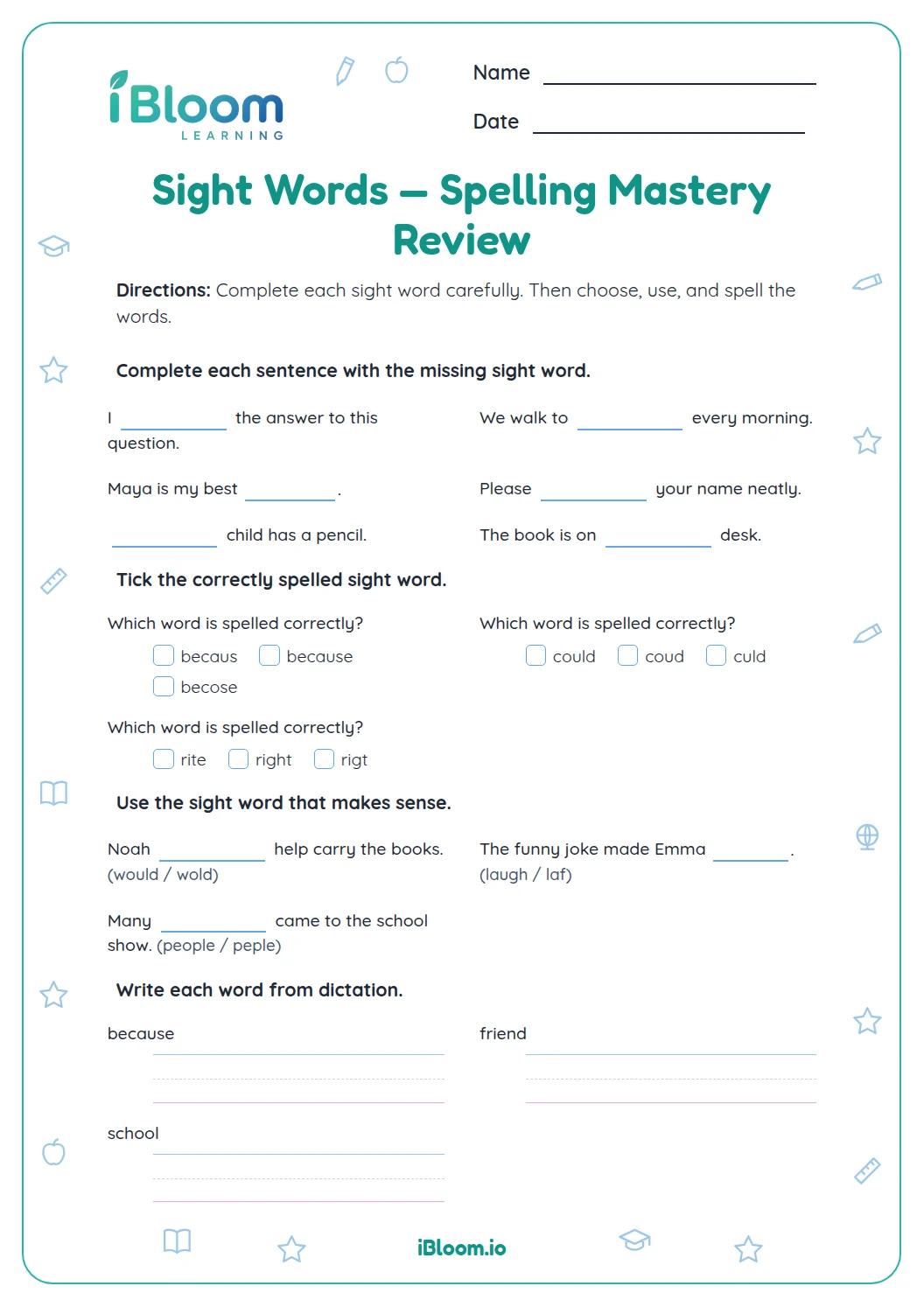
This Grade 2 printable gives children short, familiar sentence contexts for sight words such as because, friend, many, should, and their. Each item asks them to choose the correctly spelled word that completes the sentence, so they attend to both meaning and spelling. Sixteen sentences provide repeated practice across a useful range of common words, with an answer key on a separate page. The activity connects to CCSS L.2.4, using context to clarify word meaning and spelling.
Aligned to L.2.4
How does a sentence help you choose a sight word?
Read the whole sentence before looking at the choices. Meaning narrows the possibilities: “We went home ___ lunch” needs a word that tells when.
- 1We went home ___ lunch.
- 2“after” tells when the trip home happened.
- 3Choose after, then reread the sentence.
How can you check the spelling?
Compare the letters in each choice, then read the sentence with the word in place. The correct word should fit the meaning and have the familiar spelling.
What should children do after choosing?
Read the completed sentence aloud and check it against the key. Revisit any word whose spelling was unfamiliar.
How to use this worksheet
- 1Read the whole sentence once.
- 2Notice the clue words that tell what belongs in the blank.
- 3Read each choice and check its spelling.
- 4Put your choice in the sentence and read it again.
- 5Use the key to review the words that need another look.
Common mistakes and quick fixes
The mistake
Choosing a word because it sounds right but overlooking a misspelling.
The fix
Look at the letter order in each choice before deciding.
The mistake
Reading only the blank instead of the whole sentence.
The fix
Use the other words as meaning clues.
The mistake
Confusing their with a similar-sounding word.
The fix
In “their tails,” their tells who the tails belong to.
Common Core alignment
The sentences use context to support word meaning and spelling.
Use sentence context to clarify word meaning and spelling.
On this sheet: Children use sentence meaning and correct spelling to select familiar words.
Show the official wordingHide the official wording
Determine or clarify the meaning of unknown and multiple-meaning words and phrases based on grade 2 reading and content, choosing flexibly from an array of strategies.
What to practice next
Make more practice
Further reading
Questions parents and teachers ask
What does using sight words in context mean?
Children read a whole sentence and choose a word that makes sense in the blank. This sheet also asks them to recognize the familiar spelling among choices, so meaning and letter order both help them decide. In question 1, “after lunch” tells when someone went home.
Which sight words does this page practice?
The 16 sentences use words such as after, again, any, because, could, friend, great, many, should, their, and would. Each appears in a short sentence with clues that help children choose. The choices also let children compare the familiar spelling with common letter-order errors.
How can I help if a child is unsure?
Read the sentence aloud together, pause at the blank, and ask what kind of word would fit. Then compare the spellings in the choices and reread the sentence with the selected word. The clue words often make the sentence meaning clear.
Does the worksheet have an answer key?
Yes. The separate key lists the correct word for each sentence. If a child misses one, point out its letters and reread the sentence so the word is connected to both spelling and meaning. A second try can help the child remember the word.
Are children writing their own sentences on this version?
No. Each of the 16 items is a sentence completion with three spelling choices. Children read for meaning, select the correctly spelled word, and reread the completed sentence. The separate key lists the expected word for each item. This keeps attention on one target word in a complete sentence.