






About this worksheet
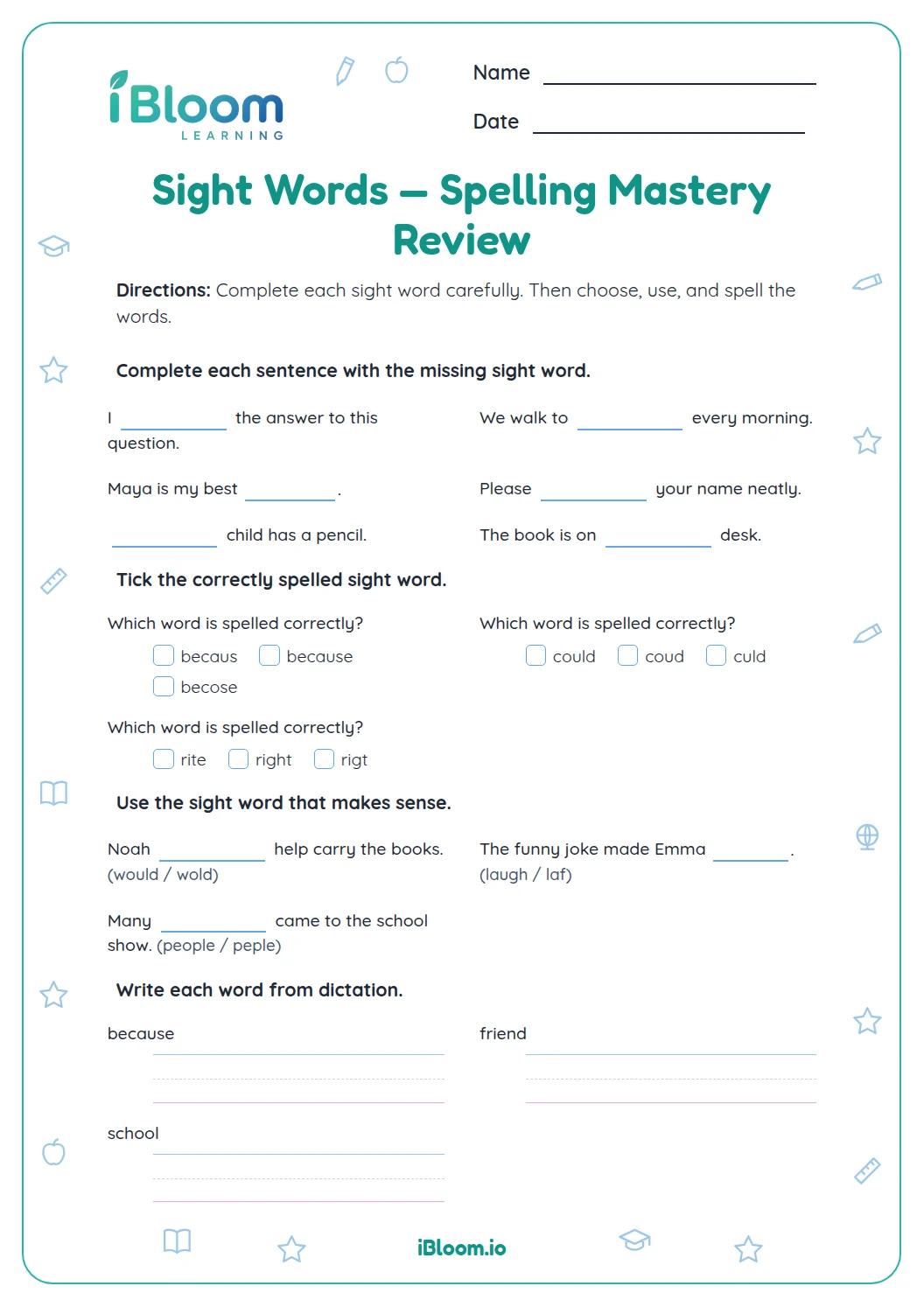
This free printable Grade 2 worksheet asks children to find and fix misspelled sight words. They circle the wrong spelling in four sentences (sed, shud, thare and frend), pick the right spelling from three choices for would, were, again and because, and rewrite three sentences that each have two spelling mistakes. It practices Common Core L.2.2 and RF.2.3f, and a separate answer key lists every correct spelling.
Aligned to L.2.2 and RF.2.3f
Why are sight words hard to spell?
Many sight words break the usual sound-letter rules, so a child cannot always sound them out. Said does not spell the way it sounds, and neither do would, friend and again. A child who writes only what they hear ends up with sed, wud, frend or agin.
These words are also the ones children use most, so a wrong spelling can repeat in every piece of writing. Spotting it in a sentence, as Part A does, trains the eye to notice when a word looks wrong.
How does finding a mistake help a child learn the right spelling?
Children first have to read the sentence and decide which word looks wrong. Then they work out what the word should be and how it differs. That close look at each letter is more active than copying a list.
In question 3, “Is thare a cookie for me?”, a child may notice that thare does not look like the word there. The right spelling ends like here and where.
- 1Is thare a cookie for me?
- 2Read one word at a time. Is, thare, a, cookie, for, me.
- 3thare does not look right. The word is there.
- 4Check: there ends like here and where.
- 5Circle thare. The right spelling is there.
What is on this worksheet?
Eleven questions on two pages, in three parts. Every question uses a sight word children see often in their reading.
- Part A, Find the mistake: four sentences, each with one misspelled sight word to circle
- Part B, Pick the right spelling: would, were, again and because, each with two wrong spellings
- Part C, Fix the sentence: three sentences to rewrite, each with two spelling mistakes
- Answer key on its own pages
How to use this worksheet at home or in class
- 1Read each Part A sentence aloud together, one word at a time, and ask which word looks wrong.
- 2After your child circles a word, ask them to say what it should be and spell it aloud.
- 3In Part B, read all three spellings aloud before choosing. Ask your child to point to the tricky letters in the right one.
- 4In Part C, have your child find both mistakes before writing. A pencil dot under each wrong word helps.
- 5Read the fixed sentences aloud together and compare each word with the first version.
- 6Check with the answer key. Put any word that was missed on a list to practice with cover, say, write and check.
Common mistakes and quick fixes
The mistake
Writing the word the way it sounds: wud for would, sed for said.
The fix
Mark the tricky part: the ou and l in would, the ai in said. Say the word slowly and look at those letters as you spell it.
The mistake
Writing friend with the letters out of order: freind.
The fix
Remember that a friend is there to the end: fri-END. Say the last three letters while writing.
The mistake
Fixing only one mistake in a sentence that has two, as in “Where did yu put the ball?”
The fix
Touch each word in the sentence as you check it. Rewrite the sentence, then compare it to the original word by word.
Common Core alignment
Most US states use the Common Core standards or a close state version. These Grade 2 standards describe the spelling work on this page.
Spell words correctly when writing sentences.
On this sheet: Part C asks children to write whole sentences with every word spelled correctly.
Show the official wordingHide the official wording
Demonstrate command of the conventions of standard English capitalization, punctuation, and spelling when writing.
Recognize and read words that do not follow the usual spelling rules.
On this sheet: Parts A and B ask children to spot the right spelling of irregular words like said, would and friend.
Show the official wordingHide the official wording
Recognize and read grade-appropriate irregularly spelled words.
What to practice next
Make more practice
Further reading
Questions parents and teachers ask
Which sight words are on this worksheet?
The misspellings in Part A stand for said, should, there and friend. Part B covers would, were, again and because. Part C rewrites sentences with where, you, every, was, they and some. Together they are common words that children meet in nearly everything they read.
Why do children misspell sed and shud?
They write what they hear. Said sounds like sed and should sounds like shud, but the real spellings use letters that do not match the sounds. Because sound-it-out does not work for these words, children need to see the correct spelling and write it several times.
How can my child remember the spelling of friend?
Try the memory trick that a friend is there to the end: fri-END. Say the last three letters aloud while writing the word. Children who write freind can circle the ie in the middle so the letters stay in order, then write the word again.
What should I do if my child misses a word?
Write the word correctly on a card and have your child look at it, say it, cover it, write it and check it. Do this for a few days. Then ask for the word in a sentence. Short, repeated practice works better than copying a word ten times.
Does my child need to find both mistakes in Part C?
Yes. Each Part C sentence has two misspelled words, so the rewrite needs both fixed. For “Wher did yu put the ball?” the answer is “Where did you put the ball?” Touching each word in the sentence as they read it helps children find both.
Is there an answer key for this worksheet?
Yes. The answer key has its own two pages and shows the circled word for each Part A sentence, the correct spelling for each Part B question and the corrected sentence for each Part C question. Print only the worksheet for your child and use the key afterward to check together.