






About this worksheet
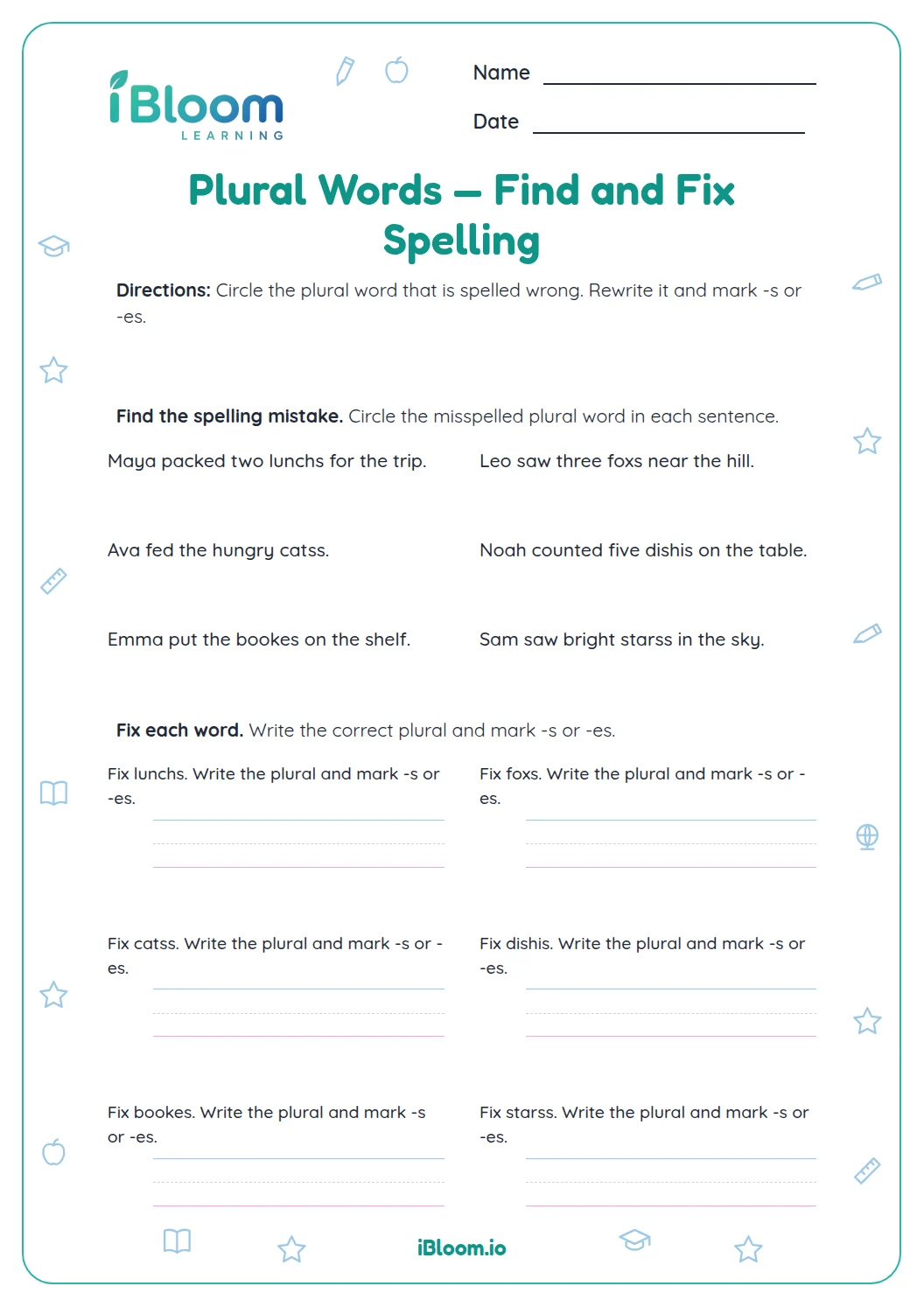
This Grade 2 spelling printable gives children sentence context for choosing and writing plural nouns. The 16 questions include common -s and -es endings, words that change y to ies or f to ves, sentence choices, and a short writing item using “children.” It practices Common Core L.2.2 conventions for spelling. A separate answer key includes the target words and a sample sentence.
Aligned to L.2.2
What should children notice first?
“Two boxes” needs a plural because there is more than one.
How can one example be worked out?
In question 2, box ends in x, so add -es: boxes.
- 1In question 2, box ends in x, so add -es: boxes.
How does the page build practice?
The page starts with choosing a plural, then asks children to spell plurals independently and correct a misspelling.
How to use this worksheet
- 1Read the entire sentence.
- 2Notice whether it means one or more than one.
- 3Check the word ending.
- 4Choose or write the plural spelling.
- 5Read the sentence again to check that it sounds right.
Common mistakes and quick fixes
The mistake
Adding only s to a word ending in x gives boxs. Add -es after x.
The fix
Boxes.
The mistake
For many consonant plus y words, change y to ies.
The fix
Berry becomes berries.
The mistake
Some f-ending plurals change f to ves, as in knife to knives.
The fix
Read the whole word after changing it.
This worksheet practices the following Common Core skill.
A plural names more than one; its spelling depends on the word ending.
On this sheet:
Show the official wordingHide the official wording
Demonstrate command of the conventions of standard English capitalization, punctuation, and spelling when writing.
What to practice next
Make more practice
Further reading
Questions parents and teachers ask
When do many nouns add -es?
Many nouns ending in s, x, z, ch, or sh add -es to form a plural. For example, box becomes boxes and dish becomes dishes. The extra syllable makes the plural easier to say. The worksheet contrasts these endings in sentence examples.
How does baby become babies?
Baby ends in a consonant followed by y. Change the y to i and add es, making babies. The worksheet asks children to use the word in a sentence so they can connect the spelling to its plural meaning. The singular is baby; the plural names more than one baby.
Why is “foxs” incorrect?
Fox ends in x, so the plural needs -es. The correct spelling is foxes. Adding only s leaves out the ending needed for this word pattern. It ends with x, which takes -es in its plural. This spelling follows the pattern for nouns ending in x.
What should a child check before writing a plural?
First check the sentence to see if it means more than one. Then look at the last letters of the noun and choose the plural ending that fits. Finally, reread the sentence with the plural inserted. The examples also show words whose spelling changes before an ending is added.
Does the worksheet include an answer key?
Yes. The separate key lists the correct plural for each item and gives one sample response for the sentence-writing question. Since a child may write different correct sentences with “children,” the sample is a model rather than the only acceptable sentence.