





About this worksheet
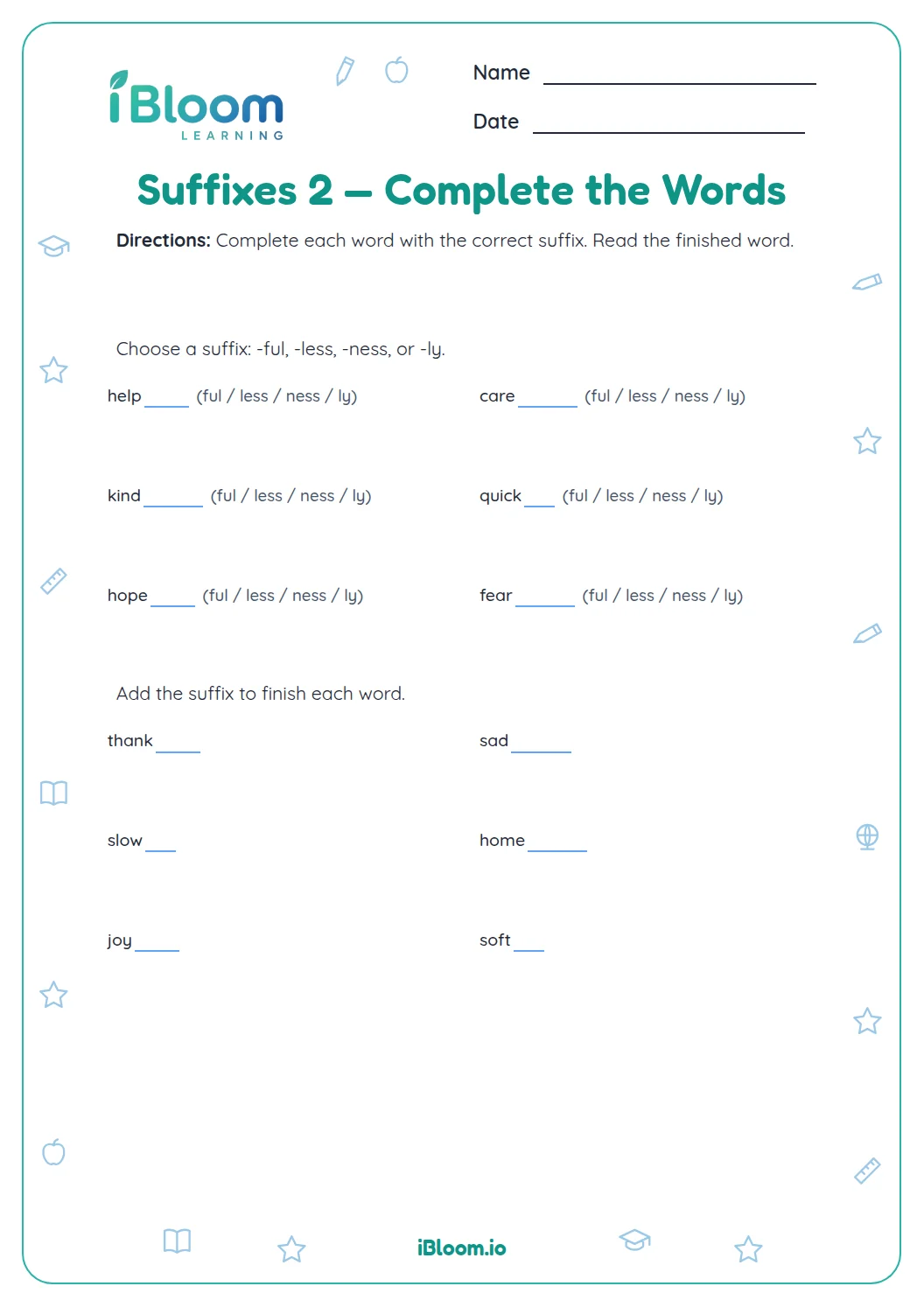
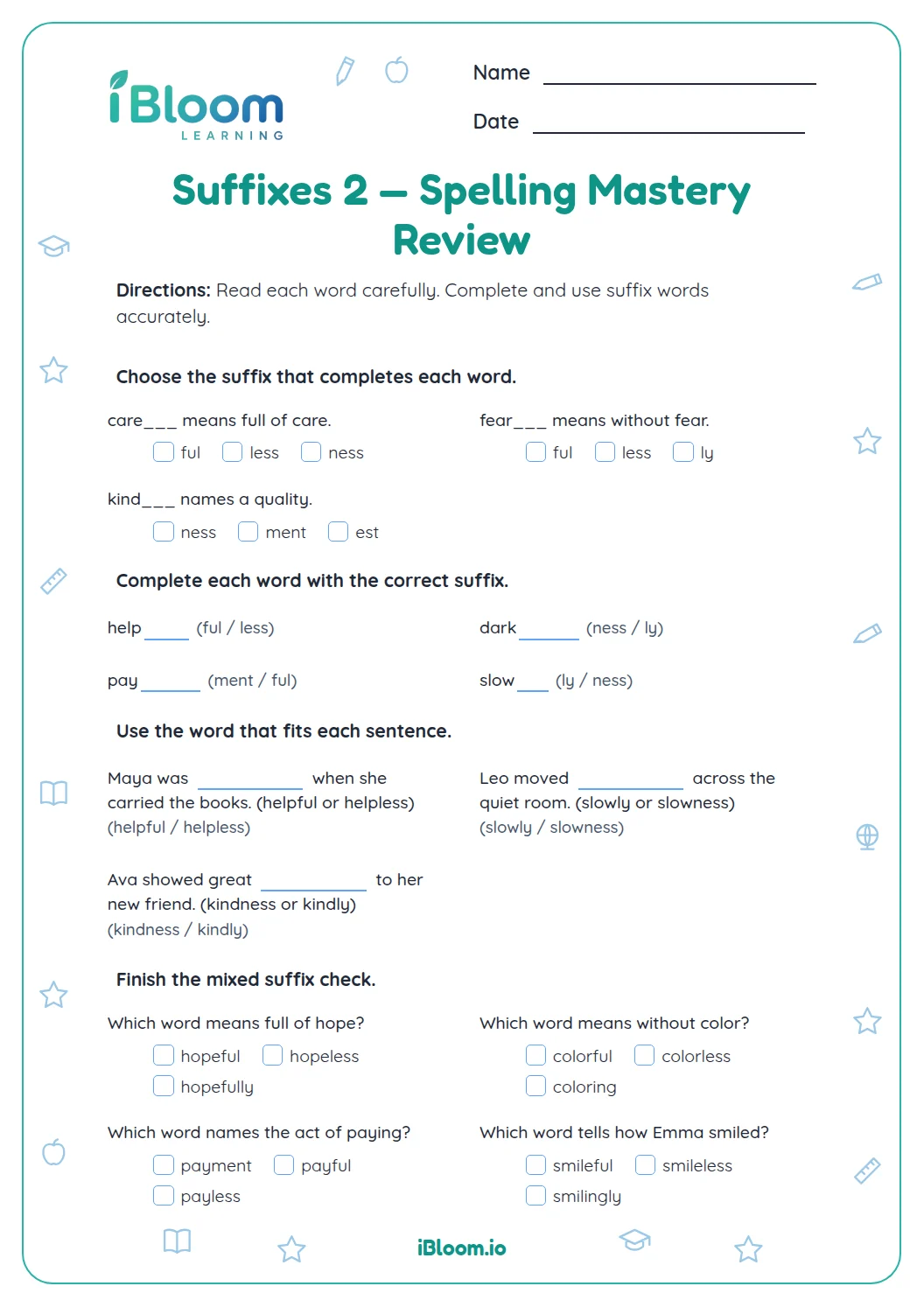
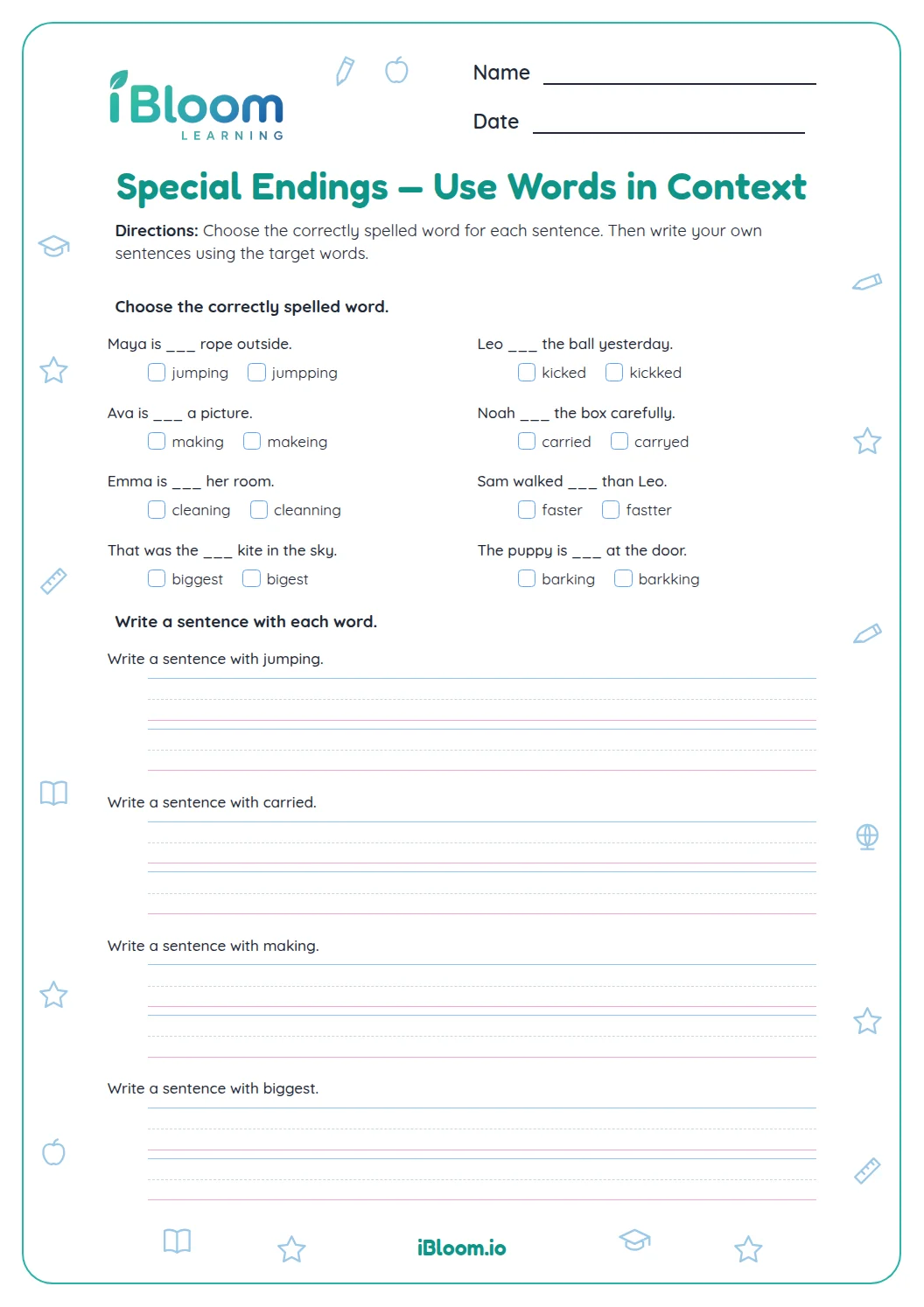
This Grade 2 worksheet gives 14 questions on building and using common suffix words. Children add endings such as -ful, -less, -er, -est, -y, and -ly, then use meaning clues to identify new words. The practice aligns with Common Core L.2.2.d, and the answer key lists each response.
Aligned to L.2.2.d
How do suffixes change a base word?
The first six questions build familiar words with -ful, -less, -er, -est, -y, and -ly. Check how the ending changes the word and its meaning.
- 1help + -ful → helpful
- 2Read the completed word and check its meaning.
How can the meaning help you choose?
Meaning clues help distinguish suffix words. For example, “without hope” points to hopeless: -less means without.
What does each part ask learners to do?
The worksheet contains 14 questions in three parts. First build words, then match meanings, then apply suffixes to fresh clues.
How to use this worksheet
- 1Read the directions and look at the model or passage first.
- 2Answer each item before checking the key.
- 3Point to the letter, number, word, or passage clue that supports the answer.
- 4Correct missed items and explain the fix aloud.
Common mistakes and quick fixes
The mistake
Rushing past a key word or direction.
The fix
Reread the prompt and underline the part that tells what to do.
The mistake
Choosing an answer without checking the model or text.
The fix
Match the response to the visible model or a specific passage detail.
The mistake
Leaving an answer unchecked.
The fix
Compare it with the answer key and correct it in a different color.
Common Core alignment
This worksheet gives Grade 2 practice applying spelling patterns when building words with suffixes.
Apply learned spelling patterns when writing words with common suffixes.
On this sheet: Children build and spell words with suffix patterns such as -ful, -less, -er, -est, -y, and -ly.
Show the official wordingHide the official wording
Generalize learned spelling patterns when writing words.
What to practice next
Make more practice
Further reading
Questions parents and teachers ask
How many questions are on this suffixes 2: sort and match words worksheet?
The worksheet practices -ful, -less, -er, -est, -y, and -ly. Children add endings to base words, identify suffix meanings, and apply suffixes to short clues. The answer key shows the intended forms so an adult and child can check spelling together.
What does this Grade 2 worksheet practice?
A suffix is a word ending added to a base word. In this worksheet, children see how endings such as -less and -ful change meaning, then choose words that fit simple definitions. The examples connect the spelling change with the meaning clue.
Does the worksheet include an answer key?
Yes. A separate answer key is included after the worksheet pages. It shows the expected answers so an adult can check work and talk through a missed item. For open responses, accept a clear answer that matches the prompt and the supporting information.
How should I use the answer key?
Let the learner complete a section before checking it. Compare each answer with the key, then return to the model or passage for any missed response. Asking the learner to explain the correction helps connect the answer to the skill being practiced.
Can I print the worksheet without the answer key?
Yes. Print the worksheet pages for the learner and keep the answer key separate for checking. The key is useful for an adult or tutor, but learners can complete the printable before seeing it. Reprint the worksheet when another round of practice would help.