



About this worksheet
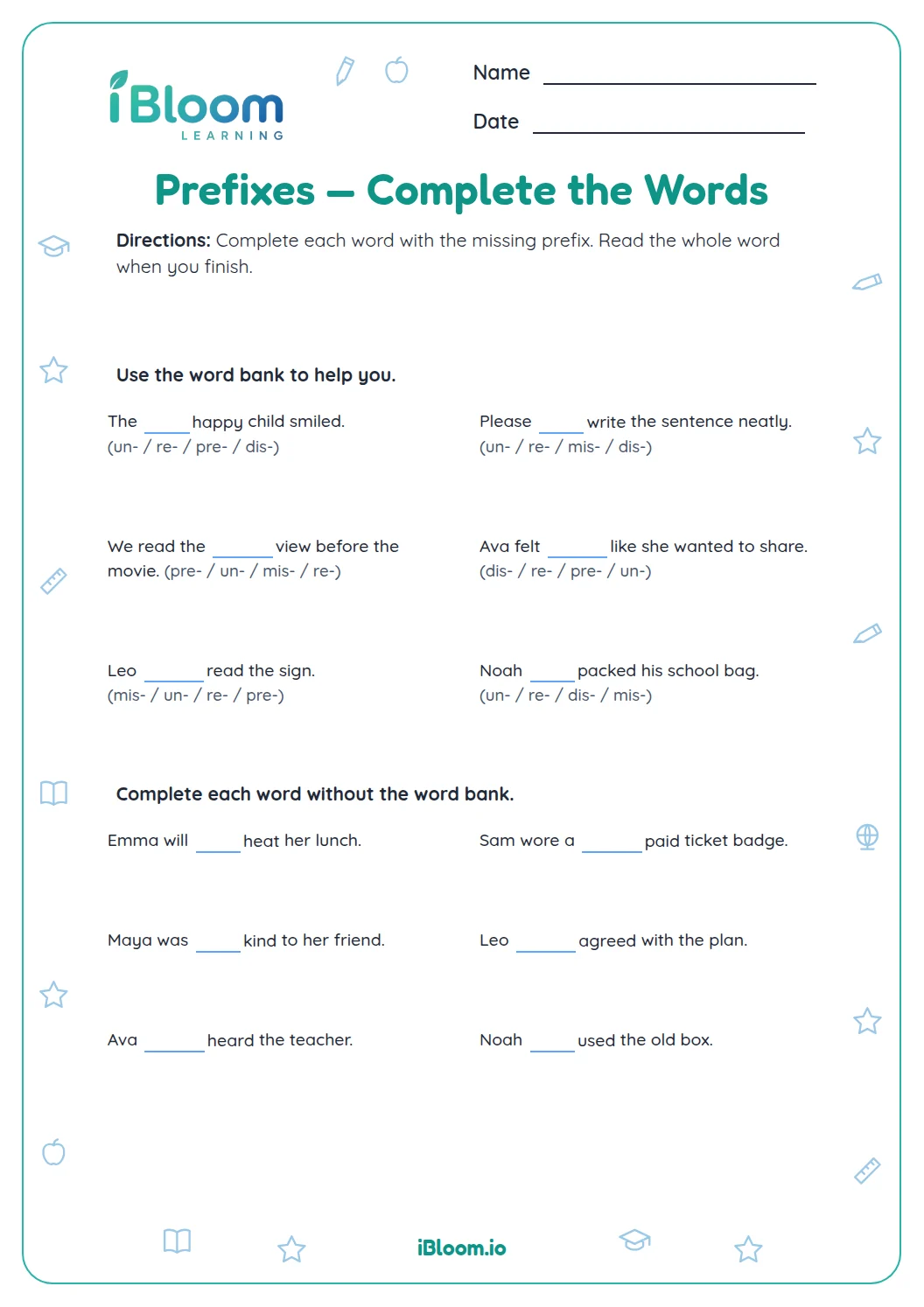
This free Grade 2 spelling worksheet gives students practice with re-, un-, pre-, mis-, and dis-. They connect prefixes to meanings, complete familiar words, and sort words by the prefix at the beginning. The answer key lists each choice and completed word. The meaning and word-building tasks practice CCSS L.2.4b by asking students to determine how a known prefix changes a known base word.
Aligned to L.2.4b
How can a prefix change a base word?
A prefix attaches to the beginning of a base word and changes its meaning. Reread means read again, unsafe means not safe, preview means view before, misspell means spell incorrectly, and dislike means not like. Read the prefix and base word together to understand the whole word.
How can students build and spell a prefix word?
Keep the base word intact when adding a prefix. Write re- plus play as replay, then read the new word and check its meaning. The middle part asks students to supply the complete word from a short meaning clue.
- 1Clue: ___play means to play again.
- 2Prefix for “again”: re-
- 3Base word: play
- 4Write: replay
How does sorting help compare prefixes?
Sorting makes patterns easier to notice. Look at the beginning of each word to find its prefix, then choose the matching group. The last part includes examples from all five prefix families.
How to use this worksheet
- 1Read the whole word or clue.
- 2Spot the letters at the beginning of the word.
- 3Name the prefix and its meaning: again, not, before, wrongly, or not like.
- 4Check what the base word means by itself.
- 5Combine the prefix and base word without changing the spelling.
- 6For Part C, sort by the prefix at the start.
Common mistakes and quick fixes
The mistake
Choosing a prefix because it sounds familiar.
The fix
Match the prefix meaning to the clue, such as again or before.
The mistake
Writing only the prefix in a missing-word item.
The fix
Write the whole new word, including its base word.
The mistake
Sorting by the last letters of a word.
The fix
Look at the beginning: the prefix comes before the base word.
Common Core alignment
Use a known prefix to understand a new word.
On this sheet: Students use five familiar prefixes to determine word meanings, complete words, and identify prefix groups.
Show the official wordingHide the official wording
Determine the meaning of the new word formed when a known prefix is added to a known word (e.g., happy/unhappy, tell/retell ).
What to practice next
Make more practice
Further reading
Questions parents and teachers ask
What are the prefixes on this worksheet?
The worksheet uses re-, un-, pre-, mis-, and dis-. In these examples, re- means again, un- means not, pre- means before, mis- means wrongly, and dis- means not or the opposite. Students use each prefix with a base word to determine the new word’s meaning and spelling.
How many questions does the page include?
There are 16 questions in three parts: five prefix-meaning choices, six completed words, and five items to sort by prefix. The last part includes one word from each group: re-, un-, pre-, mis-, and dis-. The answer key lists every choice and whole word.
What is the difference between a prefix and a base word?
A prefix is a word part at the beginning; a base word carries the main idea. For example, in replay, re- means again and play is the base word. Put together, replay means to play again. The prefix changes the base word’s meaning.
How can a child check a word built with a prefix?
Read the prefix, read the base word, then combine their meanings. If the clue says before and the base word is view, preview fits. Finally, check that the whole word is spelled with the prefix at the beginning and reread its meaning.
Is the last part a traditional cut-and-paste sort?
No cutting is needed. Each item names a word and asks the student to choose its prefix group. The final five words cover re-, un-, pre-, mis-, and dis-. This keeps the sorting decision in a printed-choice format, and the answer key makes each group easy to check.