



About this worksheet
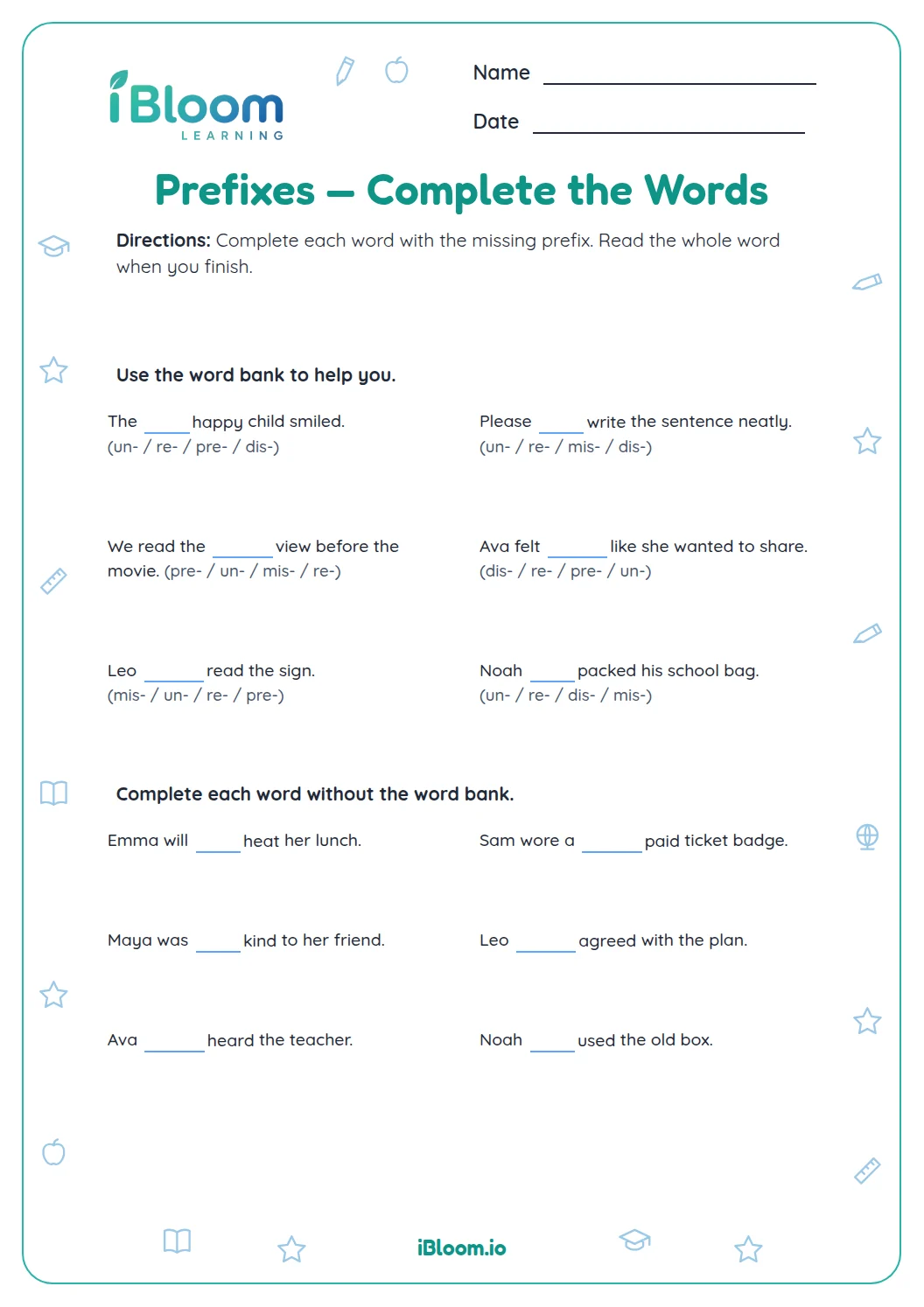
This free Grade 2 prefix worksheet reviews how word beginnings change meaning while keeping a familiar base word recognizable. Its 16 questions move from joining a prefix and a base word to choosing meanings, circling prefix words in sentences and fixing misspellings. Children work with un-, re-, pre-, mis- and dis-. The sheet practices Common Core L.2.4b by connecting familiar prefixes to the meanings of complete words. A separate answer key supports checking both the prefix and the letters in the base word.
Aligned to L.2.4b
What changes when a prefix is added?
A prefix adds meaning at the beginning of a word. On this sheet, re- can mean again, pre- means before, and mis- means incorrectly. Un- and dis- can give a negative meaning, as in unsafe and disagree.
Read the complete word after joining its parts. The spelling of the base words in these questions stays the same: happy keeps both p letters in unhappy, and spell keeps its s in misspell.
Why does misspell have two s letters?
The prefix mis- ends with s, and the base word spell begins with s. Both letters remain when the parts join. Question 4 builds the word; question 16 checks whether the child can restore the missing letter.
- 1mis + spell = misspell
- 2mis- means incorrectly.
- 3spell begins with s; mis- ends with s.
- 4Keep both: misspell means spell incorrectly.
What does each part review?
Part A asks children to write four complete words from supplied parts. Part B checks the meanings of unsafe, replay, disagree and misread. Part C has four short sentences, each containing one prefix word.
Part D gives a misspelled word and its correctly spelled base word. Children rewrite the complete word. These clues let an adult see whether an error concerns the prefix, the base word or the place where they meet.
How to use this worksheet
- 1Say happy and unhappy aloud and talk about the change in meaning.
- 2Complete Part A by joining each prefix and base word without a space.
- 3In Part B, say the base meaning first, then add the prefix meaning.
- 4For Part C, point to the word beginning and name the base word after circling.
- 5Rewrite the four misspellings, compare with the key, and underline any letters that were missing or changed.
Mistakes to check together
The mistake
Writing mispell with one s.
The fix
Keep the final s in mis- and the first s in spell.
The mistake
Choosing read again as the meaning of misread.
The fix
Compare mis- meaning incorrectly with re- meaning again.
The mistake
Writing un happy as two words.
The fix
Join the prefix directly to the base word: unhappy.
Common Core alignment
Use familiar prefixes to work out meanings such as read again and not safe.
On this sheet: Meaning questions and sentence clues connect each prefix to its complete word.
Show the official wordingHide the official wording
Determine the meaning of the new word formed when a known prefix is added to a known word (e.g., happy/unhappy, tell/retell).
What to practice next
Make more practice
Further reading
Questions parents and teachers ask
Which prefixes are included?
The sheet uses un-, re-, pre-, mis- and dis-. Children meet them in word-building tasks, meaning choices and sentences. Examples include unhappy, reread, preheat, misread and disagree. Ask your child to say the base word separately before explaining what the prefix adds to the complete word.
Is this a spelling test or a review?
It is a supported review with clues for spelling and meaning. Part A supplies both word parts, and Part D supplies the correct base word beside a misspelling. After checking the sheet, you can say a few of the completed words aloud for a separate spelling check.
Why are happy, read and heat used twice?
These words return so children can use the same spelling knowledge in a different task. First they build unhappy, reread and preheat from parts; later they correct altered spellings. Compare the two attempts to see whether the child preserves the base word when the task changes.
Can an adult read the sentences aloud?
Yes, an adult can read the sentences and meaning choices aloud. Keep the printed words visible so the child can inspect their letters. In Part C, ask the child to circle the prefix word and say its base word; in Part D, let the child write the correction.
What should I check besides the prefix?
Check the whole word, including doubled letters and familiar vowel spellings. Unhappy needs both p letters from happy; reread keeps ea from read; misspell needs two s letters where the parts meet. The answer key shows every completed word, correct meaning choice and circled sentence word.