
About this worksheet
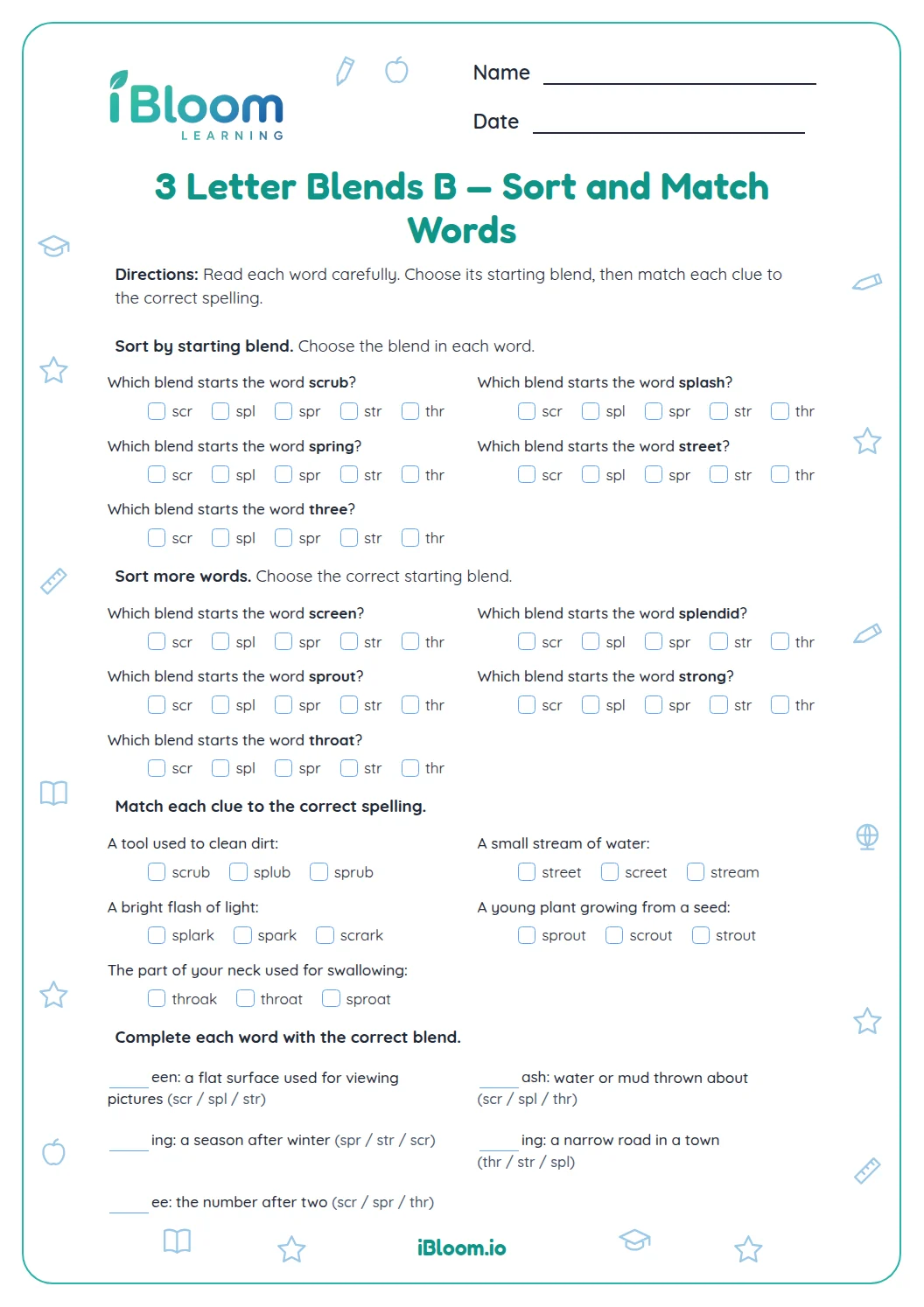
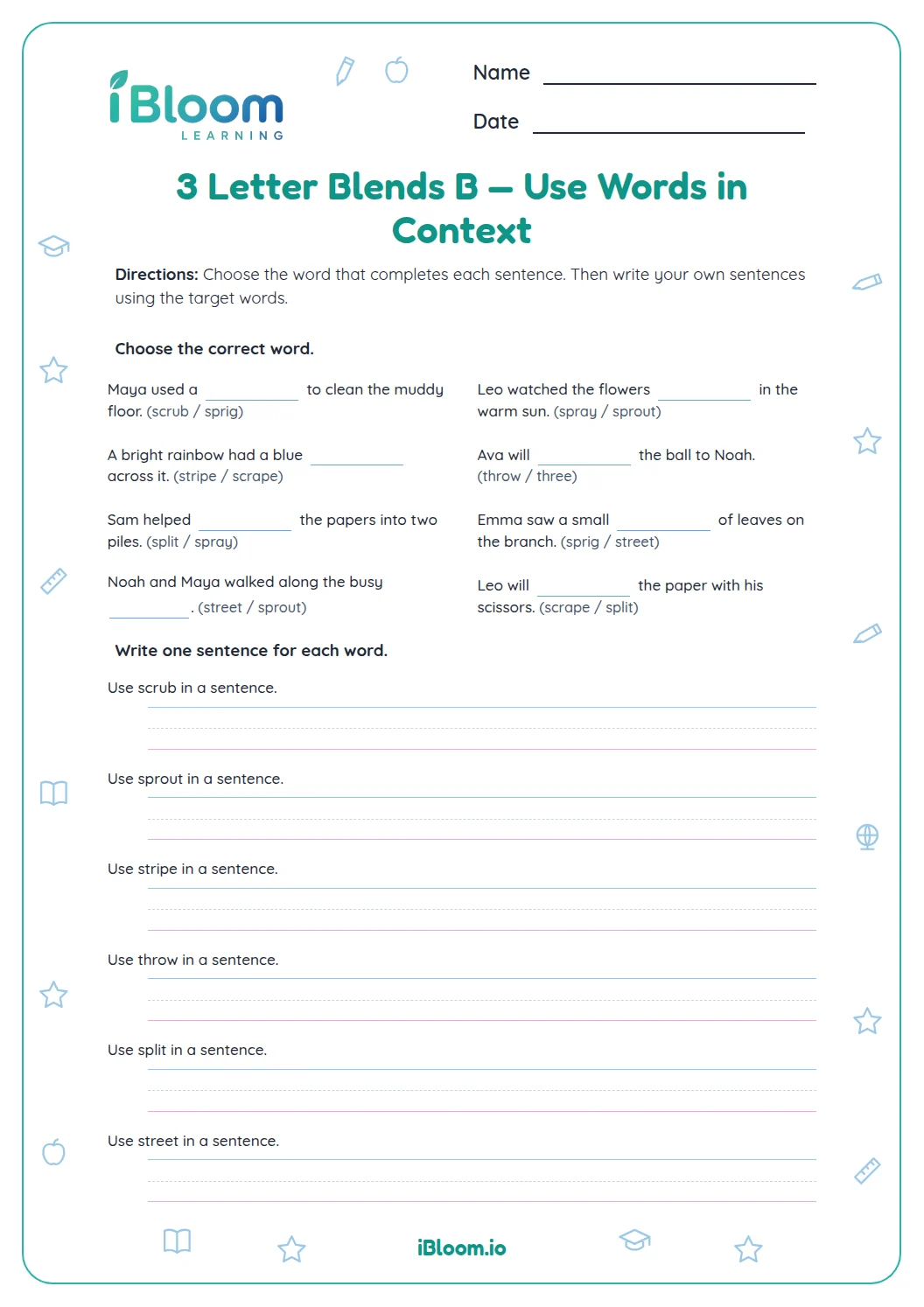
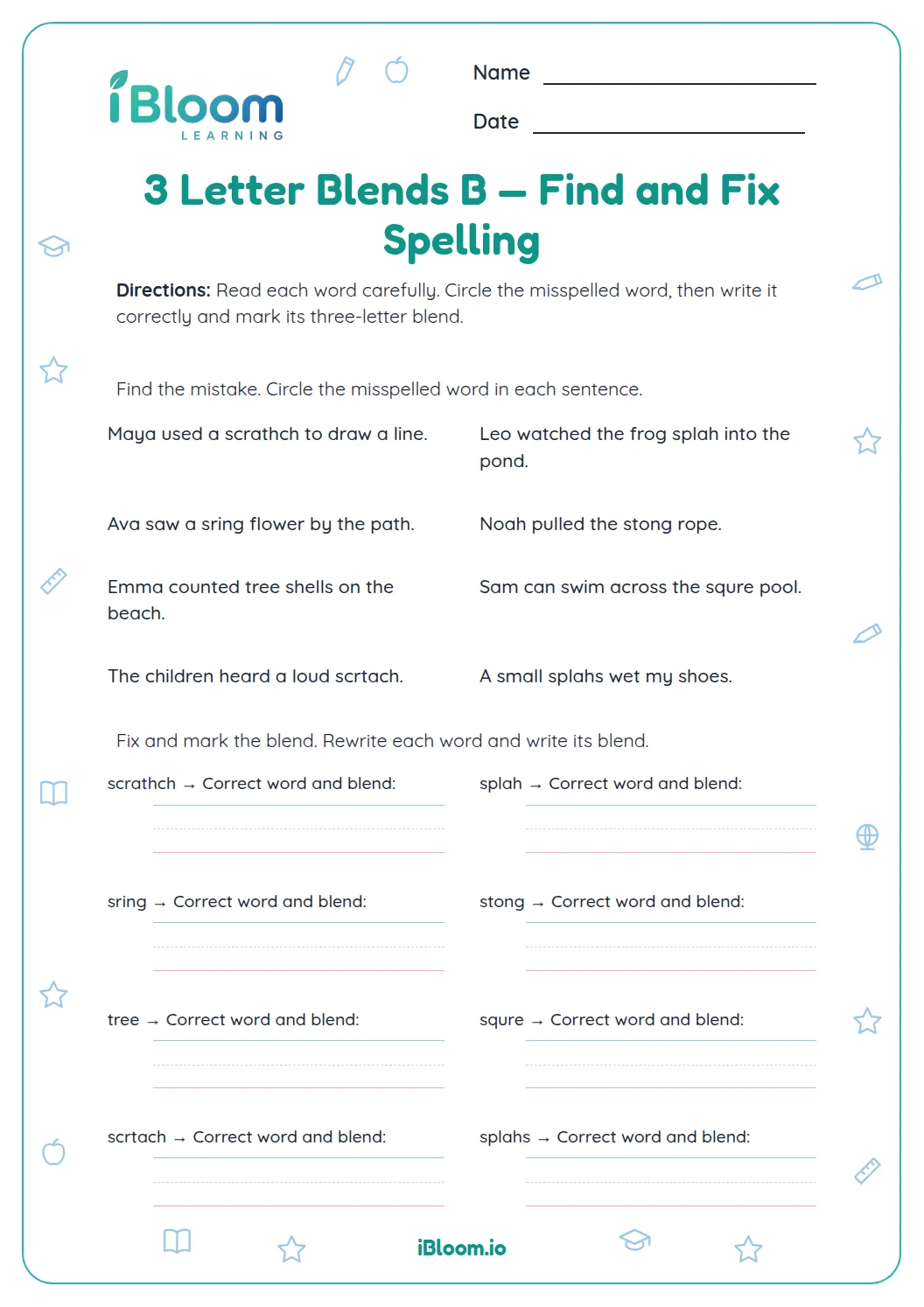
This Grade 3 review practices the six three-letter blends from the original list: scr, shr, spl, spr, str, and thr. Children choose correct spellings, supply a missing beginning blend, and use a complete blend word to match a short clue.
Aligned to L.3.2.f
What is a three-letter blend?
A consonant blend puts two or three consonant sounds together. Each sound can still be heard: in scrap, the beginning letters s, c, and r blend into the start of the word.
This review works with scr, shr, spl, spr, str, and thr. Learners recognize correct spellings, supply a missing beginning, and connect a whole word with its meaning.
How the spelling review is organized
Part A asks learners to choose the correctly spelled word that fits a clue. Part B removes the beginning letters so the three-letter blend must be written in the blank. Part C uses a meaning clue and asks for a full word.
Part A asks learners to choose a correctly spelled word. Part B supplies a word ending so the learner writes its missing beginning blend. Part C uses a meaning clue to prompt a whole word, and Part D revisits the thr blend in three.
How to check a blend
- 1Read the whole clue before choosing or writing.
- 2Say the word slowly and listen for each beginning sound.
- 3Write the three blend letters in order, then read the completed word.
- 4Check the spelling and meaning with the answer key.
Blend spelling checks
The mistake
Leaving out a consonant in a three-letter blend.
The fix
Say each beginning sound in order and match it to one letter.
The mistake
Mixing the middle letters in str or shr.
The fix
Look at the completed word and check the exact letter order.
The mistake
Choosing a word that fits the clue but not its spelling pattern.
The fix
Read the completed spelling aloud and confirm it is a real word that matches the clue.
Curriculum alignment
This page gives focused practice with the listed grade-level skill. State and district pacing can vary.
Spelling consonant blend patterns in words
On this sheet: All three parts ask learners to recognize or produce consonant blend spellings in words.
Show the official wordingHide the official wording
Use spelling patterns and generalizations (e.g., word families, position-based spellings, syllable patterns, ending rules, meaningful word parts) in writing words.
What to practice next
Make more practice
Further reading
Questions parents and teachers ask
Which three-letter blends are practiced?
The page practices scr, shr, spl, spr, str, and thr. These are the six target starts shown in the original blend list. Examples include scrap, shrimp, splash, spring, string, and three. Learners see each pattern in a word and write the beginning blend in a separate completion task.
What is different about the three parts?
Part A uses spelling choices. Part B gives a word ending so the learner supplies its three-letter start. Part C asks for a complete word from a meaning clue. Part D asks the learner to name the blend at the start of three.
Why are there three-letter blends at the start of a word?
In a blend, each consonant keeps its own sound, but the sounds are spoken close together. The first three letters in shrimp are s, h, and r. Saying each sound in order can help a learner remember all three letters when spelling the word.
How can a child check a missed word?
Read the clue again, say the word slowly, and listen for each beginning sound. Then compare the spelling with the key. If one consonant is missing, point to the blend as a group and practice saying and writing its letters in order.